villain
nounvil·lain/ˈvɪl.ən/
A character in a story who opposes the hero. Also, a deliberate scoundrel.
Every story needs a villain.
From Old French vilain, “peasant, farmer, commoner”, from Medieval Latin villanus, “farmhand”, from Latin villa, “country house, farm”.2 In English about 1300 it was an insult for a low-born rustic. “Scoundrel” is recorded by the mid-16th century, and “character whose evil motives help drive the plot” from 1822.2
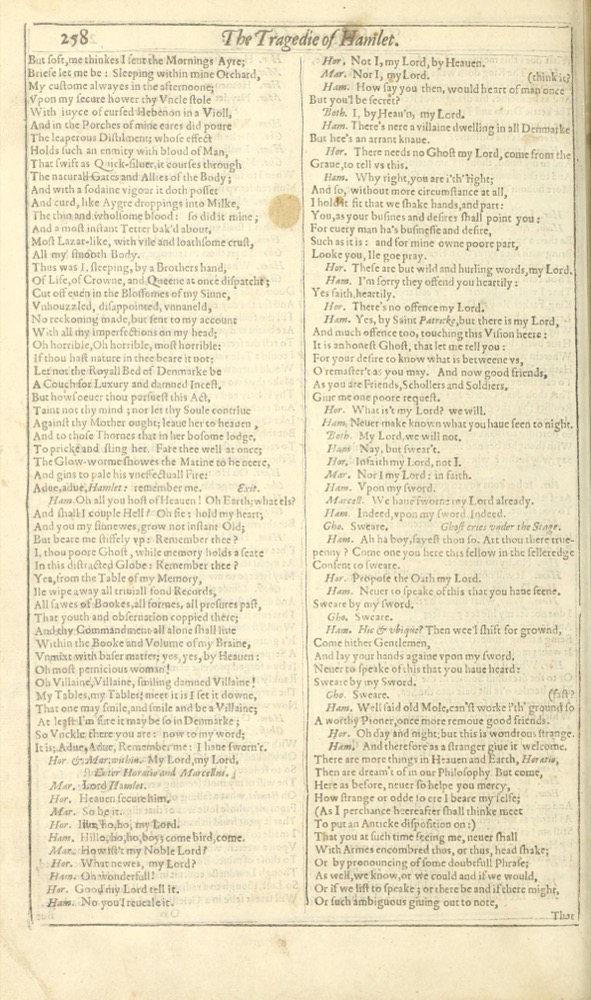
“Oh most pernicious woman! / Oh Villaine, Villaine, smiling damned Villaine!”
Page 258 of the Tragedies in the First Folio, Mr. William Shakespeares Comedies, Histories, & Tragedies, London, 1623. Hamlet, alone just after the Ghost has left, is thinking of his uncle. Spelling is as printed; the page uses the long s, which we write as s. Boston Public Library’s copy, scanned by the Internet Archive. See the book at the Internet Archive.1
Meanings
What it means today
- One blamed for a harm. Merriam-Webster’s third sense, “one blamed for a particular evil or difficulty”.5Automation as the villain in job displacement.
- A feudal peasant, a villein (old). Merriam-Webster lists “villein” as sense 4 and its first-known-use date, the 14th century, belongs to it.5 Wiktionary has a separate archaic sense, “a low-born, abject person”.4I tel thee villaine, those that lead my horse / Haue to their names tytles of dignitie. (Marlowe, Tamburlaine)4
In sentences
- Every story needs a villain.5
One who held by a base tenure.
Samuel Johnson’s first sense of villain, 1755, with a line from Sir John Davies about the Irish “in condition of slaves and villains”.7There’s nere a villaine dwelling in all Denmarke / But hee’s an arrant knaue.
Hamlet, in the same First Folio page as the one at the top of this article, 1623.1
Words that sit nearby
- villein
- The historical peasant. Etymonline: early 14th century, a spelling variant of villain for “a feudal class of half-free peasants”. It “tends to keep the literal, historical sense of the word and let the pejorative meanings go with villain”.3
- villainy
- Webster, 1828: “extreme depravity; atrocious wickedness”, and also “a crime”.8
- villainous
- Webster, 1828: “base; very vile” and “wicked; extremely depraved”.8
- villainess
- Listed in the Merriam-Webster thesaurus entry for villain.6
Synonyms
Synonyms and antonyms for villain
Synonyms
- A mean, evil or unprincipled personbrute, monster, devil, criminal, scoundrel, rogue, rascal, knave, fiend, miscreant, wretch, baddie, evildoer, blackguard.6 Merriam-Webster’s dictionary page lists heavy among its synonyms too.5
Antonyms
English has no single exact antonym for villain. The Merriam-Webster thesaurus gives only near antonyms for the whole entry, and the one that fits the story sense is hero:6
- As the opposite of a bad person, or of the bad character in a storyinnocent, hero, angel, saint.6
Through time
Through time
This word started as a description of where you lived and who owned you, and ended up describing what you did. Drag the line and read the steps.
Route to English
How it traveled from Rome to England
- villaLatin, “country house, farm”. Etymonline links it to vicus, “village, group of houses”.2
- vīllānusMedieval Latin, “farmhand”. Wiktionary: “serf or peasant, someone who is bound to the soil of a villa”.24
- vilainOld and Anglo-French, “peasant, farmer, commoner, churl, yokel”, 12th century.2
- vileinMiddle English, about 1300.2
- villainModern English.
Stops mark where each language was used. Nobody documented a single journey, and the line is a picture of the word’s family tree. The Proto-Indo-European root of vicus comes from Etymonline and Wiktionary, and we haven’t checked it against an Indo-European dictionary.24
Dates
How old is the word?
The dictionaries agree on the century for the peasant. The dates for the bad man and for the hero’s enemy come only from Etymonline.
| Source | Gives | What it is dating |
|---|---|---|
| Etymonline2 | late 12th century; about 1300 | The surname, then vilein as an insult. Bondsman by the late 14th century; “scoundrel” in the mid-16th; the story character in 1822. |
| Merriam-Webster5 | 14th century | First known use, in sense 4, “villein”, the feudal peasant. |
| Wiktionary4 | no date | Gives the line Middle English vilein, Old French vilein, Medieval Latin villanus. It puts the “evil person” sense first, then “low-born”, then the story sense. |
| Johnson 17557 | both senses present | Base tenure, and a wicked wretch, as separate senses. |
The date we could not check is the earliest written example itself. None of the dictionaries we could read prints the 12th- or 13th-century sentence, and the Middle English Dictionary refused automated access. We have not seen the first text.
How it turned
Why a farmhand became the bad guy
- It began as a fact about law and land. A villain, or villein, was “properly a bondsman, the lowest class of unfree persons under the feudal system”.2
- Then it became an insult for the whole class. Etymonline: “hence generally and in contempt, ‘one low-born, a commoner lacking a gentleman’s manners.’”2
- By the mid-16th century it had sharpened to “scoundrel”, and sometimes was used humorously or affectionately.2 On the 1623 page Hamlet uses it twice: as a curse on his uncle, and in the remark that there is never a “villaine” in Denmark who is not also “an arrant knaue”.1
- Johnson in 1755 keeps the old and the new sense next to each other. Webster in 1828 gives villanage three senses, from “base servitude” to plain “baseness; infamy”.78
- The story sense is the newest. Etymonline dates it to 1822.2 Klein, quoted there, sums up the whole road:
inhabitant of a farm; peasant; churl, boor; clown; miser; knave, scoundrel.
2
We checked for a myth that circulates about this word and did not find one worth correcting here, so there is no myth section.
Measured
The word, measured
Psychologists have asked thousands of people about tens of thousands of words. Here is where villain lands in six of those datasets.
How many people know it
Of 381 people shown it, 98.2% said they knew it, more than for 74% of the 61,855 words tested. Estimates by group: Americans 97.3%, British 98.6%, men 97.5%, women 97.5%.10
When people learn it
The average age adults recall learning it, earlier than about 81% of 31,105 words. The middle word on the list comes at 11.2. These are adults’ estimates, so read them as a rough guide.11
How concrete it feels
People rate it as something you can experience directly, more so than 72% of 39,954 words. Agreement is moderate: 28 raters, standard deviation 1.10.12
How it feels emotionally
It leans unpleasant, below 93% of 13,915 words, and raters mostly agree (standard deviation 1.82). It’s more arousing than 79% of those words at 4.91. On dominance it scores 3.46, lower than 95%, meaning people feel less in control.13
Which sense it calls up
Sight comes first, stronger than for 81% of 39,707 words, and hearing is close behind at 93%.14
Scale 0 to 5.
Ratings come from panels of roughly 20 to 30 people per word, asked about the word out of context. Percentages are how villain ranks among the words in that dataset.
Where does your vocabulary land?
Twelve words, each known by fewer Americans than the last. See your estimate against the same 221,268 people in the study above.10
Measure my vocabularyRelatives
Its relatives
- villa
- From Italian, by the 1610s, “country mansion”; from Latin villa, “country house, farm”. Etymonline links it to Latin vicus, “village”.2
- village
- Late 14th century, from Old French vilage, from Latin villaticum, “farmstead”, from villa.9
- villein
- The same word, kept for the historical peasant.3
- villanelle
- A poem form, 1580s, from French and Italian villanella, “rural song”, from villanello, “rustic”, from Medieval Latin villanus.9
- pagan
- Wiktionary says to compare it, for a similar path.4 We did not look into pagan ourselves.
The French vilain is the direct source and still exists.24 We did not check other languages for this word.
Test yourself
Three questions from this page
Sources
Where every claim comes from
We read the 1623 page, Johnson, Webster and the data files ourselves, and calculated the numbers on this page from those files. Etymonline and Merriam-Webster block automated readers, so we read their Internet Archive copies. The Middle English Dictionary refused automated access and we did not open it. Material we know only through another writer is marked as such. Checked on 5 November 2026. If something is wrong, write to hello@lexicist.com.
- Mr. William Shakespeares Comedies, Histories, & Tragedies (the First Folio). London: Isaac Jaggard and Ed. Blount, 1623. The Tragedie of Hamlet, p. 258. Boston Public Library copy, Internet Archive, public domain. archive.org/details/mrvvilliamshakes00shak
- Harper, Douglas. “villain”. Online Etymology Dictionary. We read the Internet Archive copy of January 2025; the live site blocks automated access. etymonline.com/word/villain
- Harper, Douglas. “villein”, Online Etymology Dictionary, Internet Archive copy. etymonline.com/word/villein
- Wiktionary, “villain”, English section. en.wiktionary.org/wiki/villain. The Marlowe lines are quoted from it; we have not opened the play.
- Merriam-Webster, “villain”. We read the Internet Archive copy of December 2024; the live site blocks automated access. merriam-webster.com/dictionary/villain
- Merriam-Webster Thesaurus, “villain”, Synonyms, Antonyms and Near Antonyms. Internet Archive copy of December 2024. merriam-webster.com/thesaurus/villain
- Johnson, Samuel. A Dictionary of the English Language. 1755. johnsonsdictionaryonline.com
- Webster, Noah. An American Dictionary of the English Language. 1828, entries “Villain”, “Villainy” and “Villanage”. webstersdictionary1828.com
- Harper, Douglas. “village” and “villanelle”. Online Etymology Dictionary, Internet Archive copies. etymonline.com/word/village
- Brysbaert, M., et al. “Word prevalence norms for 62,000 English lemmas”. Behavior Research Methods 51 (2019): 467–479. doi.org/10.3758/s13428-018-1077-9
- Kuperman, V., et al. “Age-of-acquisition ratings for 30,000 English words”. Behavior Research Methods 44 (2012): 978–990. doi.org/10.3758/s13428-012-0210-4
- Brysbaert, M., et al. “Concreteness ratings for 40 thousand generally known English word lemmas”. Behavior Research Methods 46 (2014): 904–911. doi.org/10.3758/s13428-013-0403-5
- Warriner, A. B., et al. “Norms of valence, arousal, and dominance for 13,915 English lemmas”. Behavior Research Methods 45 (2013): 1191–1207. doi.org/10.3758/s13428-012-0314-x
- Lynott, D., et al. “The Lancaster Sensorimotor Norms”. Behavior Research Methods 52 (2020): 1271–1291. doi.org/10.3758/s13428-019-01316-z
- Brysbaert, M., and B. New. “Moving beyond Kučera and Francis”. Behavior Research Methods 41 (2009): 977–990. doi.org/10.3758/BRM.41.4.977
- Google Books Ngram Viewer, English 2019 corpus, 1700–2022, smoothing 3. Open the chart. Method: Michel, J.-B., et al. Science 331 (2011): 176–182. doi.org/10.1126/science.1199644
Image and audio credits
1623 page: Boston Public Library, via the Internet Archive. Public domain. Recording: Gbeebani (US), CC BY-SA 3.0, via Wikimedia Commons. Map: Natural Earth, public domain.