hypocrite
nounhyp·o·crite/ˈhɪ.pə.kɹɪt/
Someone who claims virtues or beliefs they do not practise.
He’s a hypocrite about money.
From Greek hypokritēs, “stage actor, pretender”, by way of Church Latin hypocrita and Old French ypocrite.23 English had ypocrite by about 1200.23 The Greek verb behind it meant “to answer”, then “to answer a fellow actor”, then “to play a part”.38
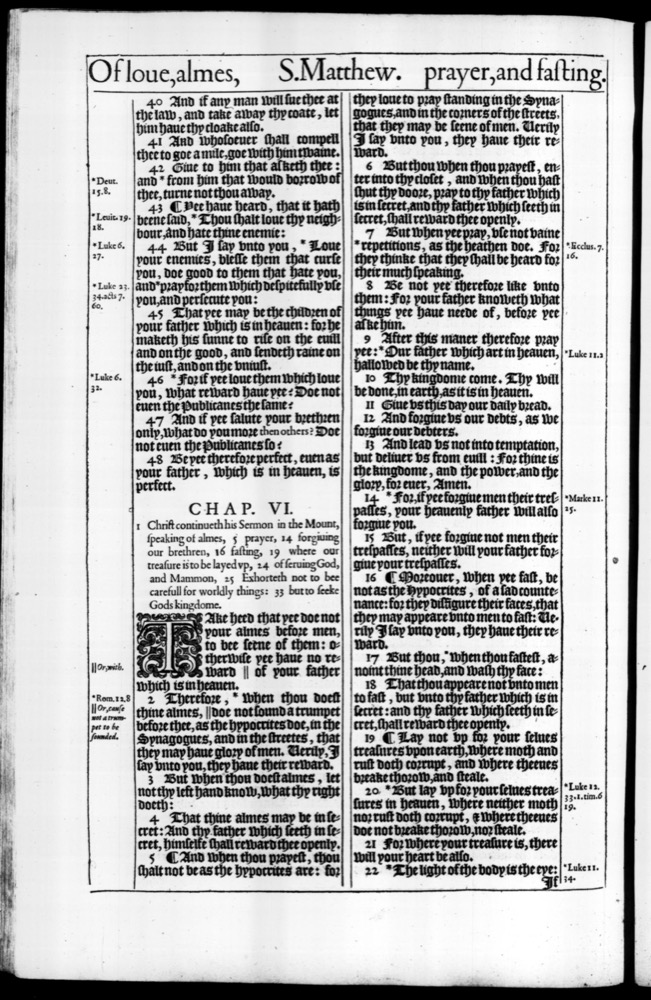
“And when thou prayest, thou shalt not be as the hypocrites are: for they loue to pray standing in the Synagogues, and in the corners of the streets, that they may be seene of men.”
Gospel of Matthew, chapter 6, in the King James Bible, London, 1611. The ring is on hypocrites in verse 5; verse 2 uses it too. The page is set in black-letter type. Scan: a copy digitized from the Early English Books collection, via the Internet Archive. See the page at the Internet Archive.1
Meanings
What it means today
- A person who acts against their own stated beliefs or feelings. Merriam-Webster numbers this second, and its thesaurus shows it with a coach who preaches a healthy diet and is always eating fast food after practice.34He demands that we maintain a healthy diet but seems to be always eating fast-food after practice.
The older dictionaries put the religious sense first. Johnson’s 1755 dictionary defines it as “a dissembler in morality or religion”.6 Webster in 1828 is longer: “one who feigns to be what he is not; one who has the form of godliness without the power”, someone who takes on the look of piety and virtue with none of the religion itself. His second sense is the wider one: “a dissembler; one who assumes a false appearance.”7
In sentences
I dare swear he is no hypocrite, but prays from his heart.
Shakespeare, quoted under hypocrite by Samuel Johnson, 1755.6…if one in twenty should be brought to true piety, and nineteen be only hypocrites, the advantage would still be great.
Jonathan Swift, quoted by Johnson, 1755.6Fair hypocrite, you seek to cheat in vain.
John Dryden, quoted by Johnson, 1755. Webster quotes the same line in 1828.67
Words that sit nearby
- hypocrisy
- Etymonline gives it as “the sin of pretending to virtue or goodness”, from about 1200.28
- hypocritical
- Listed as a derived term in Wiktionary.5 The Merriam-Webster thesaurus gives it its own entry, with insincere and two-faced among the synonyms.4
- dissembler
- Johnson’s word for it.6 It is also on the thesaurus list.4
Synonyms
Synonyms and antonyms for hypocrite
Synonyms
- For a person who pretendsimpostor, charlatan, phony, deceiver, faker, fraud, dissembler, double-dealer, pretender, sham. The thesaurus files them under liar, which it lists first.4 Wiktionary adds flip-flopper and pretender.5
- In Old Englishlīċettere, which Wiktionary says hypocrite displaced.5
Antonyms
English has no exact antonym for hypocrite. The Merriam-Webster thesaurus lists two near antonyms for the noun, and a longer list for the adjective hypocritical.4
Through time
Through time
The word comes from the theatre, entered English through the church, and has been about religion and virtue ever since. Drag the line and read what people wrote.
Route to English
How it traveled from Athens to England
- ὑποκρίνομαι, hypokrinomaiGreek, “to reply, make an answer, speak in dialogue, play a part on the stage, feign”.3
- ὑποκριτής, hypokritēsGreek, “answerer, actor on a stage, pretender”.3 Etymonline gives “stage actor; pretender, dissembler”.2
- hypocritaChurch Latin, “a hypocrite”. Merriam-Webster calls it Late Latin.23
- ypocrite, ipocriteOld French, 12th century, and Anglo-French.23
- ypocriteMiddle English, about 1200.23
- hypocriteModern English. For the related hypocrisy, Etymonline says the h was put back in the 16th century.8
Stops mark where each language was used. Nobody documented a single journey, and the line is a picture of the word’s family tree. The Proto-Indo-European root is given as *krey- by Wiktionary and as *krei-, “to sieve”, by Etymonline, and we have not checked either against an Indo-European dictionary.58
Dates
How old is the word?
The three dictionaries we could read agree on about 1200.
| Source | Gives | What it is dating |
|---|---|---|
| Etymonline2 | c. 1200 | Ypocrite, “false pretender to virtue or religion”. Its entry for hypocrisy also gives c. 1200. |
| Merriam-Webster3 | 13th century | First known use, in the sense it numbers 1, the false appearance of virtue or religion. |
| Wiktionary5 | early 13th c. | Its date note on the first sense. |
We have not seen the first sentence. Neither dictionary prints it on the page we read, and the Middle English Dictionary was behind a bot check, so we did not open it.
The myth
A myth: hypocrite means “under-judge”
Hypocrite is built from hypo-, “under”, and krinein, “to judge”, so its first meaning was a person who judges too little.Not what the dictionaries say
- Wikipedia’s article on hypocrisy offers this reading. It says the word is an amalgam of hypo- and krinein, “to sift or decide”, so that “the original meaning implied a deficiency in the ability to sift or decide”.9 The article gives a source for it, which we have not opened.
- Etymonline and Merriam-Webster say nothing of the kind. Both trace the word to the Greek verb hypokrinesthai, “to reply, make an answer”, and then “to play a part on the stage, feign”.23
- Etymonline lays out the steps for the related word hypocrisy. In Attic Greek the sense moved from “separate gradually” to “answer”, then to “answer a fellow actor on stage”, then to “play a part”.8 The prefix and the root are real, but neither dictionary reads the word as a failure to judge.238
We can only say what these dictionaries support. We did not read the sources behind Wikipedia’s sentence and cannot rule out that a classicist argues for it.
Measured
The word, measured
Psychologists have asked thousands of people about tens of thousands of words. Here is where hypocrite lands in six of those datasets.
How many people know it
Of 392 people shown it, 99.5% said they knew it, more than for 89% of the 61,855 words tested. Estimates by group: Americans 98.8%, British 99.5%, men 98.5%, women 99.1%.10
When people learn it
The average age adults recall learning it, later than about 56% of 31,105 words. The middle word on the list comes at 11.2. These are adults’ estimates, so read them as a rough guide.11
How concrete it feels
People rate it as more of an idea than a thing, more abstract than 60% of 39,954 words. Agreement is low: 30 raters, standard deviation 1.45.12
How it feels emotionally
It leans unpleasant, below 89% of 13,915 words, and raters mostly agree (standard deviation 1.77). It’s more arousing than 75% of those words at 4.77. On dominance it scores 4.85, lower than 67%, meaning people feel less in control.13
Which sense it calls up
Hearing comes first, stronger than for 94% of 39,707 words.14
Scale 0 to 5.
Ratings come from panels of roughly 20 to 30 people per word, asked about the word out of context. Percentages are how hypocrite ranks among the words in that dataset.
Where does your vocabulary land?
Twelve words, each known by fewer Americans than the last. See your estimate against the same 221,268 people in the study above.10
Measure my vocabularyRelatives
Its relatives, and the same word elsewhere
- hypocrisy
- Late Latin hypocrisis, also “an imitation of a person’s speech and gestures”, from Attic Greek hypokrisis, “acting on the stage; pretense”, then metaphorically “hypocrisy”. In English by about 1200 as ipocrisie.8
- hypocritical
- The adjective, listed as a derived term in Wiktionary.5
The same word in other languages
- hipócritaSpanish
- hypocriteFrench
- ipocritaItalian
- hipócritaPortuguese
- hipòcritaCatalan
- hypocrietDutch
- ipocritRomanian
- hipokrytaPolish
- υποκριτήςGreek
- hipokritAlbanian
Others use a different word: German Heuchler, Czech pokrytec, Swedish hycklare, Russian лицемер. French also has pharisien for the same person.5
Test yourself
Three questions from this page
Sources
Where every claim comes from
We read the 1611 page, Johnson, Webster and the data files ourselves, and calculated the numbers on this page from those files. Etymonline and Merriam-Webster block automated readers, so we read their Internet Archive copies. Material we know only through Wikipedia is marked as such. Checked on 5 November 2026. If something is wrong, write to hello@lexicist.com.
- The Holy Bible, conteyning the Old Testament and the New. London: Robert Barker, 1611, Matthew 6, as digitized in the Early English Books collection. Internet Archive, item bim_early-english-books-1475-1640_the-holy-bible-conteyni_bible-english_1611_0, scan page 1235. We read the page image and the Archive’s text search. archive.org
- Harper, Douglas. “hypocrite”. Online Etymology Dictionary. We read the Internet Archive copy of 6 December 2024; the live site blocks automated access. etymonline.com/word/hypocrite
- Merriam-Webster, “hypocrite”, with its etymology. We read the Internet Archive copy; the live site blocks automated access. merriam-webster.com/dictionary/hypocrite
- Merriam-Webster Thesaurus, “hypocrite”, Synonyms, Antonyms and Near Antonyms. Internet Archive copy. merriam-webster.com/thesaurus/hypocrite
- Wiktionary, “hypocrite”, English section, with its translation list. en.wiktionary.org/wiki/hypocrite
- Johnson, Samuel. A Dictionary of the English Language. 1755. johnsonsdictionaryonline.com
- Webster, Noah. An American Dictionary of the English Language. 1828. webstersdictionary1828.com
- Harper, Douglas. “hypocrisy”. Online Etymology Dictionary, Internet Archive copy. etymonline.com/word/hypocrisy
- Wikipedia, “Hypocrisy”, Etymology. en.wikipedia.org/wiki/Hypocrisy
- Brysbaert, M., et al. “Word prevalence norms for 62,000 English lemmas”. Behavior Research Methods 51 (2019): 467–479. doi.org/10.3758/s13428-018-1077-9
- Kuperman, V., et al. “Age-of-acquisition ratings for 30,000 English words”. Behavior Research Methods 44 (2012): 978–990. doi.org/10.3758/s13428-012-0210-4
- Brysbaert, M., et al. “Concreteness ratings for 40 thousand generally known English word lemmas”. Behavior Research Methods 46 (2014): 904–911. doi.org/10.3758/s13428-013-0403-5
- Warriner, A. B., et al. “Norms of valence, arousal, and dominance for 13,915 English lemmas”. Behavior Research Methods 45 (2013): 1191–1207. doi.org/10.3758/s13428-012-0314-x
- Lynott, D., et al. “The Lancaster Sensorimotor Norms”. Behavior Research Methods 52 (2020): 1271–1291. doi.org/10.3758/s13428-019-01316-z
- Brysbaert, M., and B. New. “Moving beyond Kučera and Francis”. Behavior Research Methods 41 (2009): 977–990. doi.org/10.3758/BRM.41.4.977
- Google Books Ngram Viewer, English 2019 corpus, 1700–2022, smoothing 3. Open the chart. Method: Michel, J.-B., et al. Science 331 (2011): 176–182. doi.org/10.1126/science.1199644
Image and audio credits
1611 page: Early English Books collection, via the Internet Archive; the book is public domain. Recording: Meepofdoom (US), CC BY-SA 4.0, via Wikimedia Commons. Map: Natural Earth, public domain.