thug
nounthug/θʌɡ/
A violent, brutish criminal or bully. In history, one of the gangs of robbers in India who strangled travelers.
From Hindi and Marathi thag, “cheat, swindler”, perhaps from Sanskrit sthaga, “cunning, fraudulent”.3 The gangs were called Thugs in English by 1810, and the general sense of a ruffian followed by 1839.3
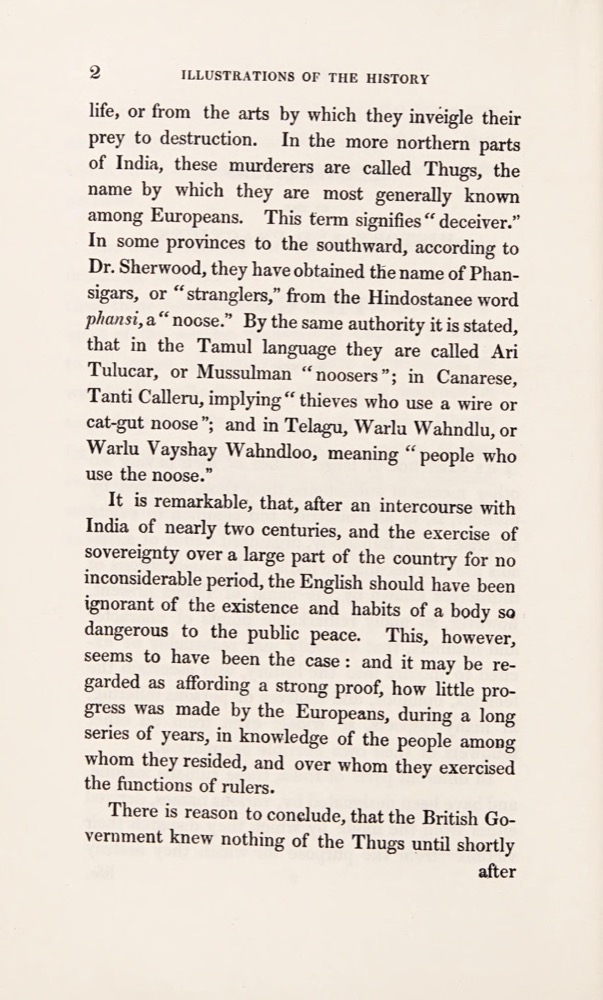
“In the more northern parts of India, these murderers are called Thugs, the name by which they are most generally known among Europeans. This term signifies ‘deceiver.’”
Page 2 of Edward Thornton, Illustrations of the History and Practices of the Thugs, London, 1851. The scan comes from a 2000 reprint of the 1851 text, digitized by Public.Resource.Org for the Internet Archive. See the page there.
Meanings
Three meanings in use today
- A violent, brutish criminal, or a bully. The everyday sense, and the one Merriam-Webster lists first.4Two thugs waited by the car.
- A plant that takes over a bed. Wiktionary lists a gardening sense: an overvigorous plant that spreads and dominates the flowerbed.6The mint turned into a thug and crowded out the roses.
In sentences
- Police arrested two thugs outside the club.
- The company hired thugs to break up the strike.
The inhabitants of Jubbulpore were this morning assembled to witness the execution of 25 Thugs.
From Wanderings of a Pilgrim, 1831, as quoted in Hobson-Jobson.2In the more northern parts of India these murderers are called Thegs, signifying deceivers.
From Asiatic Researches, 1820, as quoted in Hobson-Jobson.2
Words people mix up with it
- thuggee
- The practice, not the person: the system of ritual killing the gangs were said to follow. Etymonline gives thuggery as 1839 and thugee as the form closer to the Hindi.3
- phansigar
- The other Indian name for the gangs, “strangler”, from phansi, “noose”. Hobson-Jobson says it was their proper designation.23
- goon, hoodlum, ruffian
- Merriam-Webster’s thesaurus lists them as near synonyms for the criminal sense.5
- gangster
- The first synonym Merriam-Webster’s thesaurus gives for the criminal sense.5
Synonyms
Synonyms and antonyms for thug
Synonyms
- For the criminal or bullygangster, hoodlum, ruffian, goon, hooligan, mobster, tough, roughneck, bully.5
- For the historical killerphansigar, from the Indian name for the gangs.6
Antonyms
English has no exact antonym for thug, and the Merriam-Webster thesaurus copy we read lists none. Wiktionary’s thesaurus does list an opposite for villain, a word it groups with thug.7
- Nearest, through villainhero
Through time
What the word meant, year by year
Dictionaries say 1810 or 1839. The word started as plain Hindi for a cheat, became the name of the gangs by 1810, and by 1839 was an English word for any hard man. Drag the line and read what people wrote.
Route to English
From a word for cover to a word for crime
- *(s)teg-Proto-Indo-European, “to cover”. Etymonline lists deck and detect among its English descendants.3
- sthagaSanskrit, “cunning, fraudulent”, from sthagayati, “(he) covers, conceals”. Etymonline says “perhaps”.3
- thag, thakHindi and Marathi, “cheat, swindler”.32
- phansigarThe other name for the gangs, from phansi, “noose”.2
- ThugEnglish, as the name of the gangs by 1810, and as a general word for a ruffian by 1839.3
The stops mark central India, where the gangs were hunted, and London, where the book on them was printed. Nobody documented a single journey for the word. Wiktionary traces it to Prakrit and calls the earlier origin uncertain.6
Why dates differ
Why dictionaries date it differently
You get 1808, 1810 and 1839, and all three can be right, because the word had three jobs.
| Source | Gives | What it is dating |
|---|---|---|
| Hobson-Jobson2 | 1808 | Drummond’s Illustrations of Guzerattee, where the word means only “cheat, swindler” |
| Etymonline3 | 1810 | A member of a gang of murderers and robbers in India |
| Hobson-Jobson2 | 1820 | Thegs, “deceivers”, in Asiatic Researches |
| Etymonline and Merriam-Webster34 | 1839 | The general sense, a violent criminal. Merriam-Webster’s date is for that sense |
| Wiktionary6 | 1810, 1839 | The same two steps: the Indian gangs, then the general ruffian |
| Johnson and Webster89 | None | Neither dictionary has the word |
Hobson-Jobson dates the cheat sense earliest, and doesn’t say whether Drummond’s word was the same one that became the gangs’ name. We read that book only through Hobson-Jobson, and Etymonline gives no text for 1810.
A myth
The Kali death cult
The Thugs were a secret religious cult of stranglers who killed in the name of Kali.Overstated
- The story was told that way at the time. Macaulay in 1843 spoke of the Thugs acting
under the special protection of the most powerful goddesses
.2 The Century Dictionary, quoted by Etymonline, says a third of their spoil went to Kali, whom they worshiped.3 - The oldest accounts we could read don’t mention a goddess. The passages Hobson-Jobson quotes from Fryer in 1673 and Forbes in 1785 describe gangs strangling travelers with a cord, and say nothing about religion.2
- Modern historians have taken the cult apart. Wikipedia’s summary says Kim Wagner calls the Thugs “no more than a species of robber” and the 1830s a moral panic, while Mike Dash finds the motives not religious and the beliefs closer to folklore than a faith. Dash puts the dead at 50,000 to 100,000, colonial estimates went as high as a million, and the testimony of Thugs who turned informer rarely mentions Kali. Wagner also says the colonial picture wasn’t invented from nothing.10
We haven’t opened Wagner’s book (Thuggee: Banditry and the British in Early Nineteenth-Century India, 2007) or Dash’s, only the summary in Wikipedia, so treat the numbers as theirs, not ours.10
Measured
The word, measured
Psychologists have asked thousands of people about tens of thousands of words. Here is where thug lands in six of those datasets.
How many people know it
Of 375 people shown it, 99.2% said they knew it, more than for 84% of the 61,855 words tested. Estimates by group: Americans 98.8%, British 98.5%, men 98.8%, women 98.6%.11
When people learn it
The average age adults recall learning it, earlier than about 58% of 31,105 words. The middle word on the list comes at 11.2. These are adults’ estimates, so read them as a rough guide.12
How concrete it feels
People rate it as something you can experience directly, more so than 83% of 39,954 words. Agreement is moderate: 27 raters, standard deviation 1.03.13
How it feels emotionally
It leans unpleasant, below 97% of 13,915 words, and raters mostly agree (standard deviation 1.44). It’s more arousing than 90% of those words at 5.48. On dominance it scores 3.53, lower than 95%, meaning people feel less in control.14
Which sense it calls up
Sight comes first, stronger than for 71% of 39,707 words.15
Scale 0 to 5.
Ratings come from panels of roughly 20 to 30 people per word, asked about the word out of context. Percentages are how thug ranks among the words in that dataset.
Where does your vocabulary land?
Twelve words, each known by fewer Americans than the last. See your estimate against the same 221,268 people in the study above.11
Measure my vocabularyRelatives
Its relatives, and a few impostors
- thuggery
- In English from 1839, first as “the system of ritual killing as practiced by the thugs”.3
- thuggee
- The form closer to the Hindi name for the system. Also spelled thugee.3
- thuggish
- “Ruffianly, brutal and forceful”, from 1870.3
- phansigar
- The “stranglers”, from phansi, “noose”.23
- deck, detect
- Etymonline lists them under the Proto-Indo-European root for “cover”, and Wiktionary says thug is perhaps related to deck and thatch.36
- Spin-offs
- Wiktionary lists thug life, thugdom, thugocracy and cyberthug among the English words built on it.6
Words for it in other languages
- matónSpanish
- thugFrench
- SchlägerGerman
- bandidoPortuguese
- банди́тRussian
- zbirPolish
- haydutTurkish
- サグJapanese
- 폭력배Korean
- ठगHindi
- ٹھگUrdu
- بَلْطَجِيّArabic
Most of these are native words. Hindi and Urdu keep the original, which Wiktionary lists as a translation of thug, and French lists thug itself among its words. Japanese gives a katakana form, sagu, the script used for foreign words.6
Test yourself
Four questions from this page
Sources
Where every claim comes from
We read the 1851 page, Hobson-Jobson, Johnson, Webster and the data files ourselves, and calculated the numbers on this page from those files. Everything else is credited to the source that says it. Etymonline and Merriam-Webster blocked our requests, so we read their Internet Archive copies. Checked on 5 November 2026. If something is wrong, write to hello@lexicist.com.
- Thornton, Edward. Illustrations of the History and Practices of the Thugs, and Notices of Some of the Proceedings of the Government of India, for the Suppression of the Crime of Thuggee. London: Natali and Bond, 1851, p. 2. Scan via the Internet Archive, from a 2000 reprint. Open the page
- Yule, Henry, and A. C. Burnell. Hobson-Jobson: a glossary of colloquial Anglo-Indian words and phrases, new edition by William Crooke, London, 1903. Entry “Thug”, pp. 915–916. Internet Archive. archive.org/details/hobsonjobsonglos00yulerich
- Harper, Douglas. “thug”. Online Etymology Dictionary. We read it through its Internet Archive copy, because the live site blocked our requests. etymonline.com/word/thug
- Merriam-Webster, “thug”. Read through its Internet Archive copy, because the live site blocked our requests. merriam-webster.com/dictionary/thug
- Merriam-Webster Thesaurus, “thug”. Read through its Internet Archive copy. merriam-webster.com/thesaurus/thug
- Wiktionary, “thug”, English section, with its translation table. en.wiktionary.org/wiki/thug
- Wiktionary, “Thesaurus:villain”, Synonyms and Antonyms. en.wiktionary.org/wiki/Thesaurus:villain
- Johnson, Samuel. A Dictionary of the English Language. 1755. We searched thug and found no entry. johnsonsdictionaryonline.com
- Webster, Noah. An American Dictionary of the English Language. 1828. We searched thug and thuggee and found no entry. webstersdictionary1828.com
- Wikipedia, “Thuggee”, on the historians’ assessment of the cult and on Sleeman’s role. We haven’t opened the books it cites. en.wikipedia.org/wiki/Thuggee
- Brysbaert, M., et al. “Word prevalence norms for 62,000 English lemmas”. Behavior Research Methods 51 (2019): 467–479. doi.org/10.3758/s13428-018-1077-9
- Kuperman, V., et al. “Age-of-acquisition ratings for 30,000 English words”. Behavior Research Methods 44 (2012): 978–990. doi.org/10.3758/s13428-012-0210-4
- Brysbaert, M., et al. “Concreteness ratings for 40 thousand generally known English word lemmas”. Behavior Research Methods 46 (2014): 904–911. doi.org/10.3758/s13428-013-0403-5
- Warriner, A. B., et al. “Norms of valence, arousal, and dominance for 13,915 English lemmas”. Behavior Research Methods 45 (2013): 1191–1207. doi.org/10.3758/s13428-012-0314-x
- Lynott, D., et al. “The Lancaster Sensorimotor Norms”. Behavior Research Methods 52 (2020): 1271–1291. doi.org/10.3758/s13428-019-01316-z
- Brysbaert, M., and B. New. “Moving beyond Kučera and Francis”. Behavior Research Methods 41 (2009): 977–990. doi.org/10.3758/BRM.41.4.977
- Google Books Ngram Viewer, English 2019 corpus, 1700–2022, smoothing 3. Open the chart. Method: Michel, J.-B., et al. Science 331 (2011): 176–182.
Image and audio credits
1851 page: Internet Archive scan of a public domain book. Map: Natural Earth, public domain.