alcohol
nounal·co·hol
Drinks that can make you drunk, or ethanol, the chemical in them that does it. In chemistry, a whole family of similar compounds.
From Arabic الكحل al-kuḥl, “the kohl”, a dark powder painted around the eyes.3 In 1543 an English surgery manual still glossed the word as the finest possible powder.1 The sense of an intoxicating liquid took about two more centuries to settle.3
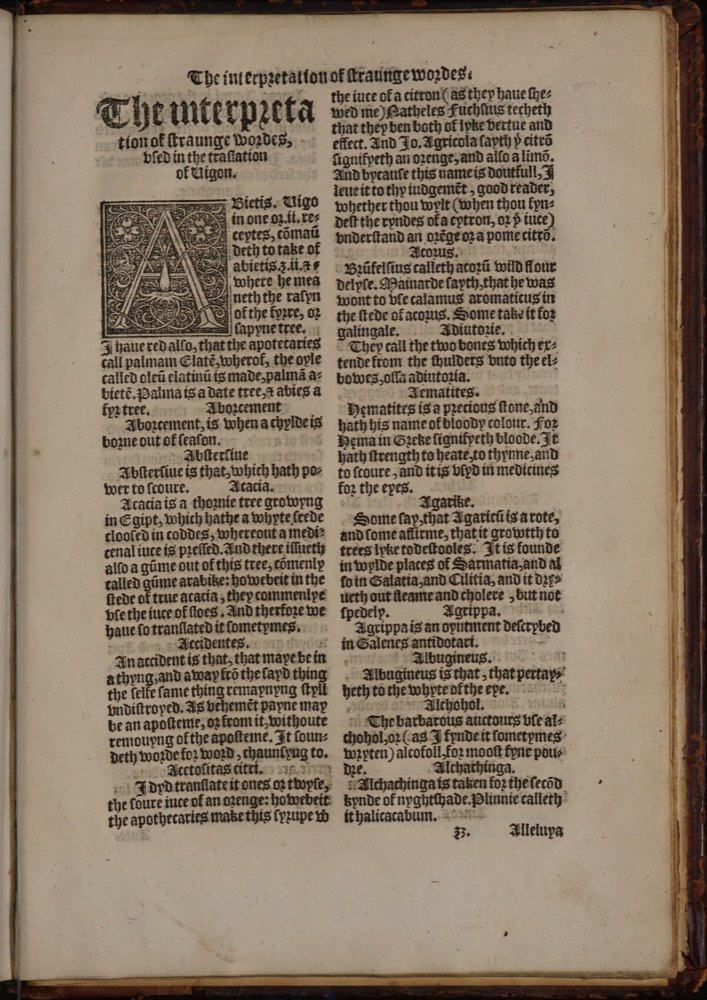
“The barbarous auctours use alchohol, or (as I fynde it sometymes wryten) alcofoll, for moost fyne poudre.”
First page of the glossary in Bartholomew Traheron’s English translation of Giovanni da Vigo, The most excellent workes of chirurgerye, London, 1543. Note the spelling, and that these are the translator’s words. See the page at Wellcome Collection.
Meanings
Three meanings in use today
- Drinks that can make you drunk, taken together. Beer, wine and spirits. No plural in this sense.20The restaurant has no license to serve alcohol.
- Ethanol, the chemical in those drinks. Formula C₂H₅OH.4This beer is 5% alcohol by volume.
- Any organic compound with a hydroxyl group (–OH) on a carbon atom of an alkyl group. Countable, so chemists can say alcohols.20Methanol and glycerol are both alcohols.
In sentences
- She gave up alcohol for a year.
- The label says the mouthwash contains no alcohol.
If the same salt shall be reduced into alcohol, as the chymists speak, or an impalpable powder, the particles and intercepted spaces will be extremely lessened.
Robert Boyle, quoted by Samuel Johnson, 1755. Here it still means powder.6Sal volatile oleosum will coagulate the serum on account of the alcahol, or rectified spirit which it contains.
John Arbuthnot, quoted by Johnson. Here it means spirit.6
Words people mix up with it
- ethanol
- The chemical name for the alcohol in drinks.4
- methanol
- A different alcohol, and acutely toxic. Being an alcohol in the chemical sense doesn’t make something drinkable.20
- liquor
- Merriam-Webster’s first listed synonym for the drink sense. In American use it usually points to distilled drinks like whiskey or gin.4
- booze
- The casual word for it, and older than alcohol in this sense: written by the 1570s, about two centuries before.3
Cambridge marks the drink sense as level A2, an early word for learners of English.20 Common phrases: alcohol by volume, rubbing alcohol, grain alcohol, isopropyl alcohol, sugar alcohol.4
Synonyms
Synonyms and antonyms for alcohol
Synonyms
- For the drinkliquor, booze, drink, alcoholic beverage, intoxicant.42930 Spirits is narrower: it covers distilled drinks only.30
- For the chemicalethanol, ethyl alcohol, grain alcohol.42930
Antonyms
English has no exact antonym for alcohol as a noun. Merriam-Webster’s thesaurus lists these near antonyms.31
- For drinkssoft drink, soda, mocktail, mixer, nonintoxicant
Through time
What the word meant, year by year
Dictionaries usually give you one date. The word has several, because its meaning moved. Drag the line and read what people wrote at the time.
How a powder word ended up in a bottle
Kohl was a very fine powder made by sublimation: heat a solid, collect what rises. People took it for the essence of the mineral.28 Distilling wine looks much the same, and what collects is the wine’s refined part.13 So the word stretched from a fine powder to “the pure spirit of anything”, liquids included.3 Alcohol of wine was then cut down to alcohol.3
Route to English
How it traveled from Mesopotamia to London
- guḫlumAkkadian, Mesopotamia. Antimony paste used as eye paint. Its own origin is unknown.9
- kuḥlāAramaic, כוחלא. Comes from the Akkadian word.8
- kuḥl, al-kuḥlArabic, كحل. Borrowed from Aramaic. Means kohl and stibnite, the antimony ore. Al- is simply “the”.83
- kuḥūl, quḥūlAndalusian Arabic, the Arabic of medieval Spain.2
- alcoholMedieval Latin, in medical and alchemical books, then Middle French or Spanish.2
- alcofol, alchoholEnglish. Alcofol in the 1400s,3 alchohol in London in 1543.1
Stops mark where each language was used. Nobody documented a single journey, and the line is a picture of the word’s family tree. The Akkadian step comes from Wiktionary’s etymology, and we haven’t checked it against an Assyriology dictionary.
Why dates differ
Why dictionaries disagree about its age
Look the word up in five places and you get five answers. Most of them are right, because each is dating something different.
| Source | Gives | What it is dating |
|---|---|---|
| Merriam-Webster4 | 1672 | The “ethanol” sense only |
| Dictionary.com29 | 1535–45 | The word as a whole, with no sense named |
| Etymonline3 | early 1400s, 1540s, 1670s, 1753, 1808 | The form alcofol, the powder, “pure spirit of anything”, the drink’s ingredient, the chemical class |
| Oxford English Dictionary, as cited by Wikipedia28 | 1543 | Traheron’s glossary. The OED is paywalled, so we read the page itself instead |
| Wiktionary2 | 1400s, 1700s, after 1850 | Middle English alcofol, ethanol, the chemical class |
One disagreement is real. Etymonline has the chemical class by 1808, and Wiktionary says after 1850. We haven’t seen the 1808 text, so we can’t settle it yet. Wikipedia also quotes the 1543 line in modern-looking spelling and credits it to Vigo. The page shows alchohol and fyne, in a glossary the translator added.1
The powder
In Egyptian pots, the powder is rarely what the dictionaries say
Dictionaries gloss the word as antimony ore. When chemists test the contents of ancient Egyptian kohl pots, they mostly find lead.
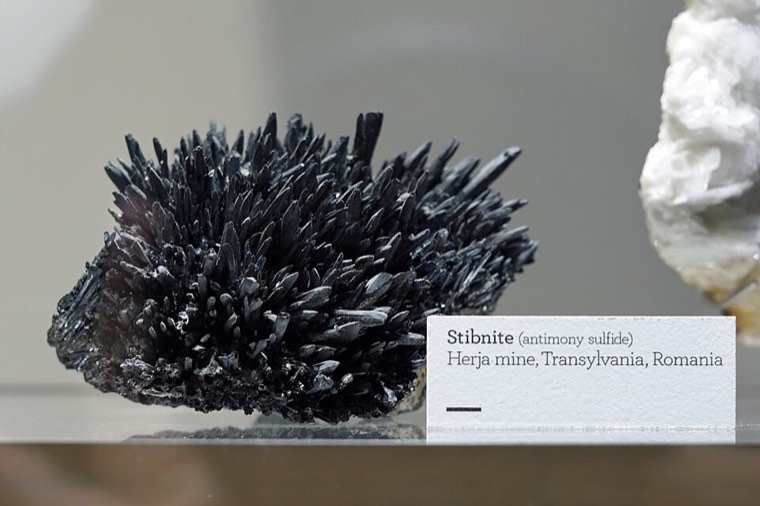
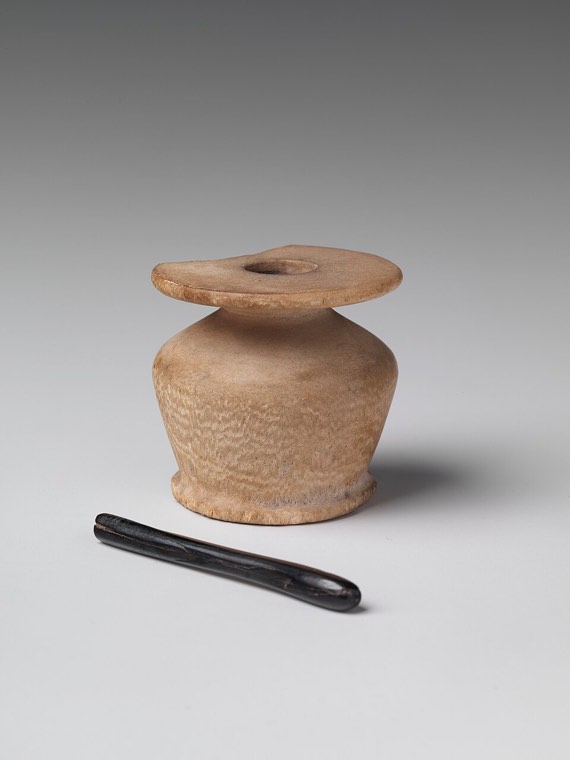
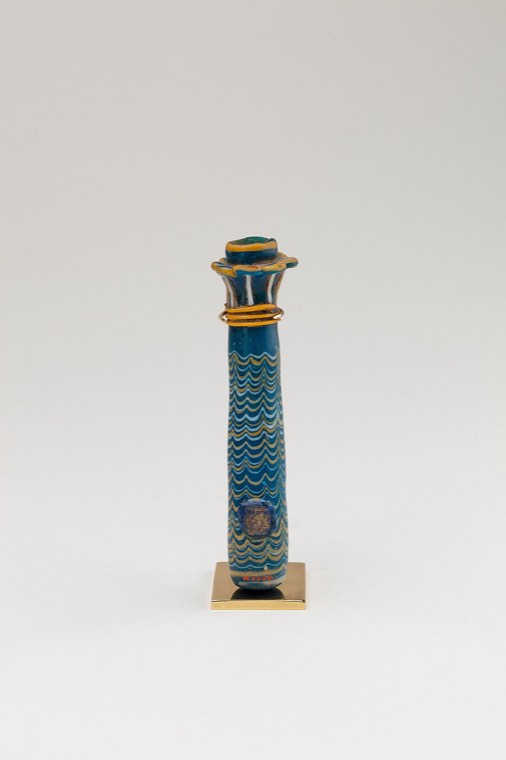
Egyptian kohls analyzed by modern methods had a lead mineral as their main component, according to the count in a 2022 study.11
A 1999 study in Nature looked at cosmetics from about 2000 to 1200 BC, still in their original containers. It found the natural lead minerals galena and cerussite, and also laurionite and phosgenite, which the authors took to be made on purpose, by wet chemistry.10
The 2022 study analyzed 11 more containers from the Petrie Museum in London. Some of those held manganese or silicon compounds, and plant and animal ingredients turned up often, sometimes as the main part of the recipe.11
These pots are far older than Arabic kuḥl, so they don’t prove the antimony gloss wrong for medieval Arabic. They do show that kohl was never one recipe.
A myth
The “body-eating spirit” story
Alcohol comes from the Arabic al-ghawl, a spirit that eats the body.False
- The earliest uses are about powder. The 1543 entry says so,1 and for many centuries the word meant any fine powder.5 A word for a spirit wouldn’t begin there.
- They’re different Arabic words. Kuḥl starts with k and ghawl with gh. English ghoul is a real borrowing from Arabic, but it has no link to alcohol. Snopes rated the claim false in 2024.12
- The verse people cite, Qur’an 37:47, describes the drink of paradise: one modern translation reads “It will neither harm them, nor will they be intoxicated by it.”14 Ghawl stands in that verse for the harm. It isn’t a name for the drink. Wiktionary adds that the word was too poetic for medieval writers to have picked up, and that the link to antimony is well documented.2
A weaker version, without the body-eating, does appear in print. Scientific American reported it in 2016 and still called the kohl origin the more credible one, noting that it’s the origin the OED lists.13
Measured
The word, measured
Psychologists have asked thousands of people about tens of thousands of words. Here is where alcohol lands in six of those datasets.
How many people know it
Of 411 people shown it, 99.8% said they knew it, more than for 96% of the 61,855 words tested. Estimates by group: Americans 99.2%, British 99.5%, men 98.9%, women 99.5%.21
When people learn it
The average age adults recall learning it, earlier than about 75% of 31,105 words. The middle word on the list comes at 11.2. These are adults’ estimates, so read them as a rough guide.22
How concrete it feels
People rate it as something you can experience directly, more so than 93% of 39,954 words. Agreement is high: 29 raters, standard deviation 0.51.23
How it feels emotionally
It leans unpleasant, below 77% of 13,915 words, but raters split widely (standard deviation 2.08). It’s more arousing than 85% of those words at 5.17. On dominance it scores 4.00, lower than 89%, meaning people feel less in control.24
Which sense it calls up
Taste comes first, stronger than for 99% of 39,707 words, and smell is close behind at 99%. Few words are as much about the mouth and nose.25
Scale 0 to 5. Sight scores higher than smell, but many words score high on sight, so smell is the unusual one.
Ratings come from panels of roughly 20 to 30 people per word, asked about the word out of context. Percentages are how alcohol ranks among the words in that dataset.
Where does your vocabulary land?
Twelve words, each known by fewer Americans than the last. See your estimate against the same 221,268 people in the study above.21
Measure my vocabularyRelatives
Its relatives, and a few impostors
- kohl
- The same Arabic word, borrowed a second time, for the original meaning. In English by 1799.192
- alcoholic
- An adjective from 1790. As a noun for a person, 1891.3
- alcoholism
- From Magnus Huss’s Alcoholismus chronicus, two volumes starting in 1849.15 Etymonline dates the Latin coinage to 1852 and the English word to 1882.3
- ethanol
- Coined after the 1892 Geneva conference on chemical names.1716
- -ol
- The chemists’ ending for an alcohol, as in cholesterol, renamed once the compound was found to be one.3
- -aholic
- The end of alcoholic, broken off for new words. Workaholic is first recorded in 1947.18
- Impostors
- Ghoul is unrelated.12 Alkali, alcove and algebra share only the Arabic word for “the”.
The eye powder in other languages
- alcoholSpanish
- alcoolFrench
- AlkoholGerman
- alcolItalian
- álcoolPortuguese
- alkolTurkish
- alkoholPolish
- alkoholiFinnish
- アルコールJapanese
- 알코올Korean
- แอลกอฮอล์Thai
- אַלְכּוֹהוֹלHebrew
By our count, 74 of the 93 languages in Wiktionary’s table for the chemical sense list a form of this word first.2 Others use a different root: Russian спирт, Greek οινόπνευμα, Mandarin 醇, Vietnamese rượu. Arabic’s own word for alcohol is كحول kuḥūl, from the same root.2
Test yourself
Three questions from this page
Sources
Where every claim comes from
We read the 1543 page, Johnson, Webster and the data files ourselves, and calculated the numbers on this page from those files. Everything else is credited to the source that says it. Checked on 5 November 2026. If something is wrong, write to hello@lexicist.com.
- Traheron, Bartholomew, trans. The most excellent workes of chirurgerye, by Giovanni da Vigo. London, 1543. Glossary, first page. Wellcome Collection, public domain. Open the scan
- Wiktionary, “alcohol”, English section. en.wiktionary.org/wiki/alcohol
- Harper, Douglas. “alcohol”. Online Etymology Dictionary. etymonline.com/word/alcohol
- Merriam-Webster, “alcohol”. merriam-webster.com/dictionary/alcohol
- “Alcohol”. Encyclopædia Britannica, 11th ed., 1911, vol. 1, p. 525. On Wikisource
- Johnson, Samuel. A Dictionary of the English Language. 1755. johnsonsdictionaryonline.com
- Webster, Noah. An American Dictionary of the English Language. 1828. webstersdictionary1828.com
- Wiktionary, “كحل”, Arabic section. en.wiktionary.org
- Wiktionary, “guḫlum”, Akkadian, citing A Concise Dictionary of Akkadian. en.wiktionary.org
- Walter, P., et al. “Making make-up in Ancient Egypt”. Nature 397 (1999): 483–484. doi.org/10.1038/17240
- Riesmeier, M., et al. “Recipes of Ancient Egyptian kohls more diverse than previously thought”. Scientific Reports 12 (2022): 5932. doi.org/10.1038/s41598-022-08669-0
- Ibrahim, Nur. Fact check on the “body-eating spirit” claim. Snopes, 23 Feb. 2024, republished by Yahoo. Read it on Yahoo
- Eplett, Layla. “A Spirited Debate”. Scientific American blog, 19 Oct. 2016. scientificamerican.com
- Qur’an 37:47, trans. Mustafa Khattab, The Clear Quran. quran.com/37/47
- Wikipedia, “Magnus Huss”. en.wikipedia.org/wiki/Magnus_Huss
- Armstrong, Henry E. “The International Conference on Chemical Nomenclature”. Nature 46 (1892): 56–59. doi.org/10.1038/046056c0
- Wikipedia, “Ethanol”. en.wikipedia.org/wiki/Ethanol
- Merriam-Webster, “workaholic”. merriam-webster.com/dictionary/workaholic
- Merriam-Webster, “kohl”. merriam-webster.com/dictionary/kohl
- Cambridge Dictionary, “alcohol”. dictionary.cambridge.org
- Brysbaert, M., et al. “Word prevalence norms for 62,000 English lemmas”. Behavior Research Methods 51 (2019): 467–479. doi.org/10.3758/s13428-018-1077-9
- Kuperman, V., et al. “Age-of-acquisition ratings for 30,000 English words”. Behavior Research Methods 44 (2012): 978–990. doi.org/10.3758/s13428-012-0210-4
- Brysbaert, M., et al. “Concreteness ratings for 40 thousand generally known English word lemmas”. Behavior Research Methods 46 (2014): 904–911. doi.org/10.3758/s13428-013-0403-5
- Warriner, A. B., et al. “Norms of valence, arousal, and dominance for 13,915 English lemmas”. Behavior Research Methods 45 (2013): 1191–1207. doi.org/10.3758/s13428-012-0314-x
- Lynott, D., et al. “The Lancaster Sensorimotor Norms”. Behavior Research Methods 52 (2020): 1271–1291. doi.org/10.3758/s13428-019-01316-z
- Brysbaert, M., and B. New. “Moving beyond Kučera and Francis”. Behavior Research Methods 41 (2009): 977–990. doi.org/10.3758/BRM.41.4.977
- Google Books Ngram Viewer, English 2019 corpus, 1700–2022, smoothing 3. Open the chart. Method: Michel, J.-B., et al. Science 331 (2011): 176–182. doi.org/10.1126/science.1199644
- Wikipedia, “Alcohol (chemistry)”, Etymology, citing the OED Online. en.wikipedia.org/wiki/Alcohol_(chemistry)
- Dictionary.com, “alcohol”, Etymology. dictionary.com/browse/alcohol
- Wiktionary, “Thesaurus:alcoholic beverage”. en.wiktionary.org/wiki/Thesaurus:alcoholic_beverage
- Merriam-Webster Thesaurus, “alcohol”, Antonyms & Near Antonyms. merriam-webster.com/thesaurus/alcohol
Image and audio credits
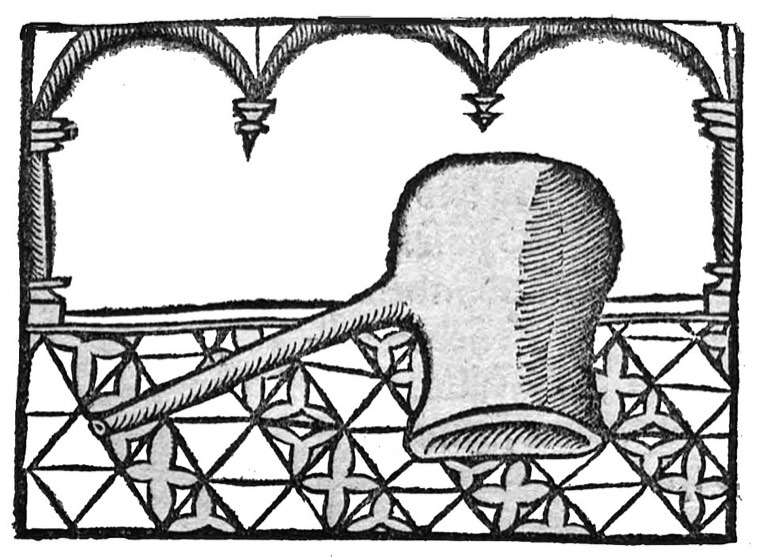
1543 page: Wellcome Collection, public domain. Kohl jar and tube: The Metropolitan Museum of Art, CC0. Stibnite: Ethmostigmus, CC BY-SA 4.0. Woodcut: Hieronymus Brunschwig, 1512, public domain. Recordings: Dvortygirl (US), CC BY-SA 3.0; Association Shtooka, Judith Franck (UK), CC BY 3.0, both via Wikimedia Commons. Map: Natural Earth, public domain.