assassin
nounas·sas·sin
A person who kills someone on purpose and by surprise, usually a public figure. With a capital letter, a member of a medieval sect of Nizari Ismailis.
John Wilkes Booth was the assassin of Abraham Lincoln.
From Medieval Latin assassinus, from Arabic ḥashshāshīn, the plural of ḥashshāsh, “hashish user”, a nickname used in the Crusader era for the Nizari Ismailis.45 The nickname came into Italian and French, then English. Etymonline says there is no evidence that these Ismailis used hashish.4
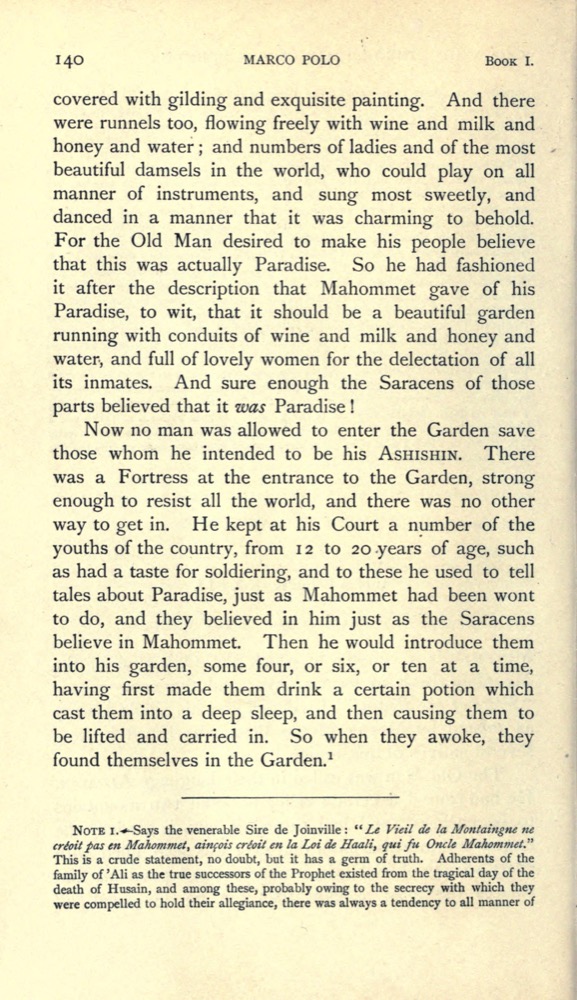
“Now no man was allowed to enter the Garden save those whom he intended to be his Ashishin. … having first made them drink a certain potion which cast them into a deep sleep …”
Page 140 of Henry Yule’s English translation of Marco Polo’s Travels, 3rd edition revised by Henri Cordier, London, 1903, Book I, chapter 23. This is a translation, not Polo’s own words. The potion is never named. See the page at the Internet Archive.1
Meanings
What it means today
- A member of the medieval sect. Usually capitalized. Merriam-Webster’s second sense: a person of a Shia Muslim sect in the time of the Crusades whose members were notorious for murdering prominent enemies.5 Wiktionary names the group as the Nizari Ismailis of the Alamut period.7
The Assassines, a nation depending of Phœnicia, are esteemed among the Mahometists of a soveraigne devotion and puritie of maners
Montaigne, in Florio’s translation, 1603, as transcribed by Wiktionary.
Johnson’s 1755 definition is “A murderer; one that kills by treachery, or sudden violence.”2 Webster in 1828 narrows it: “One who kills or attempts to kill, by surprise or secret assault”, and says that surprise or secrecy “seems essential to the signification of this word”.3
In sentences
The Syrian king, who, to surprize One man, assassin like, had levy’d war, War unproclaim’d.
Milton, Paradise Lost, book 11, quoted by Johnson, 1755.2When she hears of a murder, she enlarges more on the guilt of the suffering person, than of the assassin.
Addison, Spectator, quoted by Johnson, 1755.2
Words that sit nearby
- assassinate
- The verb, from Medieval Latin assassinare. Etymonline dates it to the 1610s.4 Johnson in 1755 prints it as a noun too,
this assassinate gave him, with a back blow, a deep wound
, quoting Wotton.2 - hashish
- From Arabic ḥashīsh, “powdered hemp”, from a word for dry herb or hay. Etymonline’s earliest English example is a traveller’s report from Egypt in 1598.4
- Bedouin
- Another word whose Arabic plural ending, -in, was mistaken in Europe for part of the word, as in assassin.4
Synonyms
Synonyms and antonyms for assassin
Synonyms
- For any killermurderer, murderess, killer, slayer, manslayer, homicide.6
- For a hired killerhit man, triggerman, torpedo, cutthroat, bravo.6
- For killing on a large scale or by officebutcher, slaughterer, massacrer, executioner.6 Murderer and killer are listed first. The thesaurus gives one list without senses; the grouping here is ours.
Antonyms
English has no antonym for assassin. The Merriam-Webster Thesaurus entry lists no antonyms and no near antonyms for it.6
Through time
Through time
Every century has told the word’s story its own way. Drag the line and read what people wrote at the time.
Route to English
How it traveled from Syria to England
- ḥashshāshīnArabic, plural of ḥashshāsh, “hashish user”. Merriam-Webster glosses the singular as “worthless person”, literally hashish user.5 A nickname for the Nizari Ismailis in the Crusader era.4
- assassinoItalian, with the generalized meaning “killer” from the start of the 14th century.4
- assassinFrench, in the mid 16th century.4
- assassinEnglish. Etymonline 1530s; Merriam-Webster c. 1520.45
Stops mark where each language was used, and the first stop is Syria, where the Crusaders met the group. Etymonline also records an earlier Middle English hassais, mid 14th century, from Old French hassasis, from the same Arabic word. The chain follows the line to today’s word.4 Wiktionary reverses the order: it lists Arabic asāsiyyīn first and calls the hashish word “the folkloric etymology”.7
Dates
How old is the word?
Dictionaries differ by a decade or so, and they are not dating the same thing.
| Source | Gives | What it is dating |
|---|---|---|
| Etymonline4 | 1530s | The English word. It adds Anglo-Latin from the mid 13th century and Middle English hassais from the mid 14th. |
| Merriam-Webster5 | circa 1520 | First known use, in the sense “a member of the sect”. The page we read gives no date for the sense “killer”. |
| Wiktionary7 | no date | Prints a 1603 quotation for the sect sense. |
| Johnson, 17552 | no date | Says the word came from Asia “about the time of the holy war”. |
So Merriam-Webster’s earlier date is for the sect’s name, and Etymonline’s is for the English word in general, which it says was borrowed after the French. Neither dictionary prints the sentence behind its date, so we have not seen a first example. The earliest English sentence we saw is the Florio quotation of 1603, through Wiktionary.
The myth
A myth: the Assassins killed on hashish
Assassin means “hashish eater”, because the sect’s killers were drugged with hashish and sent to murder.Half true
- The name very probably does come from the hashish word. Merriam-Webster and Etymonline derive it from ḥashshāshīn, plural of ḥashshāsh, “worthless person, literally, hashish user”.54 Wiktionary disagrees on the order: it names asāsiyyīn first and calls the hashish word a folk etymology.7
- But it started as an insult. Daftary, as reported by Wikipedia, traces the first use to a Fatimid caliph in 1122, and says hashishi then meant outcasts or rabble, without accusing anyone of using the drug.8
- No source we read shows the drug was used. Etymonline:
there is no evidence that the medieval Ismailis used hashish.
It says the story of killers murdering after eating hashish was the reputation they had in Western minds in the 12th and 13th centuries.4 Wikipedia quotes Daftary, who writes that there is no evidence of hashish “contrary to the medieval legends fabricated by uninformed writers and the enemies of the sect”.8 - Marco Polo, in Yule’s translation, tells of young men who drink “a certain potion” and wake in a garden. He never says hashish.1 The hashish link in that book is in Yule’s footnote, which repeats de Sacy.1
- Other origins have been proposed. Wiktionary’s own account starts from the Arabic asāsiyyīn, “people faithful to the foundation of the faith”, and says both origins have been proposed.7 Wikipedia credits that suggestion to Amin Maalouf.8 Johnson in 1755 thought of Arsacidæ.2
What is left is uncertain and we say so. The hashish word as an insult fits the dictionaries. The drugged killers do not fit anything we could open. We have not read Lewis or Daftary themselves, only what Wikipedia and the dictionaries report of them.
Measured
The word, measured
Psychologists have asked thousands of people about tens of thousands of words. Here is where assassin lands in six of those datasets.
How many people know it
Of 405 people shown it, 99.8% said they knew it, more than for 95% of the 61,855 words tested. Estimates by group: Americans 99.2%, British 99.5%, men 99%, women 99.5%.9
When people learn it
The average age adults recall learning it, later than about 51% of 31,105 words. The middle word on the list comes at 11.2. These are adults’ estimates, so read them as a rough guide.10
How concrete it feels
People rate it as something you can experience directly, more so than 85% of 39,954 words. Agreement is moderate: 28 raters, standard deviation 0.96.11
How it feels emotionally
It leans unpleasant, below 99% of 13,915 words, and raters mostly agree (standard deviation 1.32). It’s more arousing than 94% of those words at 5.82. On dominance it scores 3.36, lower than 96%, meaning people feel less in control.12
Which sense it calls up
Sight comes first, stronger than for 42% of 39,707 words.13
Scale 0 to 5.
Ratings come from panels of roughly 20 to 30 people per word, asked about the word out of context. Percentages are how assassin ranks among the words in that dataset.
Where does your vocabulary land?
Twelve words, each known by fewer Americans than the last. See your estimate against the same 221,268 people in the study above.9
Measure my vocabularyRelatives
Its relatives, and a few cousins
- Old Man of the Mountain
- Etymonline says the Crusaders’ title for the leader translates Arabic shaik-al-jibal.4 Yule’s note gives the Arabic title too.1
- hashish
- The drug name itself. Etymonline: from Arabic ḥashīsh, “hemp”.4
- Bedouin
- Same trick with a plural ending: Arabic badawin, “desert-dwellers”, was taken as one word.4
The same word in other languages
- assassinFrench
- assassinoItalian
- assassinoPortuguese
- assassíCatalan
- asesinoSpanish
- assassijnDutch
- ασσασίνοςGreek
- asasínCzech
- asasynPolish
- ассасинRussian
- asszaszinHungarian
- حشاشینPersian
These are the forms Wiktionary lists for the historical group or for the killer.7 German, Dutch and Finnish mostly use other words for a hired killer: Attentäter, sluipmoordenaar, salamurhaaja.7
Test yourself
Three questions from this page
Sources
Where every claim comes from
We read Yule’s Marco Polo, Johnson, Webster and the data files ourselves, and calculated the numbers on this page from those files. Etymonline and Merriam-Webster block automated readers, so we read their Internet Archive copies. What we know of Daftary, Lewis and Maalouf comes through Wikipedia and is marked as such. Checked on 5 November 2026. If something is wrong, write to hello@lexicist.com.
- Polo, Marco. The Book of Ser Marco Polo, trans. and ed. Henry Yule, 3rd ed. rev. Henri Cordier. London: John Murray, 1903. Vol. 1, Book I, chs. 23–24, pp. 139–143, with the note “The Assassins, Hashishin, or Muldhidah” to ch. 23. Internet Archive, public domain. archive.org
- Johnson, Samuel. A Dictionary of the English Language. 1755. johnsonsdictionaryonline.com
- Webster, Noah. An American Dictionary of the English Language. 1828. webstersdictionary1828.com
- Harper, Douglas. “assassin” and linked entries. Online Etymology Dictionary. We read the Internet Archive copy of August 2026; the live site blocks automated access. etymonline.com/word/assassin
- Merriam-Webster, “assassin”. We read the Internet Archive copy of October 2026; the live site blocks automated access. merriam-webster.com/dictionary/assassin
- Merriam-Webster Thesaurus, “assassin”. Internet Archive copy of February 2026. merriam-webster.com/thesaurus/assassin
- Wiktionary, “assassin”, English section, with its quotation from Florio’s Montaigne (1603), which we did not open ourselves. en.wiktionary.org/wiki/assassin
- Wikipedia, “Order of Assassins”, Etymology and Legends. It reports Daftary (1990, 1998, 2007), Lewis (2003) and Maalouf (1998), none of which we opened ourselves. en.wikipedia.org/wiki/Order_of_Assassins
- Brysbaert, M., et al. “Word prevalence norms for 62,000 English lemmas”. Behavior Research Methods 51 (2019): 467–479. doi.org/10.3758/s13428-018-1077-9
- Kuperman, V., et al. “Age-of-acquisition ratings for 30,000 English words”. Behavior Research Methods 44 (2012): 978–990. doi.org/10.3758/s13428-012-0210-4
- Brysbaert, M., et al. “Concreteness ratings for 40 thousand generally known English word lemmas”. Behavior Research Methods 46 (2014): 904–911. doi.org/10.3758/s13428-013-0403-5
- Warriner, A. B., et al. “Norms of valence, arousal, and dominance for 13,915 English lemmas”. Behavior Research Methods 45 (2013): 1191–1207. doi.org/10.3758/s13428-012-0314-x
- Lynott, D., et al. “The Lancaster Sensorimotor Norms”. Behavior Research Methods 52 (2020): 1271–1291. doi.org/10.3758/s13428-019-01316-z
- Brysbaert, M., and B. New. “Moving beyond Kučera and Francis”. Behavior Research Methods 41 (2009): 977–990. doi.org/10.3758/BRM.41.4.977
- Google Books Ngram Viewer, English 2019 corpus, 1700–2022, smoothing 3. Open the chart. Method: Michel, J.-B., et al. Science 331 (2011): 176–182.
Image and audio credits
Page of Yule’s Marco Polo, 1903: Internet Archive scan, public-domain book. Recording: Dangherous (author assumed by Commons from copyright claims) (UK), CC BY-SA 3.0, via Wikimedia Commons. Map: Natural Earth, public domain.