algebra
nounal·ge·bra
Arithmetic with letters standing for unknown numbers, used to solve equations. In advanced mathematics, the study of structures defined by operations.
She is good at algebra.
From Medieval Latin algebra, from Arabic al-jabr, “the restoring”, a word in the title of a book by al-Khwarizmi.58 English used algebra for setting broken bones before it used it for equations.85 The Arabic verb behind it means “to restore something broken”.2
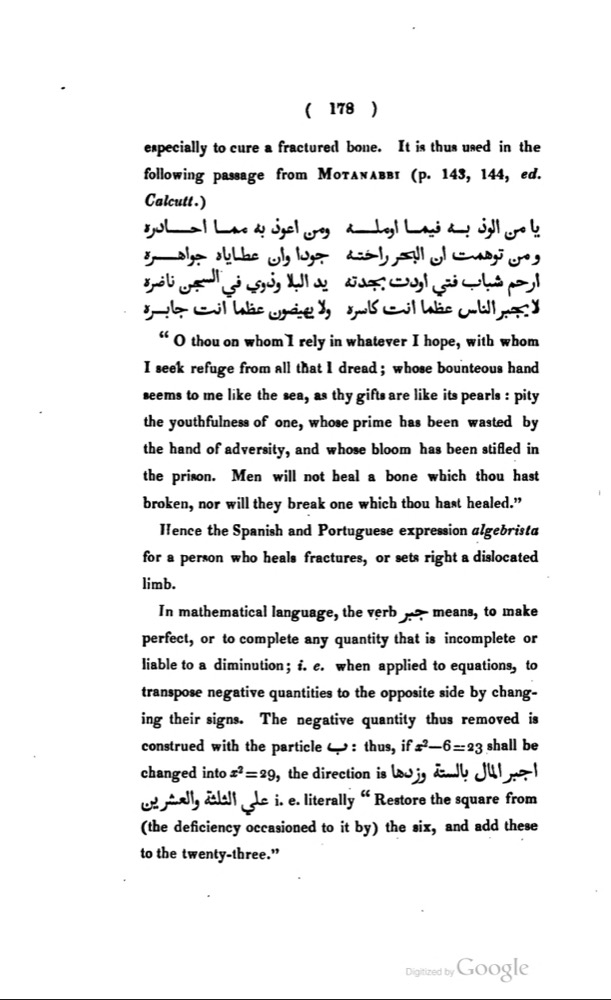
“Hence the Spanish and Portuguese expression algebrista for a person who heals fractures, or sets right a dislocated limb.”
Page 178 of Frederic Rosen’s edition and English translation of al-Khwarizmi, The Algebra of Mohammed ben Musa, London, 1831. It is a note by Rosen, not al-Khwarizmi’s own text. The page continues a sentence that begins on page 177: the verb jabara “properly signifies to restore something broken, especially to cure a fractured bone”. See the page at the Internet Archive.2
Meanings
What it means today
- Arithmetic with letters for unknowns. Merriam-Webster’s first sense is a generalization of arithmetic in which letters standing for numbers are combined by the rules of arithmetic.6 Wiktionary puts it as a system for representing and manipulating unknown quantities in equations.8She is good at algebra.
- The study of structures. Mathematicians also use the word for whole branches that deal with abstract objects such as groups, rings and fields, worked under operations that resemble those of arithmetic.6 A single such structure is also called an algebra.8
Let us conceive, then, of an Algebra in which the symbols x, y, z, &c. admit indifferently of the values 0 and 1, and of these values alone.
George Boole, 1854. - Setting a broken bone. Obsolete. Wiktionary lists a rare, historical medical sense: the surgical treatment of a dislocated or fractured bone.8 Etymonline says English used it this way in the 15th and 16th centuries.5
after the techynge þat schal be seid in þe chapitle of algebra
Lanfranc’s surgery, Middle English, a1420.
Johnson’s 1755 dictionary calls it “a peculiar kind of arithmetick” that takes the unknown quantity “as if it were granted” and works until it is found equal to something known.3 Webster in 1828 is shorter: “The science of quantity in general, or universal arithmetic.” He adds that it was “of Oriental discovery; but whether among the Arabians or Indians, is uncertain.”4
In sentences
Let us conceive, then, of an Algebra in which the symbols x, y, z, &c. admit indifferently of the values 0 and 1, and of these values alone.
George Boole, An Investigation of the Laws of Thought, 1854, p. 37, as transcribed by Wiktionary.8That Algebra of honour; which had never Been nam’d, if all had equal courage
William Clark, Marciano, 1663. Here algebra means a convoluted system of rules. As transcribed by Wiktionary.8
Words that sit nearby
- algebraic
- Etymonline dates it to the 1660s. The earlier form algebraical goes back to the 1570s.5
- algebraist
- Listed next to algebra in Merriam-Webster.6
- algebrista
- Spanish and Portuguese for a person who sets bones, according to Rosen in 1831.2
- algorithm
- Not a spelling variant. It comes from the name of the same mathematician, al-Khwarizmi.5
Synonyms
Synonyms and antonyms for algebra
Synonyms
We found no thesaurus list for algebra. The only Merriam-Webster Thesaurus copy we could open, from the Internet Archive in 2008, answers “No entries found”, and we could not open a current one.7 The word names a field, so it has no everyday synonym. Webster’s 1828 phrase “universal arithmetic” is the nearest old equivalent.4
Antonyms
English has no antonym for algebra. The nearest contrast in the old books is plain arithmetic, from which Johnson says algebra differs: it works with an unknown quantity “as if it were granted”.3
Through time
Through time
English had algebra as a doctor’s word before it had it as a mathematician’s. Drag the line and read what people wrote at the time.
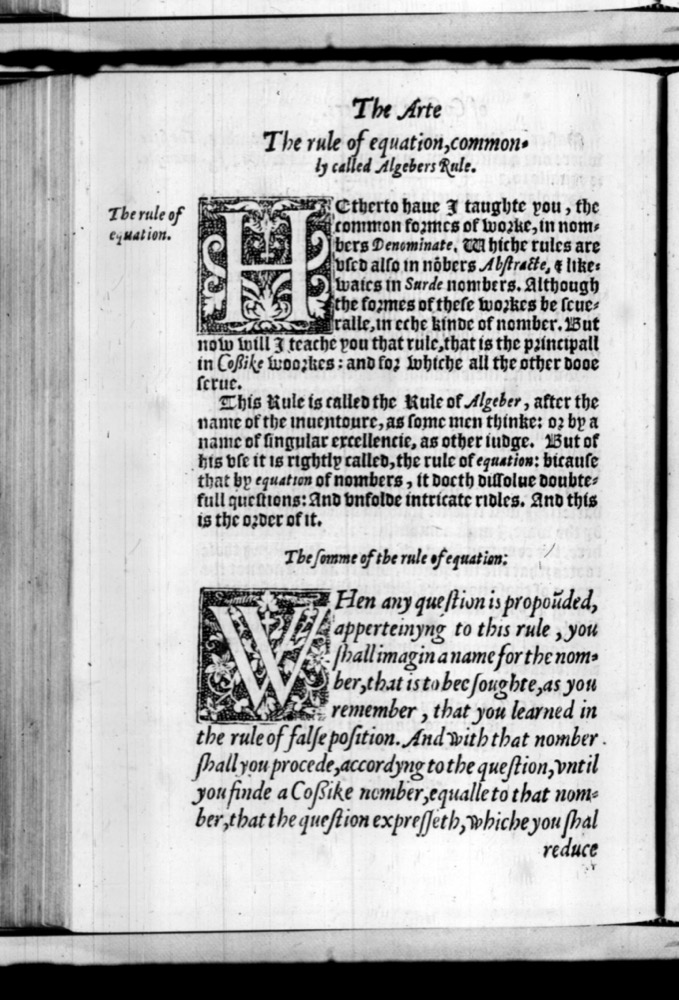
What Recorde was weighing in 1557
Recorde’s book teaches the rule of equation, which he says is “commonly called Algebers Rule”. He had two ideas about the name and offered both. The first treats it as a person’s name. The second treats it as a title of honour, a word chosen for being excellent. Johnson in 1755 had four ideas and no more certainty.13
Route to English
How it traveled from Baghdad to England
- jabaraArabic, “to reintegrate, reunite, consolidate”.5 Rosen: it properly means to restore something broken, especially to cure a fractured bone.2
- al-jabrArabic, “the restoring”. It names one of two steps for solving an equation. It stands in the title al-kitāb al-mukhtaṣar fī ḥisāb al-jabr wa-l-muqābala, “the compendious book on calculation by completion and balancing”, by the Baghdad mathematician al-Khwarizmi.58
- algebraMedieval Latin. Al-Khwarizmi’s book was translated into Latin in the 12th century.5 The same Latin word was also used for bone-setting, probably picked up from Arab doctors in Spain.5
- algebraEnglish. A bone word by a1420,8 a mathematical word by 1551.68 John Dee, in the 1500s, calls the work algiebar and almachabel.5
There is no map here because we have no source for where the Latin translators worked. The chain above is a family tree, not a documented journey.
Dates
How old is the word?
Dictionaries say 1551, or the 1550s, and they agree. But they are dating the second meaning. The first English algebra was about bones.
| Source | Gives | What it is dating |
|---|---|---|
| Etymonline5 | 1550s | The mathematical word. In another sentence it says English used it for bone-setting in the 15th and 16th centuries. |
| Merriam-Webster6 | 1551 | First known use of the mathematical sense, arithmetic with letters. |
| Wiktionary8 | a1420 and 1551 | The bone-setting sense, from a Middle English surgery, and the mathematical sense, from a passage in the Oxford English Dictionary. |
| Johnson, 17553 | 1494 | Not English. He says Pacioli printed a treatise on algebra “in Italian, at Venice” that year. |
The Lanfranc date is the only one we could not check. It comes from Wiktionary’s transcription of an 1894 edition, and we have not opened the edition or the manuscript.
The myth
A myth: algebra is named after an inventor
The word algebra comes from the name of the man who invented it, a certain Geber.An old guess, no support
- In 1557 Robert Recorde gave it as one of two opinions: the rule is called Algeber
after the name of the inuentoure, as some men thinke
, orby a name of singular excellencie, as other iudge
.1 He did not choose. - Johnson in 1755 lists it first among four guesses, and calls the word “of uncertain etymology”. The guesses are Geber the philosopher, a word for parchment, a word for a bone-setter, and Menage’s word for “the restitution of things broken”.3 He does not say which Geber he means.
- Today’s dictionaries trace the word to al-jabr, in the title of al-Khwarizmi’s book.568 None of the three we read says it is a person’s name.
- Rosen, who edited the Arabic text and translated it in 1831, writes that al-Khwarizmi
was for a long time considered as the original inventor of Algebra
, then says that nothing in the author’s preface shows he claimed to be.2 The author, Rosen adds, gives no definition of the science and does not explain the words jebr and mokabalah.2
What the Arabic word meant is better documented. Rosen quotes an Arabic definition: “Jebr is the restoration of anything defective by means of what is complete of another kind”, and says the second word, mokabalah, means facing, “whence it is applied to one praying” toward the qibla. The two together, he writes, were Restoring and Balancing
.2
Rosen also explains how the same verb works inside an equation. It means to move a negative quantity to the other side by changing its sign, so that the quantity is made complete.2 We have not read the scholars who argue over which sense came first in Arabic.
Measured
The word, measured
Psychologists have asked thousands of people about tens of thousands of words. Here is where algebra lands in six of those datasets.
How many people know it
Of 377 people shown it, 98.9% said they knew it, more than for 80% of the 61,855 words tested. Estimates by group: Americans 98.8%, British 97.6%, men 99%, women 98.2%.9
When people learn it
The average age adults recall learning it, later than about 54% of 31,105 words. The middle word on the list comes at 11.2. These are adults’ estimates, so read them as a rough guide.10
How concrete it feels
People rate it as something you can experience directly, more so than 57% of 39,954 words. Agreement is low: 28 raters, standard deviation 1.35.11
How it feels emotionally
It sits near the middle of the scale, above 57% of 13,915 words, but raters split widely (standard deviation 2.28). It’s more arousing than 70% of those words at 4.60. On dominance it scores 4.54, lower than 76%, meaning people feel less in control.12
Which sense it calls up
Sight comes first, stronger than for 84% of 39,707 words.13
Scale 0 to 5.
Ratings come from panels of roughly 20 to 30 people per word, asked about the word out of context. Percentages are how algebra ranks among the words in that dataset.
Where does your vocabulary land?
Twelve words, each known by fewer Americans than the last. See your estimate against the same 221,268 people in the study above.9
Measure my vocabularyRelatives
Its relatives, and a few cousins
- algorithm
- From Old French algorisme, from Medieval Latin algorismus, a garbled form of Arabic al-Khwarizmi, “native of Khwarazm”, the mathematician’s surname. Etymonline says the earlier Middle English form was algorism, early 13th century.5
- almanac, alchemy, alcohol
- Other English words that begin with the Arabic definite article al-, “the”. Etymonline notes that in some of them the l is absorbed by the next consonant, giving forms such as as-, az- and ar-.5
- algebrista
- Spanish and Portuguese, a bone-setter. Rosen in 1831 ties it to the same Arabic verb.2
The same word in other languages
- álgebraSpanish
- algèbreFrench
- AlgebraGerman
- algebraItalian
- álgebraPortuguese
- àlgebraCatalan
- алгебраRussian
- άλγεβραGreek
- aljabarIndonesian
- جبرPersian
- جبرArabic
- אַלגֶבּרָהHebrew
Chinese and Japanese chose a different word, 代数. Persian جبر and Indonesian aljabar, both listed by Wiktionary, keep the Arabic root.8
Test yourself
Three questions from this page
Sources
Where every claim comes from
We read the 1557 page, Rosen’s 1831 book, Johnson, Webster and the data files ourselves, and calculated the numbers on this page from those files. Etymonline and Merriam-Webster block automated readers, so we read their Internet Archive copies. The Lanfranc and 1551 quotations come from Wiktionary and are marked as such. Checked on 5 November 2026. If something is wrong, write to hello@lexicist.com.
- Record, Robert. The whetstone of witte. London, 1557. “The rule of equation, commonly called Algebers Rule”. Internet Archive scan from microfilm; the library copy is not named on the item page. archive.org
- Rosen, Frederic, ed. and trans. The Algebra of Mohammed ben Musa. London: Oriental Translation Fund, 1831. Introduction, and notes to p. 2, pp. 177–181. Internet Archive, Google scan, public domain. archive.org
- Johnson, Samuel. A Dictionary of the English Language. 1755. johnsonsdictionaryonline.com
- Webster, Noah. An American Dictionary of the English Language. 1828. webstersdictionary1828.com
- Harper, Douglas. “algebra”, and the entries it links to. Online Etymology Dictionary. We read the Internet Archive copy of October 2026; the live site blocks automated access. etymonline.com/word/algebra
- Merriam-Webster, “algebra”. We read the Internet Archive copy of August 2025; the live site blocks automated access. merriam-webster.com/dictionary/algebra
- Merriam-Webster Thesaurus, “algebra”. Internet Archive copy of 2008, which reports no entry. merriam-webster.com/thesaurus/algebra
- Wiktionary, “algebra”, English section, with its quotations from Lanfranc (a1420), the Oxford English Dictionary (1888), Clark (1663) and Boole (1854), none of which we opened ourselves. en.wiktionary.org/wiki/algebra
- Brysbaert, M., et al. “Word prevalence norms for 62,000 English lemmas”. Behavior Research Methods 51 (2019): 467–479. doi.org/10.3758/s13428-018-1077-9
- Kuperman, V., et al. “Age-of-acquisition ratings for 30,000 English words”. Behavior Research Methods 44 (2012): 978–990. doi.org/10.3758/s13428-012-0210-4
- Brysbaert, M., et al. “Concreteness ratings for 40 thousand generally known English word lemmas”. Behavior Research Methods 46 (2014): 904–911. doi.org/10.3758/s13428-013-0403-5
- Warriner, A. B., et al. “Norms of valence, arousal, and dominance for 13,915 English lemmas”. Behavior Research Methods 45 (2013): 1191–1207. doi.org/10.3758/s13428-012-0314-x
- Lynott, D., et al. “The Lancaster Sensorimotor Norms”. Behavior Research Methods 52 (2020): 1271–1291. doi.org/10.3758/s13428-019-01316-z
- Brysbaert, M., and B. New. “Moving beyond Kučera and Francis”. Behavior Research Methods 41 (2009): 977–990. doi.org/10.3758/BRM.41.4.977
- Google Books Ngram Viewer, English 2019 corpus, 1700–2022, smoothing 3. Open the chart. Method: Michel, J.-B., et al. Science 331 (2011): 176–182.
Image and audio credits
Page of Rosen, 1831, and page of Recorde, 1557: Internet Archive scans, public-domain books. Recording: Dvortygirl (US), CC BY-SA 3.0, via Wikimedia Commons.