zenith
nounze·nith
The point in the sky straight above you. Also the highest point a star or the sun reaches, and the peak of anything.
Winning the continental championship was the zenith of my career.
From Middle English cenyth, from Medieval Latin, from Arabic samt, “road, path”, short for samt ar-ra’s, “the way over the head”.58 The -ni- for -m- is often blamed on a scribe who misread three strokes. Wiktionary calls that plausible, and says it could also be a phonetic approximation.8
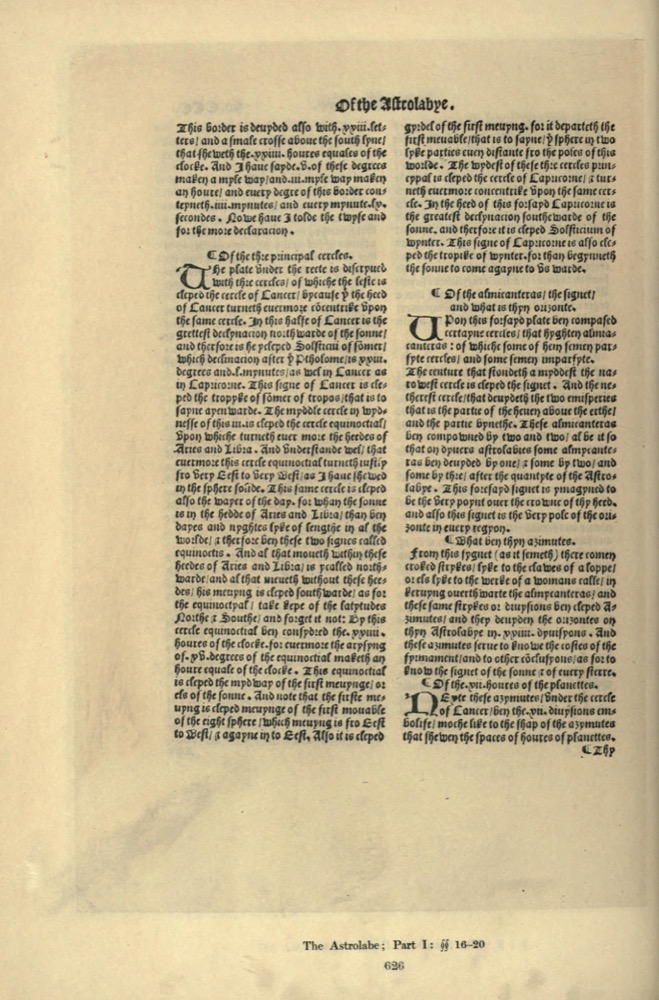
“The centure that stondeth a myddest the narowest cercle is cleped the signet.”
Page 626 of the 1905 facsimile of William Thynne’s 1532 edition of Chaucer, the first printed Treatise on the Astrolabe. Where the manuscripts Skeat used have senyth or cenyth, this print has signet. Spelling is as printed; the page uses the long s, which we write as s. See the page at the Internet Archive.2
Meanings
What it means today
- The point straight overhead. Merriam-Webster: the point of the celestial sphere directly opposite the nadir and vertically above the observer.6 Wiktionary says the same, as an astronomy term.8
in two dayes saile we made the Sunne our Zenith or verticall point
Sir Thomas Herbert, 1638, as transcribed by Wiktionary. - The highest point a star or the sun reaches. Merriam-Webster’s second sense: the highest point reached in the heavens by a celestial body.6
when the sun was in the zenith, the violence of the heat was too great to stir out
Defoe, Robinson Crusoe, as quoted by Wiktionary.
Johnson’s 1755 dictionary says “The point over head opposite to the nadir”, and notes only that it is Arabic.3 Webster in 1828 is longer: the point “vertical to the spectator”, from which a line through him “would proceed to the center of the earth”, and “opposed to nadir”.4
In sentences
These seasons are designed by the motions of the sun, when that approaches nearest our zenith, or vertical point, we call it summer.
Browne, Vulgar Errours, quoted by Johnson, 1755.3Fond men! if we believe that men do live Under the zenith of both frozen poles, Though none come thence, advertisement to give, Why bear we not the like faith of our souls?
Davies, quoted by Johnson, 1755.3
Words that sit nearby
Synonyms
Synonyms and antonyms for zenith
Synonyms
- For the peak of a career or successpinnacle, height, peak, culmination, top, apex, climax, apogee, acme, summit, crest, crown, prime, heyday.7 Pinnacle is the first the thesaurus lists. The thesaurus gives one list without senses; this grouping is ours.
- For the sky and the daymeridian, noon, noontime, high noon.7
Antonyms
For zenith as a peak, the Merriam-Webster Thesaurus lists antonyms and near antonyms. Its list is below. For the sky, the exact opposite is nadir.78
Through time
Through time
The word is as old as Chaucer in English, and it was already being garbled. Drag the line and read what people wrote at the time.
What Chaucer’s cenyth sat on
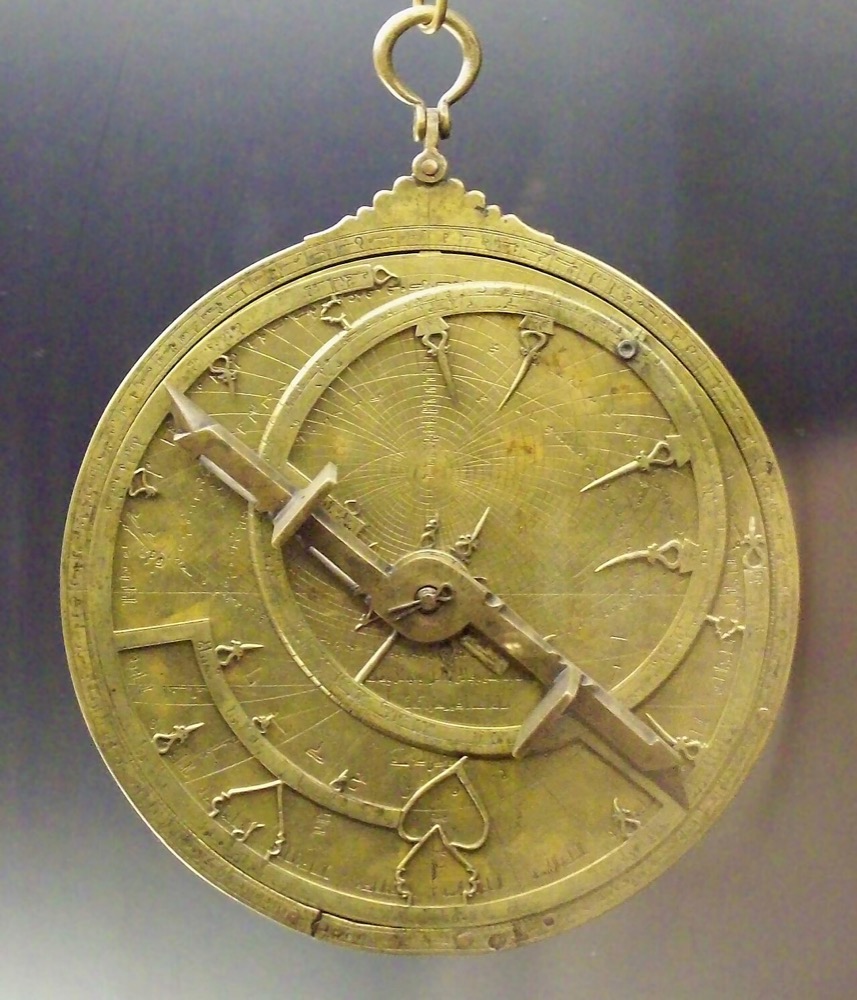
An astrolabe is a brass disc for measuring the height of the sun and stars. Chaucer’s book describes circles of altitude drawn on a plate. The middle one, he writes, is the cenyth, and it is “the verrey point over the crowne of thyn heued”.1 The photo shows a whole instrument, not the plate Chaucer describes. The plate with those circles is underneath the open metal net.

Route to English
How it traveled from Arabic to Chaucer
- samtArabic, “road, path, direction”.58 Skeat adds that al-samt also meant a point of the horizon, and then an azimuthal circle.1
- samt ar-ra’sArabic, “the way over the head”. The phrase for the point overhead.58
- zenit, cenit, senitOld Spanish and Medieval Latin. Etymonline lists the Latin spellings zyneth, zymeth, cenit, senit and calls them bungled scribal transliterations.5 Merriam-Webster puts Old Spanish zenit in the line.6
- cenithOld French. Etymonline says English took the word from Old French and also directly from Medieval Latin.5
- cenyth, zinethMiddle English, late 14th century.58 Chaucer writes it cenyth and senyth.1
- zenithModern English.8
There is no map because we have no source for where each step happened. The dictionaries differ on the middle: Merriam-Webster has an Old Spanish step, and Etymonline and Wiktionary go Latin to French, or Latin to English.568 The chain is a family tree, not a documented journey.
Dates
How old is the word?
Two dictionaries say the 14th century, and neither prints the sentence.
| Source | Gives | What it is dating |
|---|---|---|
| Etymonline5 | late 14th century | The form zineth, point overhead. It dates the figurative “highest point” sense to about 1600. |
| Merriam-Webster6 | 14th century | First known use of the astronomy sense. The page gives no sentence. |
| Wiktionary8 | no date | Lists Middle English cenyth. Its first quotation is from 1638. |
| Skeat, 18721 | 1391 | Not a dictionary. It is the year Chaucer’s book names in its title, and the year he works an example for, “the 12 day of March”. |
The Harvard manuscript of Chaucer’s Astrolabe would be the sharpest check, but its library refuses automated requests and we have not seen it. What we saw is Skeat’s printed text from the earliest manuscripts.
The tidy story
A tidy story: a scribe misread m as ni
Zenith came from Arabic samt because a scribe misread the letter m as the two letters ni.Plausible, not proven
- Etymonline states it as a fact: the Medieval Latin forms are
bungled scribal transliterations
of samt, withLetter -m- misread as -ni-
.5 - Wiktionary is cooler. It says the -ni- for -m- is “sometimes thought” to come from a misreading of the three strokes, which is plausible, “though it could be a mere phonetic approximation”.8
- The Latin spellings Etymonline lists include one with an m, zymeth, beside ones with n.5 We have not seen those manuscripts, so we cannot say which came first.
- Skeat in 1872 called zenith “a corruption of semt, from samt al-ras”, and does not say how the corruption happened.1
Chaucer already writes the n, so the change had happened before 1391.1 The two readings do not exclude each other: a scribe could misread three strokes in a word he half-knew by ear.
A second thing the page shows is easier to prove. A printer in 1532 set signet where Chaucer wrote cenyth. Skeat checked the manuscripts and found senyth in the oldest ones.12 We do not know why the printer or his copy changed it. Skeat notes that the Latin heading of Part II, §31 calls the sunrise point signum. That may or may not be related, and he does not say it is.1
Measured
The word, measured
Psychologists have asked thousands of people about tens of thousands of words. Here is where zenith lands in six of those datasets.
How many people know it
Of 399 people shown it, 92.0% said they knew it, more than for 54% of the 61,855 words tested. Estimates by group: Americans 92.8%, British 88.6%, men 90.7%, women 92%.10
When people learn it
The average age adults recall learning it, later than about 72% of 31,105 words. The middle word on the list comes at 11.2. These are adults’ estimates, so read them as a rough guide.11
How concrete it feels
People rate it as more of an idea than a thing, more abstract than 51% of 39,954 words. Agreement is low: 25 raters, standard deviation 1.61.12
How it feels emotionally
It sits near the middle of the scale, above 50% of 13,915 words, and raters mostly agree (standard deviation 1.79). It’s calmer than 69% of those words, at 3.71. On dominance it scores 5.36, higher than 54%, meaning people feel more in control.13
Which sense it calls up
Sight comes first, stronger than for 37% of 39,707 words.14
Scale 0 to 5.
Ratings come from panels of roughly 20 to 30 people per word, asked about the word out of context. Percentages are how zenith ranks among the words in that dataset.
Where does your vocabulary land?
Twelve words, each known by fewer Americans than the last. See your estimate against the same 221,268 people in the study above.10
Measure my vocabularyRelatives
Its relatives, and the twin it shares an Arabic root with
- azimuth
- From Arabic as-sumut, plural of as-samt. Etymonline dates it to the late 14th century, as azimut, from Old French.5 Skeat points out that zenith is a corruption of the root of this word.1
- nadir
- From Arabic nazir as-samt, “opposite direction”. Late 14th century in English.5
- Latin semita
- Etymonline notes that medieval Latin cenit could have been pulled toward classical semita, “side path”, by sound. It is a possibility, not a derivation.5
The same word in other languages
- cénitSpanish
- zénithFrench
- ZenitGerman
- zenitItalian
- zênitePortuguese
- zenitDutch
- зенитRussian
- ζενίθGreek
- զենիթArmenian
- zeniittiFinnish
- zenitTurkish
- سَمْتArabic
The Arabic entry is the original, samt. Chinese and Japanese use 天頂, “heavenly top”, which is a different word.8
Test yourself
Three questions from this page
Sources
Where every claim comes from
We read Skeat’s edition of Chaucer, the 1532 page, Johnson, Webster and the data files ourselves, and calculated the numbers on this page from those files. Etymonline and Merriam-Webster block automated readers, so we read their Internet Archive copies. Checked on 5 November 2026. If something is wrong, write to hello@lexicist.com.
- Chaucer, Geoffrey. A Treatise on the Astrolabe, addressed to his son Lowys, A.D. 1391, ed. Walter W. Skeat. London: Trübner for the Early English Text Society, 1872. Part I §18, Part II §31, notes and glossary. Internet Archive, Google scan, public domain. archive.org
- The Works of Geoffrey Chaucer and others, facsimile of the 1532 edition (William Thynne), intro. W. W. Skeat. London, [1905]. “The Astrolabe; Part I: §§ 16–20”, facsimile p. 626. Internet Archive, public domain. archive.org
- Johnson, Samuel. A Dictionary of the English Language. 1755. johnsonsdictionaryonline.com
- Webster, Noah. An American Dictionary of the English Language. 1828. webstersdictionary1828.com
- Harper, Douglas. “zenith” and linked entries. Online Etymology Dictionary. We read the Internet Archive copy of February 2026; the live site blocks automated access. etymonline.com/word/zenith
- Merriam-Webster, “zenith”. We read the Internet Archive copy of September 2026; the live site blocks automated access. merriam-webster.com/dictionary/zenith
- Merriam-Webster Thesaurus, “zenith”, Synonyms, Antonyms and Near Antonyms. Internet Archive copy of May 2026. merriam-webster.com/thesaurus/zenith
- Wiktionary, “zenith”, English section, with its quotations from Herbert (1638), Defoe and Shakespeare, none of which we opened ourselves. en.wiktionary.org/wiki/zenith
- Wikimedia Commons, “File:Astrolabio andalusí Toledo 1067 (M.A.N.) 04.jpg”. Photo by Luis García (Zaqarbal), CC BY-SA 3.0. commons.wikimedia.org
- Brysbaert, M., et al. “Word prevalence norms for 62,000 English lemmas”. Behavior Research Methods 51 (2019): 467–479. doi.org/10.3758/s13428-018-1077-9
- Kuperman, V., et al. “Age-of-acquisition ratings for 30,000 English words”. Behavior Research Methods 44 (2012): 978–990. doi.org/10.3758/s13428-012-0210-4
- Brysbaert, M., et al. “Concreteness ratings for 40 thousand generally known English word lemmas”. Behavior Research Methods 46 (2014): 904–911. doi.org/10.3758/s13428-013-0403-5
- Warriner, A. B., et al. “Norms of valence, arousal, and dominance for 13,915 English lemmas”. Behavior Research Methods 45 (2013): 1191–1207. doi.org/10.3758/s13428-012-0314-x
- Lynott, D., et al. “The Lancaster Sensorimotor Norms”. Behavior Research Methods 52 (2020): 1271–1291. doi.org/10.3758/s13428-019-01316-z
- Brysbaert, M., and B. New. “Moving beyond Kučera and Francis”. Behavior Research Methods 41 (2009): 977–990. doi.org/10.3758/BRM.41.4.977
- Google Books Ngram Viewer, English 2019 corpus, 1700–2022, smoothing 3. Open the chart. Method: Michel, J.-B., et al. Science 331 (2011): 176–182.
Image and audio credits
1532 page: Internet Archive scan of a 1905 facsimile, public-domain book. Astrolabe photo: Luis García (Zaqarbal), CC BY-SA 3.0, via Wikimedia Commons. Recordings: EncycloPetey (US), CC BY-SA 3.0; ATMarsden (UK), CC BY 4.0, both via Wikimedia Commons.