Panic
nounpan·ic/ˈpæn.ɪk/
Sudden, overwhelming fear that makes people act without thinking, often a whole crowd at once.
The sudden sight of a grizzly bear filled the hiker with panic.
From French panique, from Greek panikos, “of Pan”, the god of woods and fields.87 The Greek phrase was panikon deima, “Pan fright”.7 English had it as an adjective in the late 1500s, years before the noun.87 The popular story that Pan frightened the Persians at Marathon is not in Herodotus.23
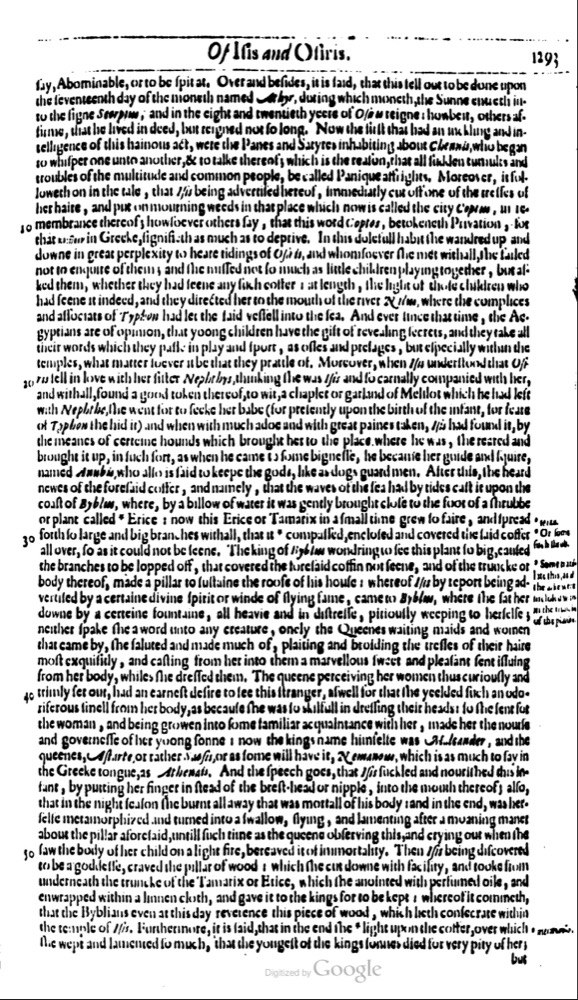
“…all sudden tumults and troubles of the multitude and common people, be called Panique affrights.”
Page 1293 of Philemon Holland’s English translation of Plutarch’s Morals, London, 1603, in the treatise Of Isis and Osiris. It says the Pans and Satyrs near Chemmis whispered about a crime, which is the reason
for the name. Spelling is as printed; the page uses the long s, which we write as s. See the book at the Internet Archive.1
Meanings
What it means today
- Sudden, overwhelming fear. Merriam-Webster defines it as a sudden overpowering fright, and also as sudden unreasoning terror often accompanied by mass flight.8The sudden sight of a grizzly bear filled the hiker with panic.
- To panic. The verb means to feel panic, or to make someone feel it.10The crowd began to panic.
There is also an adjective, with a capital letter in the dictionary: Panic, “of or relating to the god Pan”, as in Panic rites.8 The word has a second life as a plant name, but that is a different word, from Latin panicum, millet.76
In sentences
The troops were seized with a panic; they fled in a panic.
Webster’s 1828 definition of the noun: a sudden fright, often one without real cause.6I left the city in a panic fright; Lions they are in council, lambs in fight.
John Dryden, quoted under panick by Samuel Johnson, 1755. We read it from an OCR copy.5
Words that sit nearby
Synonyms
Synonyms and antonyms for panic
Synonyms
- For sudden fearfear, terror, fright, horror, scare, alarm, dismay, consternation, dread.9 Fear is the first the thesaurus lists. Its note on panic says that, among these, it implies unreasoning and overmastering fear that causes hysterical activity.9
- For nervous worryanxiety, worry, trepidation, nervousness, jitters, apprehension, disquiet.9
- As a verb, “to strike with fear”scare, frighten, terrify, startle, shock, spook, alarm, horrify.9
Antonyms
English has no exact antonym for panic. The Merriam-Webster thesaurus lists these near antonyms.9
- For the nounconfidence, assurance, boldness, courage, aplomb, daring, fortitude, fearlessness, bravery, nerve
- For the verbreassure, comfort, soothe, console, cheer, encourage, hearten, embolden
Through time
Through time
English took panic as a description of a feeling before it had a noun for it. Drag the line and watch the word move from a god’s mood to a crowd’s, then to the stock market, then to one person’s bad afternoon.
How a god got the blame for a crowd
The Greek word was panikon deima, “Pan fright”, and the Greek noun panikon on its own already meant groundless fear by the time of Polybius, Cicero and Dionysius of Halicarnassus.3 An English translator in 1603 could therefore explain it in one sentence, as Holland does on the page above: the Pans and Satyrs whispered, so that all sudden mob terror is called Panique.1 That is Plutarch’s explanation, and Plutarch wrote after Polybius and Cicero had already used the word. The explanation came later than the word.
Route to English
How it traveled from Arcadia to England
- ΠάνGreek, the name of the god Pan. Wiktionary says the god has been argued to be Indo-European, and compares the Vedic Pushan, “nourisher”, a god who guarded cattle.11
- πανικόςGreek adjective, “of Pan”, used of groundless fear.117
- paniqueFrench, 15th century.7
- panicEnglish, an adjective about 1586 to 1600 and a noun by 1708 at the latest.87
Stops mark where each language was used. Nobody documented a single journey. Arcadia is the god’s home country, not a place the word was spoken in English.
Dates
Why the dates differ
The dictionaries mostly disagree because they are dating different parts of speech.
| Source | Gives | What it is dating |
|---|---|---|
| Merriam-Webster8 | about 1586 | The adjective, “resembling the state believed induced by the god Pan”. |
| Etymonline7 | about 1600 | The same adjective, “modifying fear, terror, etc.”. |
| Merriam-Webster8 | 1612 | The noun, a sudden unreasoning terror. |
| Etymonline7 | 1708 | The noun, “sudden mass terror”. |
| Merriam-Webster8 | 1780 | The verb. |
| Etymonline7 | 1827, 1902 | The verb, first transitive and then intransitive. |
Neither page prints the early sentences, so we cannot tell why Merriam-Webster’s noun is almost a century before Etymonline’s. Holland’s page of 1603 comes after both adjective dates and before Merriam-Webster’s noun date, but it is a translation of Greek, so we do not count it as a first English use.
The myth
A myth: Pan frightened the Persians at Marathon
The word panic comes from the story that Pan scared the Persian army at Marathon.Not in Herodotus
- Herodotus does tell of Pan at Marathon. The runner Philippides met him in the mountains above Tegea, and Pan told him to ask the Athenians why they paid him no attention,
though he was of goodwill to the Athenians, had often been of service to them, and would be in the future.
The Athenians later built him a precinct under the Acropolis.2 No panic, no flight of Persians. - A 1926 study by E. Harrison in the Classical Review asks how old the link between Pan and groundless fear really is. His answer: Pan’s name does not occur in the Iliad or the Odyssey, and Herodotus, Aeschylus and Thucydides do not connect him with fear.3
- Harrison finds the first hint in a play, Rhesus, of doubtful date, with a line about being frightened by
the trembling whip of Pan
(his words, our paraphrase of the Greek).3 By Polybius’s time the noun panikon meant groundless fear all by itself, and the first writer who states the link expressly is Plutarch.3 - Writers after Herodotus did put Pan at Marathon, but Harrison’s note on them says none of those passages has Pan striking panic into the enemy.3 The tales that do, a fight against the Titans and a ruse for Dionysus, are later, in his note citing Hyginus and Polyaenus, which we have not opened.3
The word does come from Pan. That is in every dictionary, and the dictionaries say it carefully: Merriam-Webster’s etymology is simply “French panique, from Greek panikos, literally, of Pan, from Pan”.8 It is the Marathon story that was added, probably because it is a good one.
A smaller one: Pan means “all”
The older Greek poets already made this guess. In the Homeric Hymn to Pan the gods call the baby Pan because he delighted all their hearts
, which plays on the Greek word for “all”.4 Wiktionary says the grammar does not support it, since the stems differ, Πάν with the genitive Πάνος against πᾶν, πάντος.11 So panic is not “fear of everything”. It is “of Pan”.
Measured
The word, measured
Psychologists have asked thousands of people about tens of thousands of words. Here is where panic lands in six of those datasets.
How many people know it
Of 402 people shown it, 99.8% said they knew it, more than for 95% of the 61,855 words tested. Estimates by group: Americans 99.2%, British 99.5%, men 99.5%, women 99.5%.12
When people learn it
The average age adults recall learning it, earlier than about 80% of 31,105 words. The middle word on the list comes at 11.2. These are adults’ estimates, so read them as a rough guide.13
How concrete it feels
People rate it as something you can experience directly, more so than 54% of 39,954 words. Agreement is low: 28 raters, standard deviation 1.60.14
How it feels emotionally
It leans unpleasant, below 97% of 13,915 words, and raters mostly agree (standard deviation 1.55). It’s more arousing than 99% of those words at 6.40. On dominance it scores 2.65, lower than 100%, meaning people feel less in control.15
Which sense it calls up
Inside the body comes first, stronger than for 99% of 39,707 words.16
Scale 0 to 5.
Ratings come from panels of roughly 20 to 30 people per word, asked about the word out of context. Percentages are how panic ranks among the words in that dataset.
Where does your vocabulary land?
Twelve words, each known by fewer Americans than the last. See your estimate against the same 221,268 people in the study above.12
Measure my vocabularyRelatives
Its relatives, and the same word elsewhere
- panpipes
- The pipes of Pan. Wiktionary lists panpipe and panpipes among derived terms of Pan.11
- panical
- An obsolete adjective for panic, and Pandean, “of Pan”, is another.10 Camden’s
panical fear
is one of the examples Johnson gives for panick.5 - panic (grass)
- A different word, mid-15th century, from Latin panicum, millet, from panus, “ear of millet”. Webster’s 1828 dictionary lists it as a separate entry.76
The same word in other languages
- pánicoSpanish
- paniqueFrench
- PanikGerman
- panicoItalian
- pânicoPortuguese
- paniekDutch
- panikaPolish
- panikSwedish
- panikTurkish
- πανικόςGreek
- паникаRussian
- パニックJapanese
All of these are listed in Wiktionary’s translation table for the noun.10 Japanese took the English word.10
Test yourself
Three questions from this page
Sources
Where every claim comes from
We read the 1603 page, Herodotus, the Homeric hymn and the data files ourselves, and calculated the numbers on this page from those files. Etymonline and Merriam-Webster block automated readers, so we read their Internet Archive copies. Johnson’s entry comes from a rough OCR copy. What we say about Euripides, Polybius, Plutarch and the later tales rests on Harrison’s 1926 article and is marked as his. Checked on 5 November 2026. If something is wrong, write to hello@lexicist.com.
- Holland, Philemon, trans. The Philosophie, commonlie called, the Morals, written by the learned philosopher Plutarch of Chæronea. London: Arnold Hatfield, 1603. “Of Isis and Osiris”, p. 1293. Internet Archive scan of a Google Books copy, Public Domain Mark. archive.org/details/plutarchhollandmorals02
- Herodotus, Histories 6.105, trans. A. D. Godley (Loeb, 1920). Perseus Digital Library. perseus.tufts.edu
- Harrison, E. “Πάν, πάνειον, πανικόν”. The Classical Review 40 (1926): 6–8. Text on LacusCurtius, public domain. We rely on it for what Herodotus, Aeschylus, the Rhesus, Polybius and Plutarch do and do not say; we did not open those texts ourselves except Herodotus. penelope.uchicago.edu
- Homeric Hymn 19, “To Pan”, trans. H. G. Evelyn-White (Loeb, 1914). Perseus Digital Library. perseus.tufts.edu
- Johnson, Samuel. A Dictionary of the English Language. 1755, vol. 2, “PA’NICK”. Read from the OCR text of the Internet Archive scan, which is rough; Johnson’s own site was down. archive.org
- Webster, Noah. An American Dictionary of the English Language. 1828. webstersdictionary1828.com
- Harper, Douglas. “panic”. Online Etymology Dictionary. We read the Internet Archive copy of 2024; the live site blocks automated access. etymonline.com/word/panic
- Merriam-Webster, “panic”. We read the Internet Archive copy; the live site blocks automated access. merriam-webster.com/dictionary/panic
- Merriam-Webster Thesaurus, “panic”, noun and verb, with the Synonym Chooser. Internet Archive copy. merriam-webster.com/thesaurus/panic
- Wiktionary, “panic”, English section. en.wiktionary.org/wiki/panic
- Wiktionary, “Πάν”, “πανικός” (Ancient Greek) and “Pan” (English). en.wiktionary.org
- Brysbaert, M., et al. “Word prevalence norms for 62,000 English lemmas”. Behavior Research Methods 51 (2019): 467–479. doi.org/10.3758/s13428-018-1077-9
- Kuperman, V., et al. “Age-of-acquisition ratings for 30,000 English words”. Behavior Research Methods 44 (2012): 978–990. doi.org/10.3758/s13428-012-0210-4
- Brysbaert, M., et al. “Concreteness ratings for 40 thousand generally known English word lemmas”. Behavior Research Methods 46 (2014): 904–911. doi.org/10.3758/s13428-013-0403-5
- Warriner, A. B., et al. “Norms of valence, arousal, and dominance for 13,915 English lemmas”. Behavior Research Methods 45 (2013): 1191–1207. doi.org/10.3758/s13428-012-0314-x
- Lynott, D., et al. “The Lancaster Sensorimotor Norms”. Behavior Research Methods 52 (2020): 1271–1291. doi.org/10.3758/s13428-019-01316-z
- Brysbaert, M., and B. New. “Moving beyond Kučera and Francis”. Behavior Research Methods 41 (2009): 977–990. doi.org/10.3758/BRM.41.4.977
- Google Books Ngram Viewer, English 2019 corpus, 1700–2022, smoothing 3. Open the chart. Method: Michel, J.-B., et al. Science 331 (2011): 176–182. doi.org/10.1126/science.1199644
Image and audio credits
1603 page: Internet Archive scan of a Google Books copy, Public Domain Mark. Recording: Neskaya (US), CC BY-SA 3.0, via Wikimedia Commons. Map: Natural Earth, public domain.