sabotage
nounverbsab·o·tage/ˈsæb.əˌtɑʒ/
Deliberate damage or obstruction meant to hurt an employer, an enemy’s war effort, or someone’s plans.
Someone sabotaged the deal.
From French sabotage, from saboter, “to clatter around in wooden shoes, to bungle”, from sabot, “wooden shoe”.34 Merriam-Webster dates the English noun to 1906 and Etymonline to 1907.34 The story that angry workers threw their shoes into machines has no evidence behind it.34
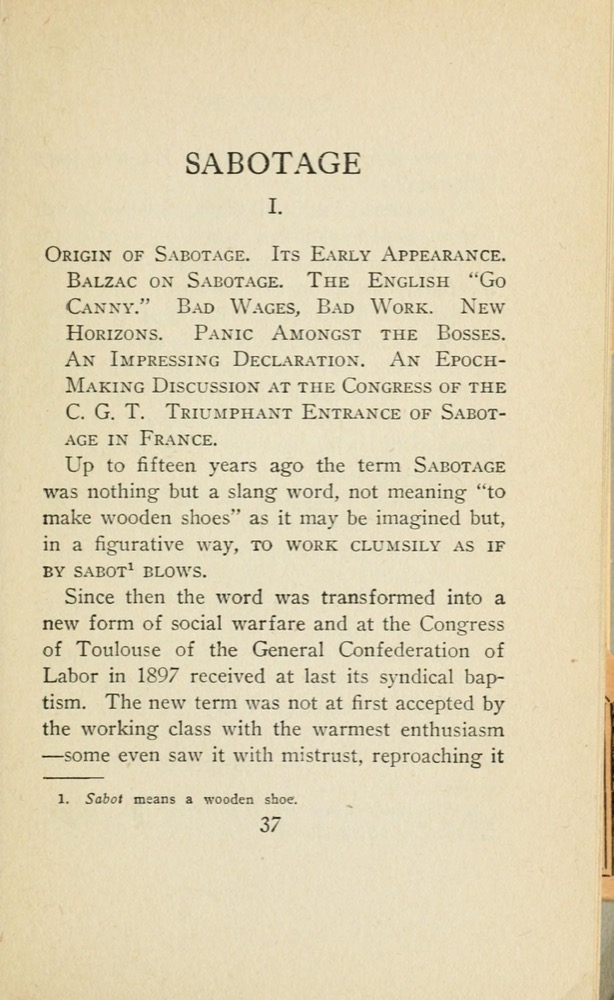
“Up to fifteen years ago the term Sabotage was nothing but a slang word, not meaning ‘to make wooden shoes’ as it may be imagined but, in a figurative way, to work clumsily as if by sabot blows.”
Page 37 of Émile Pouget’s Sabotage, translated from the French by Arturo M. Giovannitti, Chicago: Charles H. Kerr, 1913. A footnote on the page reads “Sabot means a wooden shoe.” See the page at the Internet Archive.1
Meanings
What it means today
- Damage or slowdown by workers against an employer. Merriam-Webster’s first sense is the destruction of an employer’s property, or the hindering of manufacturing, by discontented workers.3Angry workers were responsible for the sabotage of the machines.
- Any act that sets out to hurt someone’s plans. Merriam-Webster’s third sense is an act or process tending to hamper or hurt, which it also words as deliberate subversion.3 Wiktionary has one general sense: a deliberate action aimed at weakening someone or something, or preventing their success, through subversion, obstruction, disruption or destruction.2The lawyer is trying to sabotage the case by creating confusion.
Neither Johnson’s 1755 dictionary nor Webster’s of 1828 has the word.67 That is not odd. Merriam-Webster finds the French sense of damaging an employer’s property only in the early 1900s, and the English noun is first dated 1906 or 1907.34 The verb came a few years after the noun: Etymonline says 1912, Merriam-Webster 1913.34
In sentences
- Officials have not yet ruled out sabotage as a possible cause of the crash.3
The airplane crashed because it was sabotaged.
Merriam-Webster’s example of the verb.3The title we have prefixed seems to mean “scamping work.”
The Liberty Review, January 1907, quoted by Etymonline. The writer is explaining the word to English readers; we haven’t seen the original.4
Words that sit nearby
- saboteur
- Listed next to sabotage in Merriam-Webster’s nearby entries.3
- self-sabotage
- A derived term in Wiktionary, with cybersabotage, ecotage and antisabotage.2
- sabot
- The wooden shoe itself. Merriam-Webster lists it just before sabotage.3
- sabaton
- An armored foot-covering, from mid-14th century English. Etymonline traces it to the same Old French sabot.4
Synonyms
Synonyms and antonyms for sabotage
Synonyms
- For the noun, as in destructiondestruction, wrecking, desecration, vandalism, ruin, ruination, ravage, demolishing, defacement, trashing and more.5
- For the verb, as in to thwartthwart, frustrate, foil, restrain, curb, hinder, baffle, impede, hamper, obstruct, inhibit, set back, hold back, halt and more.5
- For the verb, as in to destroydestroy, ruin, wreck, annihilate, wipe out, harm, damage, smash, demolish, impair, spoil, vandalize, deface and more.5
Antonyms
There is no exact antonym. The Merriam-Webster thesaurus captures we could read list “dissimilar words” for each sense, which are the nearest it offers:
- For the noun, as in destructionprotection, conservation, saving, preservation, salvage.5
- For the verb, as in to thwartaccelerate, hasten, rush, encourage, speed up, help, facilitate, aid, advance, expedite and more.5
- For the verb, as in to destroyprotect, save, preserve, conserve, build, salvage, rebuild.5
The myth
A myth: workers threw their shoes into the machines
Sabotage exists because workers threw their wooden shoes, sabots, into machines to break them.No evidence
- Merriam-Webster’s word-origin note describes the story and then rejects it: some people have thought that industrial workers in France threw their sabots into machinery, but “there is no evidence for such an etymology”.3
- What it finds instead is a word that was already about doing a job badly. French saboter is known in the sense of damaging an employer’s property in the early 1900s, but that meaning is perhaps based on an older one, “to carry out clumsily, botch, bungle”, first recorded in 1808. That in turn is usually explained from an even older sense, to make a clattering noise with sabots.3
- Etymonline says the same: the often-repeated story is “as old as the record of the word in English”, but it is not supported by the etymology. It thinks the shoe was probably not meant as a literal image, since the French word was used for many kinds of bungling, such as playing a piece of music badly.4
- Pouget, the French syndicalist who made the word a program, says the same on page 37, at the top of this article. In the 1913 translation, the word had been slang for working clumsily, as if with the blows of a sabot, and did not mean making wooden shoes.1
- Merriam-Webster is careful about the rest. It says it is hard to know whether the clatter, the botching and the damage are one line of development, or whether “the associations evoked in Frenchmen by this piece of peasant footwear” produced separate coinages from the same noun.3
- Wikipedia retells the shoe story with workers in Liège and cites Etymonline for calling it incorrect.8 The Etymonline page we read does not name Liège, so we leave that detail out.
What the sources do support is smaller and odder. The shoe is in the word, because saboter comes from sabot, but as a sound and a picture of clumsy work, not as a weapon. Wikipedia gives an 1808 French dictionary, d’Hautel’s, with “Saboteur: an insulting nickname for a bad workman, who does everything in haste and sloppily.” That is a translation of its French quote, taken from Wikipedia; we haven’t opened the dictionary.8
Through time
Through time
A word for a bad worker became a strategy, then a wartime tactic, then a word for what you do to your own diet. Drag the line and read what people wrote at the time.
Route to English
How it came to English
- sabotOld French, “wooden shoe”, thirteenth century. Etymonline says it was altered by association with Old French bot, “boot”, from earlier savate, “old shoe”.4
- saboterFrench, “to clatter around wearing sabots, to bungle”.34
- sabotageFrench, first as slang for bungling work, then for deliberate damage to an employer’s property in labor disputes.34
- sabotageEnglish, 1906 or 1907, at first about labor disputes. A Chicago publisher issued Pouget’s book on it in English in 1913.134
Stops mark where the word was in use: Paris for French, Toulouse for the 1897 congress, Chicago for the 1913 book. Nobody documented a single journey, and where the English noun was first printed we do not know.
Dates
How old is the word?
The dictionaries agree on the decade and not on the year, and the oldest date belongs to a different word.
| Source | Gives | What it is dating |
|---|---|---|
| Merriam-Webster3 | 1906 noun, 1913 verb | First known use in English, in the sense of destroying an employer’s property. |
| Etymonline4 | 1907 noun, 1912 verb | English noun, “from 1903 as a French word in English”. The military sense is from World War I. |
| Merriam-Webster, on the French3 | 1808 | Earliest record of French saboter in the sense “to carry out clumsily, botch, bungle”. |
| Pouget1 | 1897 | He says the word was only slang until the congress of Toulouse that year gave it its “syndical baptism”. |
The date we could not check is the first printed English sentence. Etymonline quotes The Liberty Review of January 1907; we have not seen that issue.
Measured
The word, measured
Psychologists have asked thousands of people about tens of thousands of words. Here is where sabotage lands in six of those datasets.
How many people know it
Of 413 people shown it, 99.0% said they knew it, more than for 82% of the 61,855 words tested. Estimates by group: Americans 98.2%, British 99.5%, men 98.3%, women 99.5%.9
When people learn it
The average age adults recall learning it, earlier than about 59% of 31,105 words. The middle word on the list comes at 11.2. These are adults’ estimates, so read them as a rough guide.10
How concrete it feels
People rate it as more of an idea than a thing, more abstract than 53% of 39,954 words. Agreement is low: 30 raters, standard deviation 1.41.11
How it feels emotionally
It leans unpleasant, below 99% of 13,915 words, and raters mostly agree (standard deviation 1.22). It’s more arousing than 85% of those words at 5.15. On dominance it scores 3.64, lower than 93%, meaning people feel less in control.12
Which sense it calls up
Sight comes first, stronger than for 60% of 39,707 words.13
Scale 0 to 5.
Ratings come from panels of roughly 20 to 30 people per word, asked about the word out of context. Percentages are how sabotage ranks among the words in that dataset.
Where does your vocabulary land?
Twelve words, each known by fewer Americans than the last. See your estimate against the same 221,268 people in the study above.9
Measure my vocabularyRelatives
Its relatives, and the languages that took it
- sabot
- English borrowed the French word directly from about 1600, Etymonline says.4
- sabaton
- The armored foot-covering, also from sabot. Etymonline puts it in the 14th century.4
- ciabatta
- Etymonline says the Italian bread name comes from the same source as sabot, perhaps a Persian word, and notes that Italian ciabatta literally means “carpet slipper”.4
The same word in other languages
- sabotageFrench
- SabotageGerman
- sabotajeSpanish
- sabotaggioItalian
- sabotagemPortuguese
- sabotageDutch
- sabotageSwedish
- sabotážCzech
- саботажRussian
- 사보타주Korean
- サボタージュJapanese
These come from Wiktionary’s translation table.2 Russian and others also have a separate word for military sabotage, such as диверсия.2
Test yourself
Three questions from this page
Sources
Where every claim comes from
We read Pouget’s 1913 book, the Wiktionary entry and the data files ourselves, and calculated the numbers on this page from those files. Etymonline and Merriam-Webster block automated readers, so we read their Internet Archive copies. Anything we know only through Etymonline or Wikipedia is marked as such. Checked on 5 November 2026. If something is wrong, write to hello@lexicist.com.
- Pouget, Émile. Sabotage, translated from the French with an introduction by Arturo M. Giovannitti. Chicago: Charles H. Kerr & Company, 1913. Page 37 and publishers’ note. Internet Archive. archive.org
- Wiktionary, “sabotage”, English section. en.wiktionary.org/wiki/sabotage
- Merriam-Webster, “sabotage”, definitions, etymology and word origin. We read the Internet Archive copy; the live site blocks automated access. merriam-webster.com/dictionary/sabotage
- Harper, Douglas. “sabotage” and “sabaton”. Online Etymology Dictionary. We read the Internet Archive copy; the live site blocks automated access. etymonline.com/word/sabotage
- Merriam-Webster Thesaurus, “sabotage”, Related Words and Dissimilar Words. Internet Archive copy. merriam-webster.com/thesaurus/sabotage
- Johnson, Samuel. A Dictionary of the English Language. 1755. No entry for sabotage. johnsonsdictionaryonline.com
- Webster, Noah. An American Dictionary of the English Language. 1828. No entry for sabotage. webstersdictionary1828.com
- Wikipedia, “Sabotage”, Etymology. We read it for the d’Hautel and Pouget references and did not open them. en.wikipedia.org/wiki/Sabotage
- Brysbaert, M., et al. “Word prevalence norms for 62,000 English lemmas”. Behavior Research Methods 51 (2019): 467–479. doi.org/10.3758/s13428-018-1077-9
- Kuperman, V., et al. “Age-of-acquisition ratings for 30,000 English words”. Behavior Research Methods 44 (2012): 978–990. doi.org/10.3758/s13428-012-0210-4
- Brysbaert, M., et al. “Concreteness ratings for 40 thousand generally known English word lemmas”. Behavior Research Methods 46 (2014): 904–911. doi.org/10.3758/s13428-013-0403-5
- Warriner, A. B., et al. “Norms of valence, arousal, and dominance for 13,915 English lemmas”. Behavior Research Methods 45 (2013): 1191–1207. doi.org/10.3758/s13428-012-0314-x
- Lynott, D., et al. “The Lancaster Sensorimotor Norms”. Behavior Research Methods 52 (2020): 1271–1291. doi.org/10.3758/s13428-019-01316-z
- Brysbaert, M., and B. New. “Moving beyond Kučera and Francis”. Behavior Research Methods 41 (2009): 977–990. doi.org/10.3758/BRM.41.4.977
- Google Books Ngram Viewer, English 2019 corpus, 1700–2022, smoothing 3. Open the chart. Method: Michel, J.-B., et al. Science 331 (2011): 176–182. doi.org/10.1126/science.1199644
Image and audio credits
1913 page: Internet Archive scan, public domain. Map: Natural Earth, public domain.