nightmare
noun/ˈnaɪt.mɛɚ/
A frightening dream. Also, any experience that is awful and hard to get out of.
I had the same nightmare again.
Built from night and mare, an old word for a goblin that sat on sleepers and made them feel they could not breathe.24 It was in English by about 1300 as the spirit itself. The meaning moved to the feeling the spirit caused in the mid-16th century, and “any bad dream” is recorded by 1829.2 The mare in it is not the horse.4
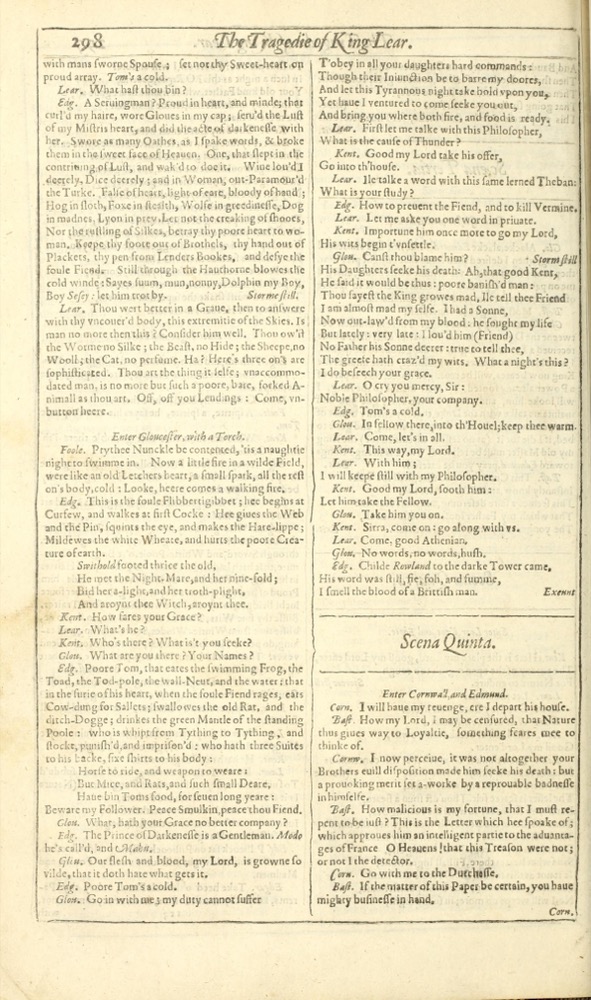
“Swithold footed thrice the old, / He met the Night-Mare, and her nine-fold; / Bid her a-light, and her troth-plight, / And aroynt thee Witch, aroynt thee.”
Page 298 of the Tragedies in the First Folio, Mr. William Shakespeares Comedies, Histories, & Tragedies, London, 1623. Edgar, pretending to be mad, recites a charm in which Saint Withold meets the night-mare and tells her to get off. Spelling is as printed; the page uses the long s, which we write as s. Boston Public Library’s copy, scanned by the Internet Archive. See the book at the Internet Archive.1
Meanings
What it means today
- A terrible experience or situation. Merriam-Webster: something “having the monstrous character of a nightmare or producing a feeling of anxiety or terror”.4 Etymonline dates “very distressing experience” to 1831; Wiktionary dates its figurative sense from the 20th century.23The party was a complete nightmare.
Johnson in 1755 has only the old meaning, and not a dream at all. He defines it as “a morbid oppression in the night, resembling the pressure of weight upon the breast”.6 Webster in 1828 gives incubus, “a sensation in sleep resembling the pressure of a weight on the breast”, and adds that it is usually the effect of indigestion or of a loaded stomach.7
In sentences
- Cleaning up after identity theft can be a nightmare of phone calls and letters.3
The forerunners of an apoplexy are, dulness, drowsiness, vertigoes, tremblings, oppressions in sleep, and night-mares.
John Arbuthnot, quoted under nightmare by Samuel Johnson, 1755. Here the plural means the oppressions themselves.6He met the Night-Mare, and her nine-fold.
Shakespeare, King Lear, First Folio, 1623. See the page at the top of this article.1
Words that sit nearby
- nightmarish
- Merriam-Webster lists it as a derived adjective, with nightmarishly as the adverb.4
- night-mare
- The older spelling in two words. Wiktionary marks it obsolete.3
- incubus
- Webster’s 1828 word for it, “a sensation in sleep resembling the pressure of a weight on the breast”.7 Etymonline uses incubus to define mare.2
- mare
- In English it survives only in nightmare, Etymonline says. The word for a female horse is a different one.24
Synonyms
Synonyms and antonyms for nightmare
Synonyms
- A situation or state that causes great sufferingagony, misery, horror, torture, torment, hell, curse, ordeal, calamity, trial, tribulation, affliction.5
- As an adjective: extremely disturbinghorrific, gruesome, shocking, horrible, terrible, frightening, terrifying, dreadful, awful, hideous, scary.5
Antonyms
The Merriam-Webster thesaurus covers the figurative senses and the adjective, not the dream. It gives no true antonym for either, only near antonyms:5
Through time
Through time
The word has stayed in one piece for seven hundred years, and its meaning has moved three times: from a spirit, to the choking feeling the spirit caused, to the dream. Drag the line and read what people wrote.
Route to English
Where the mare came from
- *mer-A Proto-Indo-European root Etymonline glosses “to rub away, harm” and “to die”. It adds that this is probable, not certain.2
- *maronProto-Germanic, “goblin”.2
- mareOld English, “incubus, nightmare, monster; witch, sorcerer”.2
- nyghtmareMiddle English, “an evil spirit attacking men or horses at night”. Wiktionary builds it from Old English *nihtmare, a form not found in writing.3
- nightmareModern English.
No map here. The word is Germanic and was already English, so it did not travel to England. Its cousins: Middle Dutch nachtmare, German Nachtmahr, Old Norse mara.2 Etymonline also lists Old Irish Morrigain, “queen of the nightmare”, and Slavic mora, Czech mura and Polish zmora.2
Dates
How old is the word?
The dictionaries agree on the century. They disagree about when it became a dream, because each is dating a different meaning.
| Source | Gives | What it is dating |
|---|---|---|
| Etymonline2 | c. 1300 | Nightmare as an evil female spirit. Shift to the feeling: mid-16th century. “Any bad dream”: by 1829. “Very distressing experience”: 1831. |
| Merriam-Webster4 | 14th century | First known use, in sense 1, the spirit. Its note says the feeling of distress was meant by the late 16th century, then frightening dreams. It gives no date for the dream. |
| Wiktionary3 | 19th century and 20th century | Dates the dream sense “from 19th c.” and the figurative sense “from 20th c.”. Etymonline’s 1831 is earlier for the figurative sense. |
| Johnson 17556 | no dream | Only the weight on the breast. |
The date we could not check is the earliest written example itself. The Middle English Dictionary, where the c. 1300 text would be quoted, refused automated access.3 We have not seen the first text.
The myth
A myth: a nightmare is a night horse
The mare in nightmare is a female horse that rides through your sleep.No
- Merriam-Webster says it directly. Most English speakers know mare as a female horse, “but the mare of nightmare is a different word, an obsolete one referring to an evil spirit”.4
- Etymonline treats it as its own entry, mare (n.3): “night-goblin, incubus”, from Old English mare, “incubus, nightmare, monster; witch, sorcerer”, and says it now survives in English only in nightmare.2
- The same word turns up in the cousins of English. Etymonline lists Middle Dutch mare, German Mahr and Old Norse mara, all with the meaning “incubus” or “nightmare”.2
- Shakespeare in 1623 treats it as a being you can speak to: Edgar tells the Night-Mare to alight and plight her troth. Johnson in 1755 gives its origin as a spirit that tormented sleepers.16
- A horse’s head looks in through the curtain in Fuseli’s painting. A picture is not an etymology, and the dictionaries we read do not tie the word to horses.824
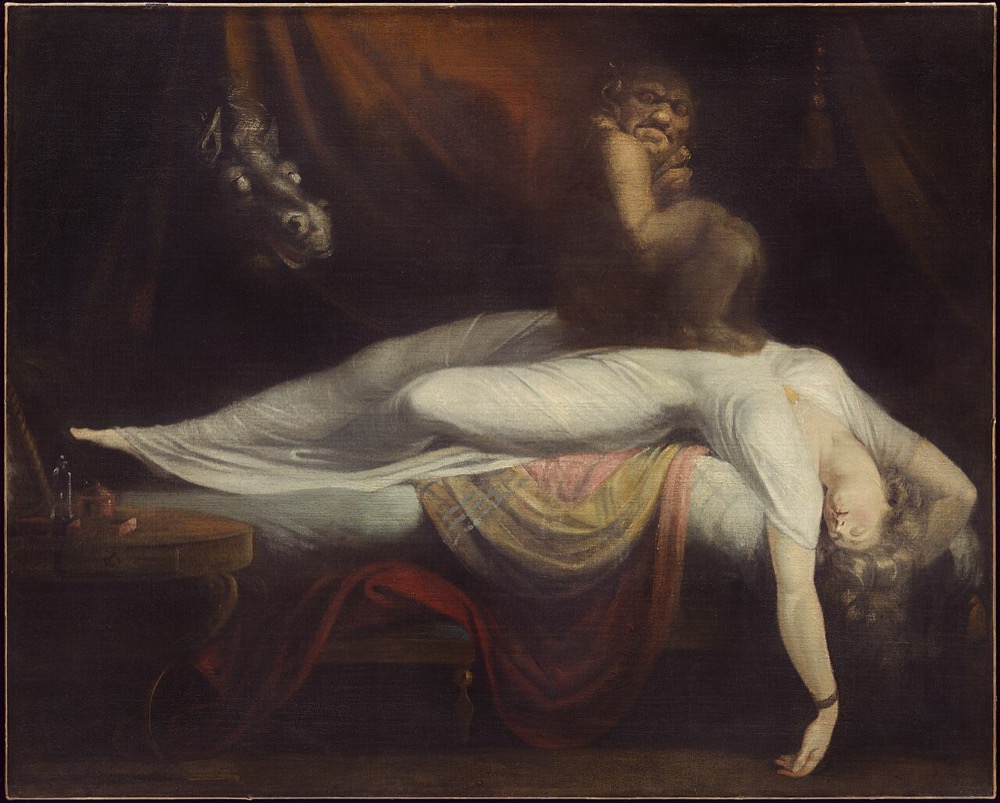
What is left is a real question: why did the spirit get a word that looks like the horse? We found no source that says it is anything but a coincidence of spelling, and we won’t guess. Etymonline compares French cauchemar, whose first part comes from Old French caucher, “to trample”, and whose second part is the same Germanic word.2
Measured
The word, measured
Psychologists have asked thousands of people about tens of thousands of words. Here is where nightmare lands in six of those datasets.
How many people know it
Of 429 people shown it, 99.5% said they knew it, more than for 92% of the 61,855 words tested. Estimates by group: Americans 99.5%, British 97.6%, men 99%, women 99%.9
When people learn it
The average age adults recall learning it, earlier than about 94% of 31,105 words. The middle word on the list comes at 11.2. These are adults’ estimates, so read them as a rough guide.10
How concrete it feels
People rate it as more of an idea than a thing, more abstract than 48% of 39,954 words. Agreement is low: 29 raters, standard deviation 1.23.11
How it feels emotionally
It leans unpleasant, below 100% of 13,915 words, and raters mostly agree (standard deviation 0.92). It’s more arousing than 95% of those words at 5.83. On dominance it scores 3.21, lower than 97%, meaning people feel less in control.12
Which sense it calls up
Inside the body comes first, stronger than for 97% of 39,707 words.13
Scale 0 to 5.
Ratings come from panels of roughly 20 to 30 people per word, asked about the word out of context. Percentages are how nightmare ranks among the words in that dataset.
Where does your vocabulary land?
Twelve words, each known by fewer Americans than the last. See your estimate against the same 221,268 people in the study above.9
Measure my vocabularyRelatives
Its relatives
- night
- From late Old English niht, “the dark part of a day”.2
- mare
- Not the horse. Old English mare, “incubus”, from Proto-Germanic *maron, “goblin”.2
- cauchemar
- French for “nightmare”. First part from caucher, “to trample”, second part from the Germanic mar. Not a descendant of the English word, but a relative of the same Germanic word.2
Cousins in other languages
- NachtmahrGerman
- nachtmerrieDutch
- nichtmareScots
- cauchemarFrench, a relative
Wiktionary names Scots nichtmare and nichtmeer, Dutch nachtmerrie, Middle Low German nachtmār and German Nachtmahr as cognates.3 French cauchemar is Etymonline’s “compare”.2 We did not check which of these are in everyday use.
Test yourself
Three questions from this page
Sources
Where every claim comes from
We read the 1623 page, Johnson, Webster and the data files ourselves, and calculated the numbers on this page from those files. Etymonline and Merriam-Webster block automated readers, so we read their Internet Archive copies. The Middle English Dictionary refused automated access and we did not open it. Material we know only through another writer is marked as such. Checked on 5 November 2026. If something is wrong, write to hello@lexicist.com.
- Mr. William Shakespeares Comedies, Histories, & Tragedies (the First Folio). London: Isaac Jaggard and Ed. Blount, 1623. The Tragedie of King Lear, p. 298. Boston Public Library copy, Internet Archive, public domain. archive.org/details/mrvvilliamshakes00shak
- Harper, Douglas. “nightmare” and “mare (n.3)”, shown inside the same entry. Online Etymology Dictionary. We read the Internet Archive copy of December 2024; the live site blocks automated access. etymonline.com/word/nightmare
- Wiktionary, “nightmare” (English) and “nyghtmare” (Middle English). en.wiktionary.org/wiki/nightmare
- Merriam-Webster, “nightmare”, with its “Did you know?” note. We read the Internet Archive copy of December 2024; the live site blocks automated access. merriam-webster.com/dictionary/nightmare
- Merriam-Webster Thesaurus, “nightmare”, Synonyms, Antonyms and Near Antonyms. Internet Archive copy of December 2024. merriam-webster.com/thesaurus/nightmare
- Johnson, Samuel. A Dictionary of the English Language. 1755. johnsonsdictionaryonline.com
- Webster, Noah. An American Dictionary of the English Language. 1828, entry “Nightmar”. webstersdictionary1828.com
- Füssli, Johann Heinrich. The Nightmare, 1781. Detroit Institute of Arts. Image: Wikimedia Commons, public domain. commons.wikimedia.org; museum page dia.org
- Brysbaert, M., et al. “Word prevalence norms for 62,000 English lemmas”. Behavior Research Methods 51 (2019): 467–479. doi.org/10.3758/s13428-018-1077-9
- Kuperman, V., et al. “Age-of-acquisition ratings for 30,000 English words”. Behavior Research Methods 44 (2012): 978–990. doi.org/10.3758/s13428-012-0210-4
- Brysbaert, M., et al. “Concreteness ratings for 40 thousand generally known English word lemmas”. Behavior Research Methods 46 (2014): 904–911. doi.org/10.3758/s13428-013-0403-5
- Warriner, A. B., et al. “Norms of valence, arousal, and dominance for 13,915 English lemmas”. Behavior Research Methods 45 (2013): 1191–1207. doi.org/10.3758/s13428-012-0314-x
- Lynott, D., et al. “The Lancaster Sensorimotor Norms”. Behavior Research Methods 52 (2020): 1271–1291. doi.org/10.3758/s13428-019-01316-z
- Brysbaert, M., and B. New. “Moving beyond Kučera and Francis”. Behavior Research Methods 41 (2009): 977–990. doi.org/10.3758/BRM.41.4.977
- Google Books Ngram Viewer, English 2019 corpus, 1700–2022, smoothing 3. Open the chart. Method: Michel, J.-B., et al. Science 331 (2011): 176–182. doi.org/10.1126/science.1199644

Image and audio credits
1623 page: Boston Public Library, via the Internet Archive. Public domain. The Nightmare: Detroit Institute of Arts, via Wikimedia Commons. Public domain. Recording: Neskaya (US), CC BY-SA 3.0, via Wikimedia Commons.