lunatic
nounadjectivelu·na·tic/ˈluːnətɪk/
A person who behaves in a wildly foolish or reckless way. In older use, someone thought to be mad, with the moon blamed for it.
He drives like a lunatic.
From Late Latin lunaticus, “moonstruck”, built on Latin luna, “moon”.23 It came through Old French lunatique and was in English by the late 13th century as an adjective for madness that comes and goes with the moon.2 The belief behind it has not held up under study.89
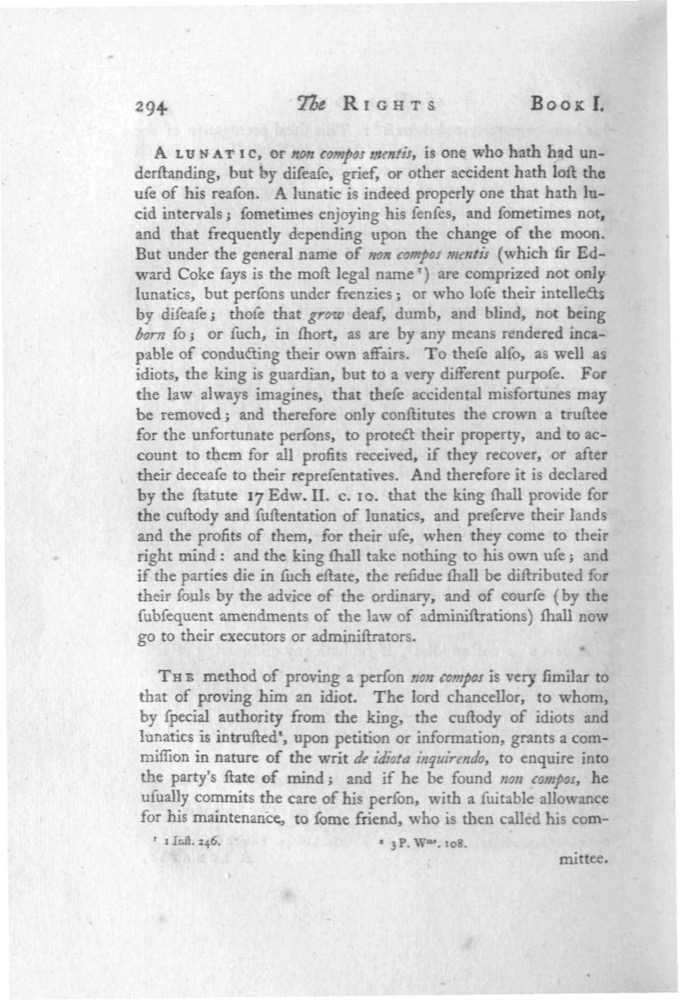
“A lunatic is indeed properly one that hath lucid intervals; sometimes enjoying his senses, and sometimes not, and that frequently depending upon the change of the moon.”
Page 294 of William Blackstone, Commentaries on the Laws of England, volume 1, Oxford: Clarendon Press, dated 1765 in the Archive’s record. The page uses the long s, which we write as s. Scan: Internet Archive, public domain. See the page at the Internet Archive.1
Meanings
What it means today
- A person who behaves in a wildly foolish, reckless or uncontrolled way. Merriam-Webster marks this informal. As an adjective it means wildly foolish: a lunatic idea, lunatic behavior.3He drives like a lunatic.
- Someone with a severely disordered mind. Dated, and now offensive. This was the main sense for centuries. Merriam-Webster labels it dated and now offensive, as it does the adjective use for a person ill in mind and for a lunatic asylum.3…who think you a criminal or a lunatic unless you carefully plod along. (Hilaire Belloc, as quoted by Wiktionary)
- Of the moon. Literary and rare. Wiktionary records an adjective sense “relating to the Moon” and another, “influenced or affected by the Moon”.5This I remember: she was false as the lunatic sea. (David Slavitt, 1956, as quoted by Wiktionary)
Older dictionaries kept the moon in the definition. Johnson’s 1755 dictionary gives the adjective as “mad; having the imagination influenced by the moon” and the noun as “a madman”. For lunacy he writes “a kind of madness influenced by the moon; madness in general”.6 Webster in 1828 hedges: “affected by a species of madness, supposed to be influenced by the moon”, and the noun “supposed to be influenced or produced by the moon, or by its position in its orbit; a madman”.7
In sentences
The lunatick, the lover, and the poet, are of imagination all compact.
Shakespeare, A Midsummer Night’s Dream, quoted under lunatick by Samuel Johnson, 1755.6The residue of the yearly profits shall be laid out in purchasing a piece of land, and in building thereon an hospital for the reception of idiots and lunaticks.
Jonathan Swift, quoted by Johnson, 1755.6See the blind beggar dance, the cripple sing, the sot a hero, lunatick a king.
Alexander Pope, quoted by Johnson, 1755.6
Words that sit nearby
- lunacy
- Johnson’s 1755 entry has it as madness “influenced by the moon”.6 Wiktionary lists it as a derived term.5
- lunatic fringe
- Etymonline says it was popularized and apparently coined by Theodore Roosevelt, in his 1913 autobiography.2
- lunatic soup
- Slang from 1918 for alcoholic drink.2
- moonstruck
- On the Merriam-Webster thesaurus list.4 Old English had monseoc, literally “moon-sick”.2
- de lunatico inquirendo
- Listed as a related term in Wiktionary.5 Blackstone names the matching writ for idiots, de idiota inquirendo, on the same page as his lunatics.1
Synonyms
Synonyms and antonyms for lunatic
Synonyms
- For someone ill in mind (dated)madman, maniac, madwoman.4 Wiktionary adds moonling.5 Johnson’s word was madman.6
- For a reckless foolfool, simpleton, daredevil, madman, dolt. The thesaurus files this sense under fool.4
- As an adjective, ill in mind (dated)mad, insane, crazed, demented, moonstruck.45
- As an adjective, wildly foolishfoolish, silly, absurd, irrational, ridiculous, harebrained, preposterous. The thesaurus files this sense under stupid.4
Antonyms
English has no exact antonym for lunatic. For the adjective the Merriam-Webster thesaurus lists sane first, and for the noun it lists only near antonyms.4
Through time
Through time
The moon sits inside the word, and every century has had to decide whether to believe it. Drag the line and read what people wrote.
The Bible gave it a second life
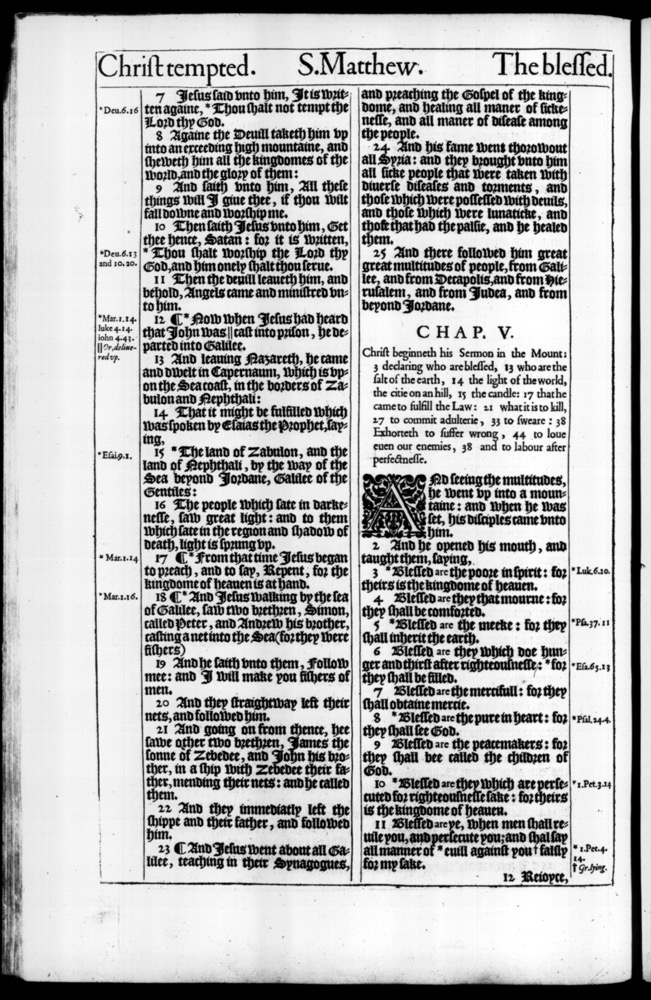
The English Bible carried the word to every reader. In Matthew 4:24 the list of the sick includes “those which were lunaticke”, and in the Greek the verb behind it is built on the word for the moon.32 Merriam-Webster glosses that verb as “to suffer from seizures”, and Etymonline as “be epileptic”.32 The word ends a line in the right-hand column, near the top of the page.
Route to English
How it traveled from Rome to England
- lunaLatin, “moon, goddess of the moon”, from a Proto-Indo-European root for light and brightness.2
- lūnāticusLate Latin, “moonstruck”. Merriam-Webster says it is unattested in classical Latin apart from the legal treatises of Julius Paulus, 2nd to 3rd century AD.3
- lunatiqueOld French, “insane”.2
- lunatikMiddle English, late 13th century as an adjective.25
- lunaticModern English.5
Stops mark where each language was used. Nobody documented a single journey, and the line is a picture of the word’s family tree. Merriam-Webster adds that the Latin form was perhaps modeled on fānāticus, “inspired by orgiastic rites”, and compares the Greek New Testament verb selēniázesthai.3 We could not open the Middle English Dictionary, which sits behind a bot check.
Dates
Why dates differ
The two dictionaries we could read are a few decades apart. We can see the gap, and we cannot see the reason for it.
| Source | Gives | What it is dating |
|---|---|---|
| Etymonline2 | late 13c. (adjective), late 14c. (noun) | The adjective, “affected with periodic insanity dependent on the changes of the moon”. The noun, “lunatic person”, comes about a century later. |
| Merriam-Webster3 | 14th century (both) | First known use of the noun and of the adjective, in their first senses. |
| Wiktionary5 | no date | Its Middle English entries quote Langland, about 1378, for the noun, and a Wycliffe New Testament manuscript for the adjective. |
A gap like “late 13th century” against “14th century” can come from dating the same early sentence differently, or from the two dictionaries having found different sentences. The first written examples are not printed on the pages we read, and the Middle English Dictionary would show them.
The myth
A myth: the moon drives people mad
The changing moon brings on bouts of madness, which is why the word is lunatic.No effect found
- The belief is in the word itself. Etymonline lists Old English monseoc, “moon-sick”, and the Greek verb of the New Testament built on selēnē, “moon”.2 Merriam-Webster describes the Late Latin lunaticus as suffering from a disorder “allegedly affected by the phases of the moon”.3
- In 1765 Blackstone put it in a law book as a fact about how lunatics behave.1 By 1828 Webster only says “supposed”.7
- Researchers tested it. By the late 1980s there were at least 40 published studies of the supposed link between the moon and lunacy, and Wikipedia reports that reviews and meta-analyses of them find no correlation between the lunar cycle and human behavior.8 The best known is Rotton and Kelly’s 1985 meta-analysis.9
- Wikipedia also suggests why the belief lasts: it says the belief “may depend on” illusory correlation, which means seeing a link that is not there.8
We have read the dictionaries, the law book and the PubMed record. We have not read the studies themselves, and the Wikipedia summary is as good as that source gets. So the verdict is the one Wikipedia gives: the research does not find the effect.
Measured
The word, measured
Psychologists have asked thousands of people about tens of thousands of words. Here is where lunatic lands in six of those datasets.
How many people know it
Of 416 people shown it, 99.3% said they knew it, more than for 86% of the 61,855 words tested. Estimates by group: Americans 98.5%, British 99.5%, men 99%, women 99.1%.12
When people learn it
The average age adults recall learning it, earlier than about 66% of 31,105 words. The middle word on the list comes at 11.2. These are adults’ estimates, so read them as a rough guide.13
How concrete it feels
People rate it as something you can experience directly, more so than 60% of 39,954 words. Agreement is low: 30 raters, standard deviation 1.48.14
How it feels emotionally
It leans unpleasant, below 87% of 13,915 words, but raters split widely (standard deviation 2.22). It’s more arousing than 92% of those words at 5.64. On dominance it scores 3.29, lower than 97%, meaning people feel less in control.15
Which sense it calls up
Sight comes first, stronger than for 86% of 39,707 words, and hearing is close behind at 90%.16
Scale 0 to 5.
Ratings come from panels of roughly 20 to 30 people per word, asked about the word out of context. Percentages are how lunatic ranks among the words in that dataset.
Where does your vocabulary land?
Twelve words, each known by fewer Americans than the last. See your estimate against the same 221,268 people in the study above.12
Measure my vocabularyRelatives
Its relatives, and the same word elsewhere
- luna
- Latin, “moon”. The English noun dates from the late 14th century, “the moon”, especially as a Roman goddess, and it was also an alchemical name for silver. The luna moth, from 1841, is named for the crescent-shaped eye-spots on its wings.2
- moonstruck
- On the thesaurus list.4 In Old English the same idea was monseoc, “moon-sick”.2
- Laune
- German for “mood”. Etymonline compares Middle High German lune, “humor, temper, mood, whim”, which comes from Latin luna.2
The same word in other languages
- lunaticusLatin
- lunatiqueFrench
- lunáticoPortuguese
- llunàticCatalan
- lunaticOccitan
- lunatikoEsperanto
Wiktionary’s translation list gives other words for the noun in most languages: Spanish insano and orate, German Irre, Italian demente, Dutch gek, Turkish deli.5
Test yourself
Three questions from this page
Sources
Where every claim comes from
We read the 1765 page, the 1611 page, Johnson, Webster, the Middle English line in Langland and the data files ourselves, and calculated the numbers on this page from those files. Etymonline and Merriam-Webster block automated readers, so we read their Internet Archive copies. Material we know only through Wikipedia is marked as such. Checked on 5 November 2026. If something is wrong, write to hello@lexicist.com.
- Blackstone, William. Commentaries on the Laws of England, vol. 1. Oxford: Clarendon Press, 1765. Book 1, ch. 8, p. 294. Scan on the Internet Archive; text of the chapter at the Avalon Project, Yale. archive.org · avalon.law.yale.edu
- Harper, Douglas. “lunatic”. Online Etymology Dictionary. We read the Internet Archive copy of 30 December 2024; the live site blocks automated access. The entries for luna and insane are shown on the same page. etymonline.com/word/lunatic
- Merriam-Webster, “lunatic”, with its etymology. We read the Internet Archive copy; the live site blocks automated access. merriam-webster.com/dictionary/lunatic
- Merriam-Webster Thesaurus, “lunatic”, Synonyms, Antonyms and Near Antonyms. Internet Archive copy. merriam-webster.com/thesaurus/lunatic
- Wiktionary, “lunatic”, English section, and “lunatik”, Middle English section. en.wiktionary.org/wiki/lunatic
- Johnson, Samuel. A Dictionary of the English Language. 1755. Entries lunatick (adjective and noun) and lunacy. johnsonsdictionaryonline.com
- Webster, Noah. An American Dictionary of the English Language. 1828. webstersdictionary1828.com
- Wikipedia, “Lunar effect”. en.wikipedia.org/wiki/Lunar_effect
- Rotton, James, and I. W. Kelly. “Much ado about the full moon: a meta-analysis of lunar-lunacy research.” Psychological Bulletin 97(2), 1985: 286–306. We confirmed the record at PubMed; no abstract is on file there. pubmed.ncbi.nlm.nih.gov/3885282
- The Holy Bible, conteyning the Old Testament and the New. London: Robert Barker, 1611, Matthew 4, as digitized in the Early English Books collection. Internet Archive, item bim_early-english-books-1475-1640_the-holy-bible-conteyni_bible-english_1611_0, scan page 1233. We read the page image and the Archive’s text search. archive.org
- Langland, William. The Vision of William concerning Piers the Plowman, ed. W. W. Skeat. London: Early English Text Society, 1869. Internet Archive, item visionofwilliamc02lang; we read the line “loked vp a lunatik” in its text search. archive.org
- Brysbaert, M., et al. “Word prevalence norms for 62,000 English lemmas”. Behavior Research Methods 51 (2019): 467–479. doi.org/10.3758/s13428-018-1077-9
- Kuperman, V., et al. “Age-of-acquisition ratings for 30,000 English words”. Behavior Research Methods 44 (2012): 978–990. doi.org/10.3758/s13428-012-0210-4
- Brysbaert, M., et al. “Concreteness ratings for 40 thousand generally known English word lemmas”. Behavior Research Methods 46 (2014): 904–911. doi.org/10.3758/s13428-013-0403-5
- Warriner, A. B., et al. “Norms of valence, arousal, and dominance for 13,915 English lemmas”. Behavior Research Methods 45 (2013): 1191–1207. doi.org/10.3758/s13428-012-0314-x
- Lynott, D., et al. “The Lancaster Sensorimotor Norms”. Behavior Research Methods 52 (2020): 1271–1291. doi.org/10.3758/s13428-019-01316-z
- Brysbaert, M., and B. New. “Moving beyond Kučera and Francis”. Behavior Research Methods 41 (2009): 977–990. doi.org/10.3758/BRM.41.4.977
- Google Books Ngram Viewer, English 2019 corpus, 1700–2022, smoothing 3. Open the chart. Method: Michel, J.-B., et al. Science 331 (2011): 176–182. doi.org/10.1126/science.1199644
Image and audio credits
1765 page and 1611 page: Internet Archive; the books are public domain. Recording: Vealhurl (UK), CC BY-SA 4.0, via Wikimedia Commons. Map: Natural Earth, public domain.