vaccine
nounvac·cine/vækˈsin/
A preparation given, usually by injection, to train the body’s immune system against a particular disease.
The vaccine takes two weeks to work.
From Latin vaccīnus, “of or from a cow”, built on vacca, “cow”.35 It began as an adjective for cowpox, the mild disease whose matter Edward Jenner used against smallpox.25 Vaccine as a noun for matter used in vaccination is dated 1846, and the broad sense of any immunizing preparation came later, with Pasteur.34
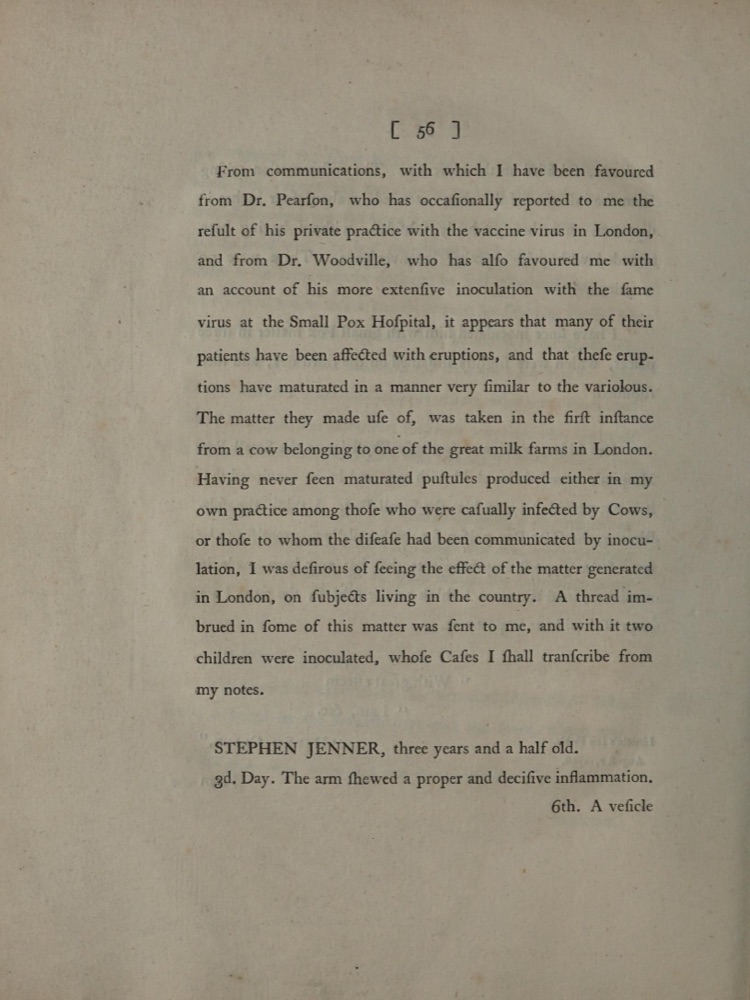
“…the refult of his private practice with the vaccine virus in London…”
Page 56 of Edward Jenner, Further Observations on the Variolae Vaccinae, or Cow Pox, London, 1799. The page prints the long s, which looks like an f. It is Jenner’s own sentence, about the work of Dr. Pearson. See the page at the Internet Archive, from the Wellcome Collection copy.1
Meanings
What it means today
- A preparation that trains the immune system against a disease. Merriam-Webster defines it as a preparation, given for example by injection, that stimulates the body’s immune response against a specific infectious agent. It can be a weakened or killed germ, a piece of one, or genetic material that makes a cell produce a harmless fragment.4The vaccine takes two weeks to work.
- Figurative: something protective. Wiktionary also lists antivirus software under this word.5
The word had a narrower job in 1828. Webster defines only an adjective: “Pertaining to cows; originating with or derived from cows; as the vaccine disease or cow-pox.”9 Johnson’s 1755 dictionary has no entry, which is no surprise, because Jenner’s work came more than 40 years later.8
In sentences
- Merriam-Webster’s examples are a trivalent influenza vaccine and an oral polio vaccine.4
From communications, with which I have been favoured from Dr. Pearson, who has occasionally reported to me the result of his private practice with the vaccine virus in London…
Edward Jenner, 1799, page 56, with the long s written as s.1
Words that sit nearby
- vaccination
- The act of giving one. Etymonline dates it to 1800 and says Jenner used the term for the technique he published.3
- variolation
- The older 18th-century method, using matter from real smallpox. Etymonline names it as the rival that Jenner’s cowpox method replaced.3
- inoculation
- The word Jenner’s 1800 book uses for the act. Wiktionary lists it as a meaning of vaccination.57
- antivaccine, antivax
- Listed by Wiktionary among the terms built on vaccine.5
- vaccine hesitancy
- A phrase Merriam-Webster lists with vaccine.4
Synonyms
Synonyms and antonyms for vaccine
Synonyms
We could not open a thesaurus entry for vaccine. The Internet Archive holds only an error page for Merriam-Webster’s. Wiktionary’s “see also” for the noun lists the informal jab and shot, which name the injection more than the substance.5 For the archaic verb to vaccine it gives vaccinate, immunize and inoculate.5
Antonyms
English has no exact antonym for vaccine. Anti-vaccine describes people who oppose it, which is a position and not an opposite thing.5
Through time
Through time
For its first half century the word was a label for a cow disease, written in Latin. Drag the line and read what was printed as it moved into English and then out of the cowshed.
Route to English
How it went from a Roman cowshed to Gloucestershire
- vaccaLatin, “cow”. Etymonline calls its origin uncertain, and Merriam-Webster says it is perhaps akin to Sanskrit vaśā, “cow”.34
- vaccīnusLatin adjective, “of or from a cow”.35
- variolae vaccinaeNew Latin, literally “infectious diseases of cattle causing pustules”, Jenner’s name for cowpox.25
- vaccineEnglish adjective “of cowpox”, in Jenner’s pages by 1799.14
- vaccin, vaccineThe noun, helped by French vaccin, “cowpox material used for vaccination”.45
The map shows only the first step, from Latin to the English countryside where Jenner worked. The French noun came back across the Channel, so a single line would be wrong. Merriam-Webster itself says the noun is “borrowed from New Latin or English” and, in part, from French.4
Dates
How old is the word?
Here the dictionaries disagree by more than eighty years. They are dating three different things: the adjective, the noun for cowpox matter, and the broad sense of any immunizing preparation.
| Source | Gives | What it is dating |
|---|---|---|
| Etymonline3 | 1798 | The adjective, “pertaining to cows, from cows”. |
| Etymonline3 | 1846 | The noun, “matter used in vaccination”, from French vaccin. |
| Merriam-Webster4 | 1880 | First known use, in the sense of a preparation that stimulates immunity. Its etymology note says an earlier noun meant cowpox fluid. |
| Wiktionary5 | no date | Sets out two etymologies: the adjective from Latin, and the noun partly from that adjective and partly from French. |
What we saw ourselves is Jenner writing vaccine virus in 1799, a year after the first date above and long before the second.1 We have not seen the 1846 text or the 1880 text, so those two dates rest on the dictionaries alone.
The myth
A myth: Jenner was first to use cowpox
Edward Jenner was the first person to protect someone from smallpox with cowpox.Not the first
- In 1774 a Dorset farmer, Benjamin Jesty, deliberately gave cowpox to his wife and two sons at Yetminster, during a smallpox outbreak. That is 22 years before Jenner’s boy.6
- Jenner’s date is clear from his own book. The matter was inserted on 14 May 1796, and the boy’s later smallpox inoculation on 1 July caused no disease.2
- What Jenner added is the published test and the name. He wrote the case up, tried to infect the boy with smallpox, and put a Latin label on the disease. The word vaccine comes from that label.23
- The method he replaced was variolation, which gave people matter from real smallpox. Etymonline says doctors gave healthy young patients a local dose of the minor form of smallpox, usually a mild case, and that Jenner’s method involved no smallpox exposure.3
Our source for Jesty is Wikipedia, which in turn cites a 2003 Lancet paper and a historian’s monograph. We have opened neither of those, so treat the story as likely and not yet checked against its sources.
Measured
The word, measured
Psychologists have asked thousands of people about tens of thousands of words. Here is where vaccine lands in six of those datasets.
How many people know it
Of 419 people shown it, 99.3% said they knew it, more than for 86% of the 61,855 words tested. Estimates by group: Americans 99.2%, British 97.8%, men 99%, women 99.1%.12
When people learn it
The average age adults recall learning it, earlier than about 82% of 31,105 words. The middle word on the list comes at 11.2. These are adults’ estimates, so read them as a rough guide.13
How concrete it feels
People rate it as something you can experience directly, more so than 91% of 39,954 words. Agreement is high: 26 raters, standard deviation 0.68.14
How it feels emotionally
It leans pleasant, above 87% of 13,915 words, but raters split widely (standard deviation 2.14). It’s more arousing than 99% of those words at 6.45. On dominance it scores 5.00, lower than 62%, meaning people feel less in control.15
Which sense it calls up
Sight comes first, stronger than for 30% of 39,707 words.16
Scale 0 to 5.
Ratings come from panels of roughly 20 to 30 people per word, asked about the word out of context. Percentages are how vaccine ranks among the words in that dataset.
Where does your vocabulary land?
Twelve words, each known by fewer Americans than the last. See your estimate against the same 221,268 people in the study above.12
Measure my vocabularyRelatives
Its relatives, and the words that share a cow
- vaccination
- From the adjective vaccine, with the same Latin root. Etymonline dates it to 1800.3
- variolae vaccinae
- Jenner’s New Latin name for cowpox, literally infectious diseases of cattle causing pustules.5
- vacca
- The Latin cow, and the first part of the word.35
The same word in other languages
- vaccinFrench
- vacunaSpanish
- vaccinoItalian
- vacinaPortuguese
- vacunaCatalan
- vaccinDutch
- vaccinSwedish
- vaccinRomanian
- вакцинаRussian
- vakcínaCzech
- ワクチンJapanese
- 백신Korean
Others say it another way: German Impfstoff, Polish szczepionka, Turkish aşı and Greek εμβόλιο.5
Test yourself
Three questions from this page
Sources
Where every claim comes from
We read the 1799 page, Jenner’s 1798 and 1800 texts, Johnson, Webster and the data files ourselves, and calculated the numbers on this page from those files. Etymonline and Merriam-Webster block automated readers, so we read their Internet Archive copies. Material we only know through Wikipedia or a dictionary is marked as such. Checked on 5 November 2026. If something is wrong, write to hello@lexicist.com.
- Jenner, Edward. Further Observations on the Variolae Vaccinae, or Cow Pox. London: Sampson Low, 1799, p. 56. Wellcome Collection copy at the Internet Archive, public domain mark. archive.org/details/b33519390_0001
- Jenner, Edward. An Inquiry into the Causes and Effects of the Variolae Vaccinae. London: Sampson Low, 1798. Internet Archive scan text. archive.org
- Harper, Douglas. “vaccine” and “vaccination”. Online Etymology Dictionary. We read the Internet Archive copy of 2024; the live site blocks automated access. etymonline.com/word/vaccine
- Merriam-Webster, “vaccine”. We read the Internet Archive copy; the live site blocks automated access. merriam-webster.com/dictionary/vaccine
- Wiktionary, “vaccine”, English and translation sections. en.wiktionary.org/wiki/vaccine
- Wikipedia, “Benjamin Jesty”. It cites Pead, The Lancet 362 (2003), 2104–09, which we have not opened. en.wikipedia.org/wiki/Benjamin_Jesty
- Wiktionary, “vaccine”, noun sense 2, “the process of vaccination; immunization, inoculation”. en.wiktionary.org
- Johnson, Samuel. A Dictionary of the English Language. 1755. No entry for vaccine. johnsonsdictionaryonline.com
- Webster, Noah. An American Dictionary of the English Language. 1828. webstersdictionary1828.com
- Jenner, Edward. A Continuation of Facts and Observations relative to the Variolae Vaccinae, or Cow Pox. London: Sampson Low, 1800. Internet Archive scan text. archive.org/details/b2201343x_0004
- Pasteur, Louis. “An Address on Vaccination in Relation to Chicken Cholera and Splenic Fever.” British Medical Journal, 1881. Listed in Europe PMC (PMC2264103). The scanned PDF would not open for us. europepmc.org
- Brysbaert, M., et al. “Word prevalence norms for 62,000 English lemmas”. Behavior Research Methods 51 (2019): 467–479. doi.org/10.3758/s13428-018-1077-9
- Kuperman, V., et al. “Age-of-acquisition ratings for 30,000 English words”. Behavior Research Methods 44 (2012): 978–990. doi.org/10.3758/s13428-012-0210-4
- Brysbaert, M., et al. “Concreteness ratings for 40 thousand generally known English word lemmas”. Behavior Research Methods 46 (2014): 904–911. doi.org/10.3758/s13428-013-0403-5
- Warriner, A. B., et al. “Norms of valence, arousal, and dominance for 13,915 English lemmas”. Behavior Research Methods 45 (2013): 1191–1207. doi.org/10.3758/s13428-012-0314-x
- Lynott, D., et al. “The Lancaster Sensorimotor Norms”. Behavior Research Methods 52 (2020): 1271–1291. doi.org/10.3758/s13428-019-01316-z
- Brysbaert, M., and B. New. “Moving beyond Kučera and Francis”. Behavior Research Methods 41 (2009): 977–990. doi.org/10.3758/BRM.41.4.977
- Google Books Ngram Viewer, English 2019 corpus, 1700–2022, smoothing 3. Open the chart. Method: Michel, J.-B., et al. Science 331 (2011): 176–182. doi.org/10.1126/science.1199644
Image and audio credits
1799 page: Wellcome Collection via the Internet Archive, public domain mark. Recording: DroEsperanto (US), Public domain, via Wikimedia Commons. Map: Natural Earth, public domain.