quarantine
nounquar·an·tine/ˈkwɔɹ.ənˌtin/
A period of enforced isolation, for people, animals or goods, to stop a disease from spreading.
The ship stayed in quarantine.
From French quarantaine and Italian quarantena, both built on the word for “forty”, which comes from Latin quadrāgintā.56 In English it first meant a widow’s forty days in her husband’s house, in the 1520s.46 The ship sense follows in the 1600s.45
Meanings
What it means today
- Enforced isolation to stop a disease or pest from spreading. Merriam-Webster’s sense is a restraint on the activity or communication of people, or on the movement of goods, designed to prevent the spread of disease or pests. It also lists the place where such people are kept, and a state of enforced isolation in general.5The ship stayed in quarantine.
- A blockade or a cut in relations. Wiktionary lists a figurative political sense, “a blockade of trade, suspension of diplomatic relations”, and says it was popularized by the Roosevelt administration’s approach to the Axis powers in 1937, and again in 1962 over Cuba.6
Dictionaries have always had to say what the forty days are for. Johnson’s 1755 entry begins The space of forty days, being the time which a ship, suspected of infection, is obliged to forbear intercourse or commerce.
8 Webster in 1828 gives the forty days first, and then admits that officers set the term as they see fit: Hence we hear of a quarantine of five days, of ten, of thirty, etc. as well as of forty.
9
In sentences
Pass your quarantine among some of the churches round this town, where you may learn to speak before you venture to expose your parts in a city congregation.
Jonathan Swift, quoted by Samuel Johnson, 1755.8Our Gallyes which were upon the point of finishing their Quarantaine, and entering into this Port, have been hindred from it by th’arrival of three others that were out a roaming.
From Toulon, Moderate Intelligencer, no. 236, 1649, quoted by Wiktionary.6What I wish to put under Quarantine are family events…
Lord Byron, letter of 27 November 1816, quoted by Wiktionary. It is a figurative use.6
Words that sit nearby
- lazaretto
- A building set apart for quarantine. Etymonline says it comes from Italian lazareto and the Biblical name Lazarus.4
- isolation
- Merriam-Webster’s first synonym for the noun. Medical isolation is different: it separates people already known to be sick, and quarantine separates people who might be.710
- lockdown
- Wiktionary’s synonym for the “stay at home” sense.6
- quarantine ground, quarantine station
- Two compounds Wiktionary lists.6
Synonyms
Synonyms and antonyms for quarantine
Synonyms
- For the noun, isolationisolation, segregation, containment, seclusion, confinement, sequestration, insulation, internment. The thesaurus also lists blockade and siege, which share only the idea of cutting someone off.7
- For the verb, to confineconfine, isolate, separate, segregate, detain, sequester, cut off, keep.7
- For the stay-at-home senselockdown, stay-at-home order.6
Antonyms
English has no exact antonym for the noun, and the thesaurus lists none for it. For the verb, Merriam-Webster’s thesaurus gives these antonyms and near antonyms.7
- For the verbrelease, discharge, free, liberate, loose for letting someone out. Join, connect, link, unite, associate, assimilate, integrate and reintegrate for bringing them back among others.7
Through time
Through time
The word spent its first English century on a widow’s forty days, not on plague. Drag the line and read the rule, the word and the arguments about it in the order they appeared.
Route to English
How it traveled from Italy to England
- quadrāgintāLatin, “forty”, literally “four tens”.56
- quarantaItalian, “forty”. Wiktionary proposes a Late Latin *quaranta between the two.46
- quarentena, quarantinaMedieval Latin quarentena, “40-day period, Lent”, and Italian quarantina.6
- quarantaineFrench, from Old French quarante. Wiktionary also gives Norman quarenteine.56
- quarentineMiddle English. Etymonline has quarentyne in the 15th century for the desert where Christ fasted for forty days.4
- quarantineModern English: the widow’s forty days in the 1520s, the ship’s isolation in the 1600s.45
Stops mark where each language was used, and the line is a picture of the word’s family tree. Merriam-Webster says the English noun is partly from French and partly from Italian, so no single path is right.5 The Late Latin *quaranta is Wiktionary’s proposal, marked with an asterisk because no text shows it.6
Dates
How old is the word?
The sources give five different dates, and almost every one of them is right, because they date different things: a rule, a word and several senses.
| Source | Gives | What it is dating |
|---|---|---|
| Gensini 20042 | 1377 | The practice. The Ragusan thirty-day trentina, which is not yet the word. |
| Etymonline4 | 1520s | The English word, for a widow’s forty days. The 15th-century quarentyne is the Lent desert. |
| Merriam-Webster5 | 1617 | First known use, in the sense of a period of forty days. |
| Wiktionary6 | 1649 | Its earliest ship quotation, in the Moderate Intelligencer. |
| Etymonline4 | 1660s | The ship sense, “period a ship suspected of carrying contagious disease is kept in isolation”. |
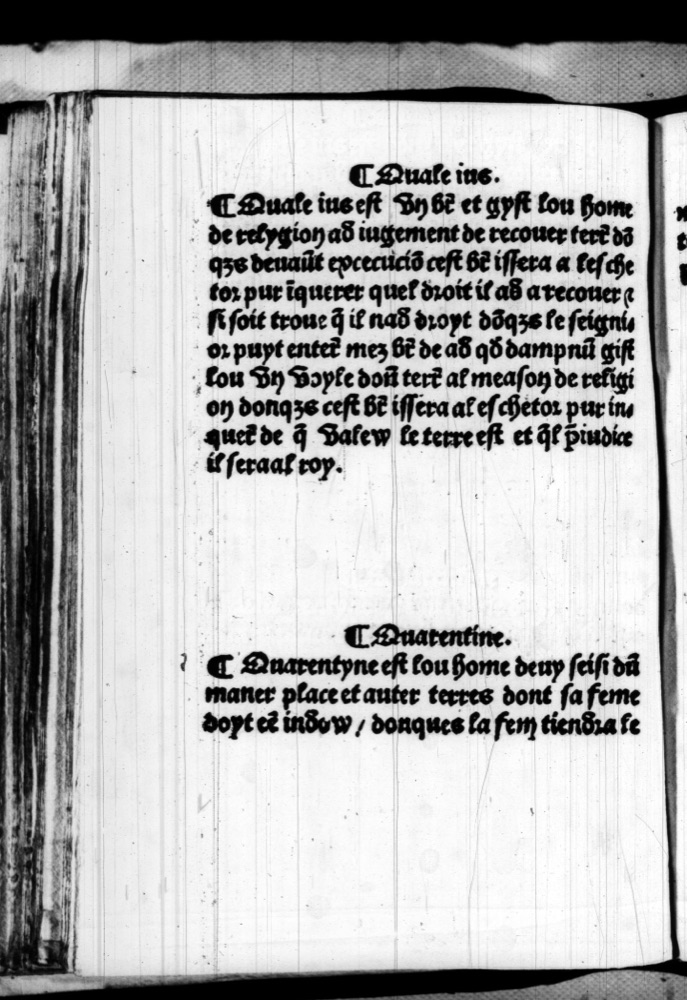
The oldest printed use of the word we could read ourselves is the black-letter page above, which dates the 1527 edition.1 Neither dictionary prints its first example on the page we read, so we did not see the earliest sentence behind 1617 or 1660s.
The myth
A myth: quarantine began in Venice with forty days
Quarantine was a Venetian rule of forty days from the start.It began at thirty
- Etymonline says the name is from
the Venetian policy (first enforced in 1377) of keeping ships from plague-stricken countries waiting off its port for 40 days
.4 - Two papers date the first rule to 1377 too, but put it in Ragusa, now Dubrovnik, and make it thirty days. The Italian word trentina came first. Gensini says the period for land travellers became forty, and that the Italian number forty gave the term.23
- Venice’s own contribution came in 1423, when it opened the first permanent plague hospital on a lagoon island. That is a place, not a number.3
- Nobody knows why forty. Tognotti calls it unknown and offers three guesses: Hippocrates, Pythagorean numbers and the forty days of Jesus in the desert. Gensini says Hippocratic teaching held that an acute illness shows itself within forty days.23
- Even in print, the number never held. Pepys wrote in 1663 of a quarantine of thirty days as “contrary to the import of the word”.6 Webster in 1828 lists quarantines of five, ten and thirty days.9
Gensini’s abstract describes Ragusa as “then belonging to the Venetian Republic”, which may be why Venice gets the credit. Tognotti and Gensini’s own account give the 1377 rule to Dubrovnik, and we did not check Ragusa’s status that year.23
Measured
The word, measured
Psychologists have asked thousands of people about tens of thousands of words. Here is where quarantine lands in six of those datasets.
How many people know it
Of 395 people shown it, 98.7% said they knew it, more than for 78% of the 61,855 words tested. Estimates by group: Americans 98.5%, British 97.7%, men 98%, women 97.9%.11
When people learn it
The average age adults recall learning it, later than about 70% of 31,105 words. The middle word on the list comes at 11.2. These are adults’ estimates, so read them as a rough guide.12
How concrete it feels
People rate it as something you can experience directly, more so than 63% of 39,954 words. Agreement is low: 28 raters, standard deviation 1.37.13
How it feels emotionally
It leans unpleasant, below 94% of 13,915 words, but raters split widely (standard deviation 2.36). It’s more arousing than 89% of those words at 5.39. On dominance it scores 2.95, lower than 99%, meaning people feel less in control.14
Which sense it calls up
Sight comes first, stronger than for 67% of 39,707 words.15
Scale 0 to 5.
Ratings come from panels of roughly 20 to 30 people per word, asked about the word out of context. Percentages are how quarantine ranks among the words in that dataset.
Where does your vocabulary land?
Twelve words, each known by fewer Americans than the last. See your estimate against the same 221,268 people in the study above.11
Measure my vocabularyRelatives
Its relatives, and the number inside
- trentina
- Italian, from trenta, thirty. The word for Ragusa’s first, thirty-day rule.2
- lazaretto
- The building for quarantine. Etymonline says the Italian word may have been influenced by a Venetian hospital linked to the church of Santa Maria di Nazaret.4
- forty, four, quart, quarter
- Etymonline lists them under the same Proto-Indo-European root for “four”, with quarantine in the same list.4
- quarentyne
- The 15th-century English word for the desert of Christ’s fast.4
The same word in other languages
- quarantaineFrench
- quarantenaItalian
- cuarentenaSpanish
- quarentenaPortuguese
- quarantenaCatalan
- quarantaineDutch
- QuarantäneGerman
- carantinăRomanian
- карантинRussian
- kwarantannaPolish
- karanténaCzech
- karantänSwedish
- karantinaTurkish
- καραντίναGreek
- كَرَنْتِينَةArabic
Japanese uses a different word, 検疫, and Wiktionary lists it as the translation.6
Test yourself
Three questions from this page
Sources
Where every claim comes from
We read the 1527 page, Johnson, Webster, the two quarantine histories and the data files ourselves, and calculated the numbers on this page from those files. Etymonline and Merriam-Webster block automated readers, so we read their Internet Archive copies. The English quotations from 1523, 1649 and 1663 are known to us only through Wiktionary. Checked on 5 November 2026. If something is wrong, write to hello@lexicist.com.
- Rastell, John. Expositiones terminorum legum Anglorum. London, 1527 edition, p. 183 of the scan. Internet Archive, from Early English Books. archive.org
- Gensini, G. F., Yacoub, M. H., Conti, A. A. “The concept of quarantine in history: from plague to SARS.” Journal of Infection 49 (2004): 257–261. Europe PMC, open access. europepmc.org
- Tognotti, Eugenia. “Lessons from the history of quarantine, from plague to influenza A.” Emerging Infectious Diseases 19 (2013): 254–259. wwwnc.cdc.gov
- Harper, Douglas. “quarantine”, with “lazaretto” and the root *kwetwer-. Online Etymology Dictionary. We read the Internet Archive copy of 2024; the live site blocks automated access. etymonline.com/word/quarantine
- Merriam-Webster, “quarantine”. We read the Internet Archive copy; the live site blocks automated access. merriam-webster.com/dictionary/quarantine
- Wiktionary, “quarantine”, English section, including the quotations from Rastell, the Moderate Intelligencer, Pepys, Chambers and Byron. en.wiktionary.org/wiki/quarantine
- Merriam-Webster Thesaurus, “quarantine”, Synonyms, Antonyms and Near Antonyms. Internet Archive copy. merriam-webster.com/thesaurus/quarantine
- Johnson, Samuel. A Dictionary of the English Language. 1755. johnsonsdictionaryonline.com
- Webster, Noah. An American Dictionary of the English Language. 1828. webstersdictionary1828.com
- Wikipedia, “Quarantine”, which states that quarantine is distinct from medical isolation of people already confirmed to be infected. en.wikipedia.org/wiki/Quarantine
- Brysbaert, M., et al. “Word prevalence norms for 62,000 English lemmas”. Behavior Research Methods 51 (2019): 467–479. doi.org/10.3758/s13428-018-1077-9
- Kuperman, V., et al. “Age-of-acquisition ratings for 30,000 English words”. Behavior Research Methods 44 (2012): 978–990. doi.org/10.3758/s13428-012-0210-4
- Brysbaert, M., et al. “Concreteness ratings for 40 thousand generally known English word lemmas”. Behavior Research Methods 46 (2014): 904–911. doi.org/10.3758/s13428-013-0403-5
- Warriner, A. B., et al. “Norms of valence, arousal, and dominance for 13,915 English lemmas”. Behavior Research Methods 45 (2013): 1191–1207. doi.org/10.3758/s13428-012-0314-x
- Lynott, D., et al. “The Lancaster Sensorimotor Norms”. Behavior Research Methods 52 (2020): 1271–1291. doi.org/10.3758/s13428-019-01316-z
- Brysbaert, M., and B. New. “Moving beyond Kučera and Francis”. Behavior Research Methods 41 (2009): 977–990. doi.org/10.3758/BRM.41.4.977
- Google Books Ngram Viewer, English 2019 corpus, 1700–2022, smoothing 3. Open the chart. Method: Michel, J.-B., et al. Science 331 (2011): 176–182. doi.org/10.1126/science.1199644
Image and audio credits
1527 page: Internet Archive, Early English Books scan, public domain work. Recording: EncycloPetey (US), CC BY-SA 3.0, via Wikimedia Commons. Map: Natural Earth, public domain.