nostalgia
nounnos·tal·gia/nɑˈstæld͡ʒə/
A warm, wistful longing for a time or place that is gone. It began as a word for homesickness, which doctors treated as a disease.
The song filled him with nostalgia.
A Latin word made up in 1688 by Johannes Hofer, a young medical student in Basel, from Greek nostos, “homecoming”, and algos, “pain”.41 He needed a name for what the Swiss already called Heimweh.1 Ancient Greek had no such word.6 The wistful sense for the past is recorded by 1920.4
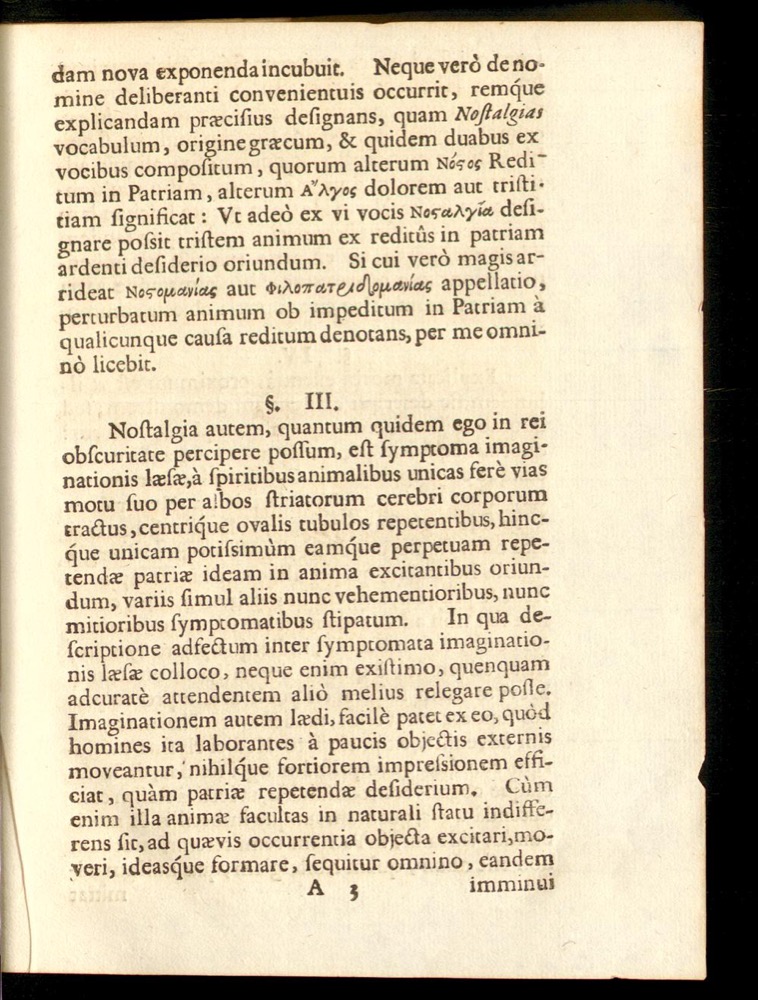
“…quam Nostalgias vocabulum, origine græcum, & quidem duabus ex vocibus compositum, quorum alterum Νόστος Reditum in Patriam, alterum Ἄλγος dolorem aut tristitiam significat…”
Page 5 of the scan of Johannes Hofer’s Dissertatio medica de nostalgia, oder Heimwehe, Basel, printed by Jakob Bertsch, [1688?]. In our translation: the name Nostalgia, Greek in origin and made of two words, nostos, return to the homeland, and algos, pain or sadness. Spelling is as printed; the page uses the long s, which we write as s. See the thesis at e-rara.1
Meanings
What it means today
- A wistful longing for the past. Merriam-Webster defines it as a wistful or excessively sentimental yearning for a past period or an irrecoverable condition, and also as something that stirs such a feeling.5 Wiktionary calls this the transferred sense, from the 20th century.6The song filled him with nostalgia.
In sentences
I have an idea that some men are born out of their due place. Accident has cast them amid certain surroundings, but they have always a nostalgia for a home they know not.
W. Somerset Maugham, The Moon and Sixpence, as quoted by Wiktionary.6were now pretty far gone with the longing for home which the Physicians have gone so far as to esteem a disease under the name of Nostalgia
Joseph Banks, journal of Cook’s first voyage, 3 September 1770, about the sailors. Quoted by Wikipedia from Beaglehole’s 1962 edition; we have not seen the book.8
Words that sit nearby
- nostalgic
- The adjective. Wiktionary lists it first among derived terms.6
- nostalgist
- Someone who feels or chases nostalgia. Merriam-Webster lists it beside the main entry.5
- solastalgia
- Wiktionary lists it as a related term, a later word built on the same ending.6
- Heimweh
- The German word Hofer was translating.14
Synonyms
Synonyms and antonyms for nostalgia
Synonyms
- For the old sensehomesickness. Merriam-Webster’s second sense is “the state of being homesick: homesickness”, and Wiktionary glosses the old sense as a longing for home or familiar surroundings.56
- For the modern feelingyearning, longing, wistfulness, sentimentality. These are the words the dictionaries use in their own definitions.56 We could not read a thesaurus entry for nostalgia: the Internet Archive has no usable copy of Merriam-Webster’s, so this list is not theirs.
Antonyms
English has no common antonym for nostalgia. Wiktionary lists a rare one, nostophobia, which it glosses as an aversion to the past, “the antithesis of nostalgia”, and also as a fear of going home.67 Wiktionary also lists nostopathy, a fear of returning home, as an antonym of the older sense.67
Through time
Through time
Almost every word has a first use that nobody can find. This one has a thesis, a title page, a date and an author. Drag the line and read how the word grew from a diagnosis into a mood.
Why a student needed a new word
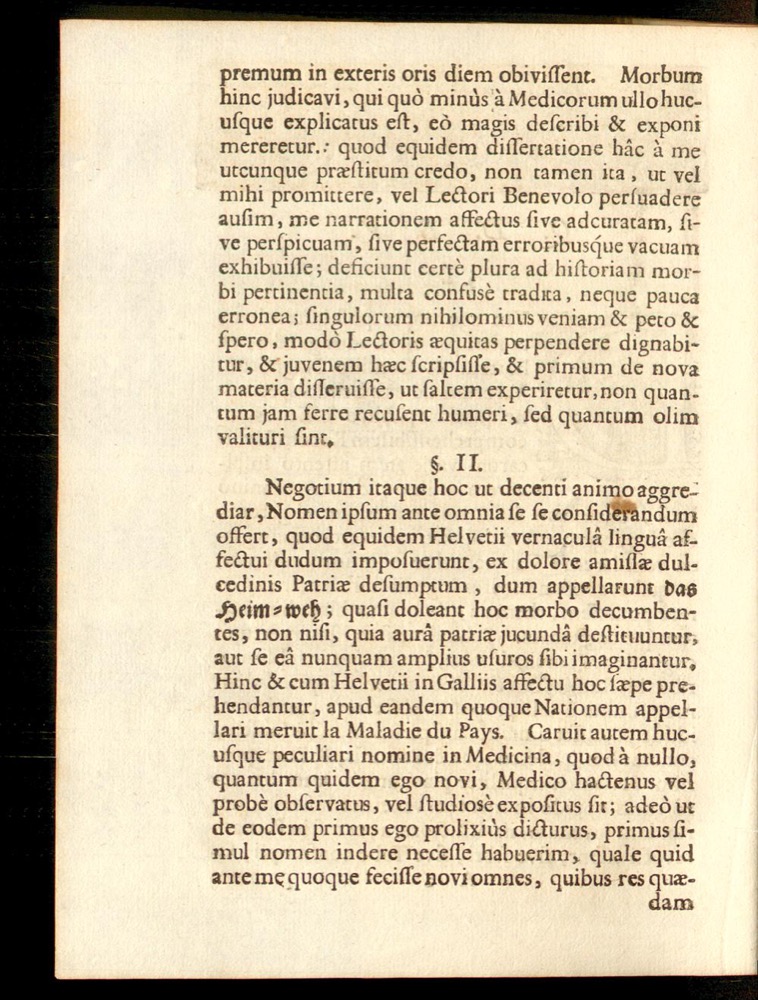
Hofer says plainly that medicine had no name for it. The Swiss, he writes, already called it Heimweh, from the pain of a lost sweetness of home. The French said la Maladie du Pays when Swiss soldiers in France caught it. He says no doctor had properly observed or described it before, so he, the first to write at length, was also the first who had to give it a name.1 He chose Greek parts and said anyone who preferred another Greek name, such as Philopatridomania, was free to use it.1 He placed the illness among disorders of the imagination.1
Route to English
How it traveled from Greece to England
- νόστος, ἄλγοςGreek, “return home” and “pain”. Etymonline traces nostos to a verb meaning “to get home”, and the root to an Indo-European word for returning safely home.4
- HeimwehGerman, “homesickness”, which Hofer says the Swiss already used.1 Wiktionary describes nostalgia as a calque of it.6
- nostalgiaNew Latin, coined in Basel in 1688.15
- nostalgiaEnglish, 1726 in Etymonline, as a medical term for severe homesickness.4
- nostalgiaEnglish, with the wistful sense for the past recorded by 1920.4
Stops mark where each language was used. Nobody documented a single journey. Greek never had a word nostalgia, and Wiktionary marks the Greek form as unattested.6
Dates
Why the dates differ
Three dates float around this word, and each is right about something different.
| Source | Gives | What it is dating |
|---|---|---|
| The thesis itself1 | 1688 | The coinage, in Latin. The e-rara catalogue gives the imprint as [1688?], and the title page says the disputation was set for 22 June 1688. |
| Etymonline4 | 1726 | The first English use, in the medical sense. |
| Merriam-Webster5 | 1756 | First known use, in the sense of homesickness. |
| Etymonline4 | by 1920 | The transferred sense, a wistful longing for the past. |
| Wiktionary6 | from 18th c. and 20th c. | The two senses, by century. |
The gap between 1726 and 1756 is a gap between two dictionaries’ reading lists. Neither page prints the sentence it relies on, so we do not know which text Merriam-Webster used.
The myth
A myth: Swiss soldiers were forbidden to sing it
Swiss soldiers abroad were forbidden, on pain of death, to play or sing one cattle song, because it made them homesick and drove them to desert.Told as fact, no order found
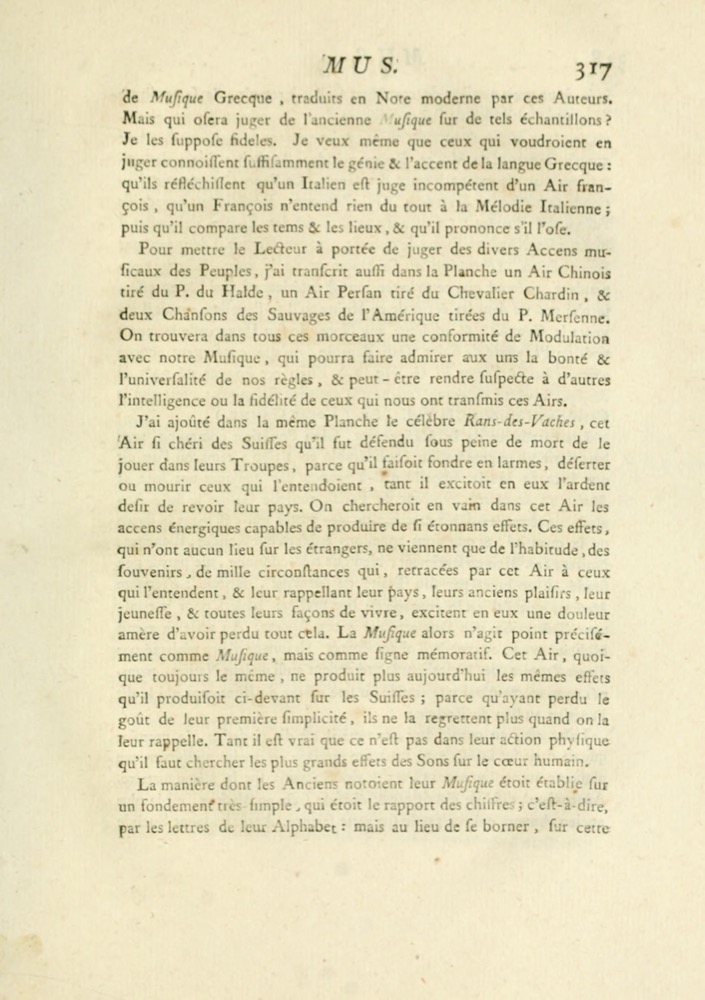
- The earliest version we could read is Rousseau’s. He adds the famous Rans-des-Vaches to his plate of tunes,
cet Air si chéri des Suisses qu’il fut défendu sous peine de mort de le jouer dans leurs Troupes, parce qu’il faisoit fondre en larmes, déserter ou mourir ceux qui l’entendoient
. We write the long s as s.2 - Rousseau gives no regiment, year or order. In the next sentences he says that the tune itself has no striking qualities and that its power comes from habit and memories.2
- The Historical Dictionary of Switzerland says Hofer reported that Swiss soldiers in foreign service were struck down by melancholy when they heard the song, and that a man who played or sang it risked death.3 We searched a machine reading of all 16 scanned pages of the 1688 thesis for words about song and music, and found none. We read only the pages with the coinage by eye. The Dictionary adds that Zwinger’s 1710 reissue carried added texts on the Swiss cattle song. That would fit, but we have not seen the 1710 book.3
- We did not search army archives, so we cannot say that no order ever existed. We found none, and the two printed sources we could read do not name one.
What is firm is that the word was a medical term first. A thesis made it, armies adopted it, and the song story came later and stuck to it.
Measured
The word, measured
Psychologists have asked thousands of people about tens of thousands of words. Here is where nostalgia lands in six of those datasets.
How many people know it
Of 409 people shown it, 99.3% said they knew it, more than for 86% of the 61,855 words tested. Estimates by group: Americans 98.5%, British 99.5%, men 98.5%, women 98.1%.9
When people learn it
The average age adults recall learning it, later than about 75% of 31,105 words. The middle word on the list comes at 11.2. These are adults’ estimates, so read them as a rough guide.10
How concrete it feels
People rate it as more of an idea than a thing, more abstract than 88% of 39,954 words. Agreement is low: 30 raters, standard deviation 1.39.11
How it feels emotionally
It leans pleasant, above 90% of 13,915 words, but raters split widely (standard deviation 2.08). It’s more arousing than 61% of those words at 4.38. On dominance it scores 5.36, higher than 54%, meaning people feel more in control.12
Which sense it calls up
Inside the body comes first, stronger than for 98% of 39,707 words, and taste is close behind at 94%.13
Scale 0 to 5.
Ratings come from panels of roughly 20 to 30 people per word, asked about the word out of context. Percentages are how nostalgia ranks among the words in that dataset.
Where does your vocabulary land?
Twelve words, each known by fewer Americans than the last. See your estimate against the same 221,268 people in the study above.9
Measure my vocabularyRelatives
Its relatives, and the same word elsewhere
- genesen
- German, “to recover”. Etymonline lists it as a cousin of nostos, from the same root for getting home safely.4
- nest
- Old Norse, “food for a journey”, from the same root according to Etymonline.4
- -algia
- The Greek algos, “pain, grief, distress”, which also ends many medical words.4
The same word in other languages
- nostalgiaSpanish
- nostalgieFrench
- NostalgieGerman
- nostalgiaItalian
- nostalgiaPortuguese
- nostalgieDutch
- nostalgiaPolish
- nostalgiSwedish
- nostaljiTurkish
- νοσταλγίαGreek
- ностальгияRussian
- nosztalgiaHungarian
Others use their own word. Japanese 懐古 and Korean 향수 are the equivalents Wiktionary gives.6
Test yourself
Three questions from this page
Sources
Where every claim comes from
We read Hofer’s thesis and Rousseau’s page ourselves, and calculated the numbers on this page from the data files. Etymonline and Merriam-Webster block automated readers, so we read their Internet Archive copies. We could not read a Merriam-Webster thesaurus entry, Johnson’s 1755 dictionary (its site was down) or Webster’s 1828 dictionary, which has no entry for nostalgia on the site we searched. Quotations marked as quoted by Etymonline or Wikipedia are not ours. Checked on 5 November 2026. If something is wrong, write to hello@lexicist.com.
- Hofer, Johannes. Dissertatio medica de nostalgia, oder Heimwehe, presided over by Johann Jakob Harder. Basel: Jakob Bertsch, [1688?]. University Library Basel, Diss 45:2, via e-rara, Public Domain Mark. Pages 4 and 5 read by eye, the rest by machine reading. doi.org/10.3931/e-rara-18924
- Rousseau, Jean-Jacques. Dictionnaire de musique. Paris: la veuve Duchesne, 1767. Page 317, entry “Musique”. Internet Archive, University of Toronto copy. archive.org/details/dictionnairedem00rous
- Baumann, Max Peter. “Ranz des vaches”. Historical Dictionary of Switzerland (French version of 2011). hls-dhs-dss.ch
- Harper, Douglas. “nostalgia”. Online Etymology Dictionary. We read the Internet Archive copy of 2024; the live site blocks automated access. etymonline.com/word/nostalgia
- Merriam-Webster, “nostalgia”. We read the Internet Archive copy; the live site blocks automated access. merriam-webster.com/dictionary/nostalgia
- Wiktionary, “nostalgia”, English section. en.wiktionary.org/wiki/nostalgia
- Wiktionary, “nostophobia” and “nostopathy”. en.wiktionary.org/wiki/nostophobia
- Wikipedia, “Nostalgia”. en.wikipedia.org/wiki/Nostalgia
- Brysbaert, M., et al. “Word prevalence norms for 62,000 English lemmas”. Behavior Research Methods 51 (2019): 467–479. doi.org/10.3758/s13428-018-1077-9
- Kuperman, V., et al. “Age-of-acquisition ratings for 30,000 English words”. Behavior Research Methods 44 (2012): 978–990. doi.org/10.3758/s13428-012-0210-4
- Brysbaert, M., et al. “Concreteness ratings for 40 thousand generally known English word lemmas”. Behavior Research Methods 46 (2014): 904–911. doi.org/10.3758/s13428-013-0403-5
- Warriner, A. B., et al. “Norms of valence, arousal, and dominance for 13,915 English lemmas”. Behavior Research Methods 45 (2013): 1191–1207. doi.org/10.3758/s13428-012-0314-x
- Lynott, D., et al. “The Lancaster Sensorimotor Norms”. Behavior Research Methods 52 (2020): 1271–1291. doi.org/10.3758/s13428-019-01316-z
- Brysbaert, M., and B. New. “Moving beyond Kučera and Francis”. Behavior Research Methods 41 (2009): 977–990. doi.org/10.3758/BRM.41.4.977
- Google Books Ngram Viewer, English 2019 corpus, 1700–2022, smoothing 3. Open the chart. Method: Michel, J.-B., et al. Science 331 (2011): 176–182. doi.org/10.1126/science.1199644
Image and audio credits
Thesis pages: University Library Basel via e-rara, Public Domain Mark. Rousseau page: Internet Archive, University of Toronto copy, public domain. Map: Natural Earth, public domain.