robot
nounro·bot/ˈɹoʊ.bɑt/
A machine that can move and do work on its own, often built to look like a person or an animal.
A robot packs the boxes now.
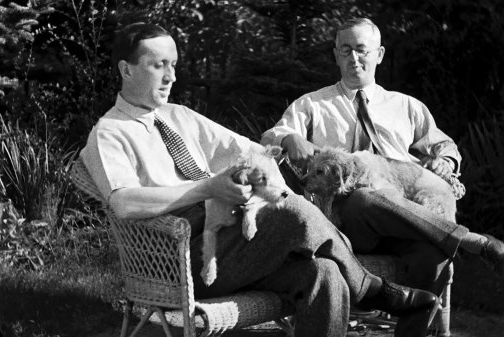
Borrowed from Czech robot, which comes from robota, “forced labor”.56 It reached English through the 1920 play R.U.R. by Karel Čapek.48 Čapek said the word was his brother Josef’s idea, not his own.35
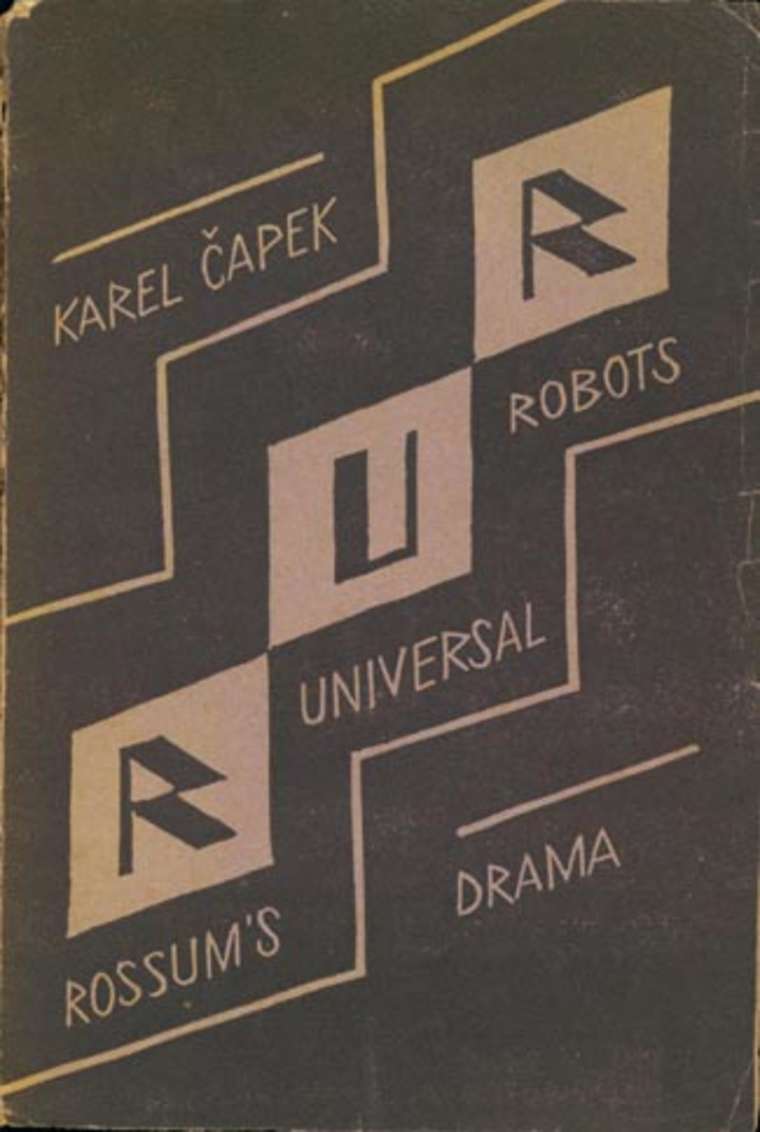
“ROSSUM’S UNIVERSAL ROBOTS”
Cover of the first edition of R.U.R., Prague: Aventinum, 1920. The cover prints the English words in the title. The designer is not named on the Commons page. See the file at Wikimedia Commons.1

Meanings
What it means today
- A machine that moves on its own and does complex work. Merriam-Webster’s first sense is a machine that resembles a living creature in being able to move independently and perform complex actions. It adds that such a machine is often built to look like a person or an animal.5A robot packs the boxes now.
- A device that does a complicated, often repetitive job automatically. The dictionary’s examples are a robot arm on an assembly line and a mechanism guided by automatic controls.5The cars are assembled by robots.
- A person who seems to work like a machine, or to have no feelings. Wiktionary dates this figurative sense to the 20th century.6
- In South Africa, a traffic light. Wiktionary says it comes from the earlier phrase robot policeman.6
There is an older English robot that has nothing to do with machines. Wiktionary lists it as a historical word for the system of serfdom in Central Europe, in which a tenant paid his rent in forced labor, and dates it from the 19th century. It came into English from German.6
Neither Johnson’s 1755 dictionary nor Webster’s 1828 has an entry for robot. Johnson’s site returns nothing for it, and Webster’s site offers a list of lookalikes such as robbed and robed.9
In sentences
- The cars are assembled by robots.5
My dear Miss Glory, the Robots are not people. Mechanically they are more perfect than we are; they have an enormously developed intelligence, but they have no soul.
Domin, in R.U.R., English version by Paul Selver and Nigel Playfair, 1923.2
Words that sit nearby
- automaton
- The older English word. Wiktionary says robot largely displaced it, and lists automaton as the broader term.6
- android
- A robot built to look human. Wiktionary lists it under robots, and Merriam-Webster tells you to compare it.56
- bot
- Short for robot, and the Merriam-Webster entry to compare. Wiktionary gives bot as a synonym for software that does a task.57
- robotism
- Merriam-Webster lists it as a derived noun.5
Synonyms
Synonyms and antonyms for robot
Synonyms
- For the machinebot, robo (informal), clanker (derogatory in some uses).7 Automaton is the broader parent word.67
- For kinds of robotandroid, droid, cyborg, drone, mech, mechanoid, cobot. Each names a narrower kind, so none is a plain synonym.7
Antonyms
English has no exact antonym for robot. We could not open Merriam-Webster’s thesaurus page for it, because the Internet Archive holds only an error page. The synonyms above come from Wiktionary’s thesaurus page. The nearest contrast is the play’s own: Domin says the Robots are not people.27
Through time
Through time
Few English words have a birthday this easy to name. Drag the line and read what was printed, staged and said as the word crossed from a Prague stage to every language on the list at the bottom.
Route to English
How it traveled from a Slavic root to a theatre in New York
- *orbh-Proto-Indo-European, “to pass from one status to another”. Etymonline puts it behind orphan and German Arbeit.4
- *orbotaProto-Slavic, from *orbiti and the suffix *-ota.6
- robotaOld Czech and Czech, “forced labor, compulsory service, drudgery”.456
- robotCzech, the word for the made workers in the play, 1920.368
- robotEnglish, first heard on stage in New York in 1922 and printed in the English edition of 1923.245
The stops mark the play’s path to English: printed in Prague, translated by Paul Selver in England, staged in New York.8 Nobody documented a journey for the word itself. The Proto-Indo-European and Proto-Slavic steps come from Etymonline and Wiktionary, and we haven’t checked them against an Indo-European dictionary.
Dates
How old is the word?
The dictionaries land one year apart, and both are describing the same event: the play reaching English.
| Source | Gives | What it is dating |
|---|---|---|
| Merriam-Webster5 | 1922 | First known use, in the sense of a machine that resembles a living creature. Its note says the word entered English in 1922, when the play was translated. |
| Etymonline4 | 1923 | “Mechanical person”, from the English translation of the play. Its note on the New York staging gives 9 October 1922. |
| Wiktionary6 | 20th century | The machine and the figurative sense. The older serfdom sense, from German, is marked 19th century. |
We could not open the printed program of the 1922 New York run or any English text before it, so we cannot say which printed page is the very first. The one document we did read is the 1923 English edition, which already explains the word to its readers in a note.2
The myth
A myth: Karel Čapek invented the word
Karel Čapek coined the word robot.He said no
- Čapek’s own account is a short piece in Lidové noviny, 24 December 1933. In it he wanted to call the artificial workers laboři, from Latin labor, but it seemed to him
nějak papírové
, a bit papery. His brother Josef answered through the brush in his mouth:Tak jim řekni roboti.
3 - English translations of the first line differ. One says laboři struck him as a bit “bookish”, another as a bit “literal”.3 We know the Czech only as quoted on a language blog and have not seen the paper.
- Merriam-Webster and Etymonline say the same. Etymonline quotes the lexicographer Rawson that the word was popularized by Karel’s play “but was coined by his brother Josef (the two often collaborated), who used it initially in a short story.”45 Wiktionary also says it was suggested by his brother.6
A second false trail is Russian. Wiktionary notes that Polish robotnik and Russian rabotnik, “worker”, are sometimes cited as the direct source. They are cousins from the same Slavic root, and the English word came from Czech.6
One more thing the word carries is a picture of a metal machine. The play’s Robots are not built that way. Domin says old Rossum found a substance that behaved exactly like living matter although its chemical composition was different, and the Robots are made from that.2

Measured
The word, measured
Psychologists have asked thousands of people about tens of thousands of words. Here is where robot lands in six of those datasets.
How many people know it
Of 432 people shown it, 99.5% said they knew it, more than for 92% of the 61,855 words tested. Estimates by group: Americans 99.2%, British 98.7%, men 98.9%, women 99.1%.11
When people learn it
The average age adults recall learning it, earlier than about 96% of 31,105 words. The middle word on the list comes at 11.2. These are adults’ estimates, so read them as a rough guide.12
How concrete it feels
People rate it as something you can experience directly, more so than 90% of 39,954 words. Agreement is high: 26 raters, standard deviation 0.80.13
How it feels emotionally
It leans pleasant, above 81% of 13,915 words, and raters mostly agree (standard deviation 1.65). It’s more arousing than 63% of those words at 4.43. On dominance it scores 5.14, lower than 56%, meaning people feel less in control.14
Which sense it calls up
Sight comes first, stronger than for 82% of 39,707 words.15
Scale 0 to 5.
Ratings come from panels of roughly 20 to 30 people per word, asked about the word out of context. Percentages are how robot ranks among the words in that dataset.
Where does your vocabulary land?
Twelve words, each known by fewer Americans than the last. See your estimate against the same 221,268 people in the study above.11
Measure my vocabularyRelatives
Its relatives, and the words it replaced
- robota
- Czech, “forced labor, compulsory service”. The Czech word the English one is cut from.46
- robotnik
- Czech, “forced worker”, which Etymonline gives as the source of the play’s word.4
- orphan
- A cousin through the Proto-Indo-European root for passing from one status to another. A slave and a child without parents are both people who changed status.4
- Arbeit
- German, “work”. Etymonline calls it a cousin of the Slavic word.4
- automaton
- The word robot largely displaced it.6
The same word in other languages
- robotCzech
- robotWelsh
- robotiSwahili
- ロボットJapanese
- 로봇Korean
- रोबोटHindi
- রোবটBengali
- ரோபோTamil
- رُوبُوتArabic
- رُباتPersian
Wiktionary lists all of these but Czech as descendants of English robot.6
Test yourself
Three questions from this page
Sources
Where every claim comes from
We read the 1923 English edition of the play, Johnson, Webster and the data files ourselves, and calculated the numbers on this page from those files. Etymonline and Merriam-Webster block automated readers, so we read their Internet Archive copies. Čapek’s 1933 piece is known to us only through a quotation. Checked on 5 November 2026. If something is wrong, write to hello@lexicist.com.
- R.U.R.: Rosumovi Univerzální Roboti, first edition cover. Prague: Aventinum, 1920. Wikimedia Commons, public domain. commons.wikimedia.org
- Čapek, Karel. R. U. R. (Rossum’s Universal Robots), English version by Paul Selver and Nigel Playfair. Samuel French, copyright 1923 by Doubleday, Page and Company. Project Gutenberg eBook 59112. We read the full text. gutenberg.org/ebooks/59112
- Čapek, Karel. Newspaper piece on the word robot, Lidové noviny, 24 December 1933, p. 12. We know it only as quoted in the comments of Language Hat, “Translating Čapek”, which gives the Czech lines and two English translations. languagehat.com
- Harper, Douglas. “robot”. Online Etymology Dictionary. We read the Internet Archive copy of 2024; the live site blocks automated access. etymonline.com/word/robot
- Merriam-Webster, “robot”, including its “Did you know?” note. We read the Internet Archive copy; the live site blocks automated access. merriam-webster.com/dictionary/robot
- Wiktionary, “robot”, English section and the Afrikaans etymology. en.wiktionary.org/wiki/robot
- Wiktionary, “Thesaurus:robot”. en.wiktionary.org/wiki/Thesaurus:robot
- Wikipedia, “R.U.R.”, sections on the word’s origin and on publication and translation. en.wikipedia.org/wiki/R.U.R.
- Johnson, Samuel. A Dictionary of the English Language, 1755, no entry for robot at johnsonsdictionaryonline.com. Webster, Noah. An American Dictionary of the English Language, 1828, no entry at webstersdictionary1828.com.
- Photograph of Karel and Josef Čapek, before 1938. Wikimedia Commons, public domain. commons.wikimedia.org
- Brysbaert, M., et al. “Word prevalence norms for 62,000 English lemmas”. Behavior Research Methods 51 (2019): 467–479. doi.org/10.3758/s13428-018-1077-9
- Kuperman, V., et al. “Age-of-acquisition ratings for 30,000 English words”. Behavior Research Methods 44 (2012): 978–990. doi.org/10.3758/s13428-012-0210-4
- Brysbaert, M., et al. “Concreteness ratings for 40 thousand generally known English word lemmas”. Behavior Research Methods 46 (2014): 904–911. doi.org/10.3758/s13428-013-0403-5
- Warriner, A. B., et al. “Norms of valence, arousal, and dominance for 13,915 English lemmas”. Behavior Research Methods 45 (2013): 1191–1207. doi.org/10.3758/s13428-012-0314-x
- Lynott, D., et al. “The Lancaster Sensorimotor Norms”. Behavior Research Methods 52 (2020): 1271–1291. doi.org/10.3758/s13428-019-01316-z
- Brysbaert, M., and B. New. “Moving beyond Kučera and Francis”. Behavior Research Methods 41 (2009): 977–990. doi.org/10.3758/BRM.41.4.977
- Google Books Ngram Viewer, English 2019 corpus, 1700–2022, smoothing 3. Open the chart. Method: Michel, J.-B., et al. Science 331 (2011): 176–182. doi.org/10.1126/science.1199644
Image and audio credits
Book cover and photograph of the brothers: Wikimedia Commons, public domain. Recording: Dvortygirl (US), CC BY-SA 3.0, via Wikimedia Commons. Map: Natural Earth, public domain.