salary
nounsal·a·ry/ˈsæləɹi/
A fixed amount of pay that comes at regular intervals, usually by the month or the year, not by the hour.
They offered a better salary.
From Latin salarium, “wages, an allowance”, which is built on sal, “salt”.67 English had salarie by the 13th century.78 Why a word for pay should come from salt is not settled, and the story that soldiers were paid in salt has no ancient source.45
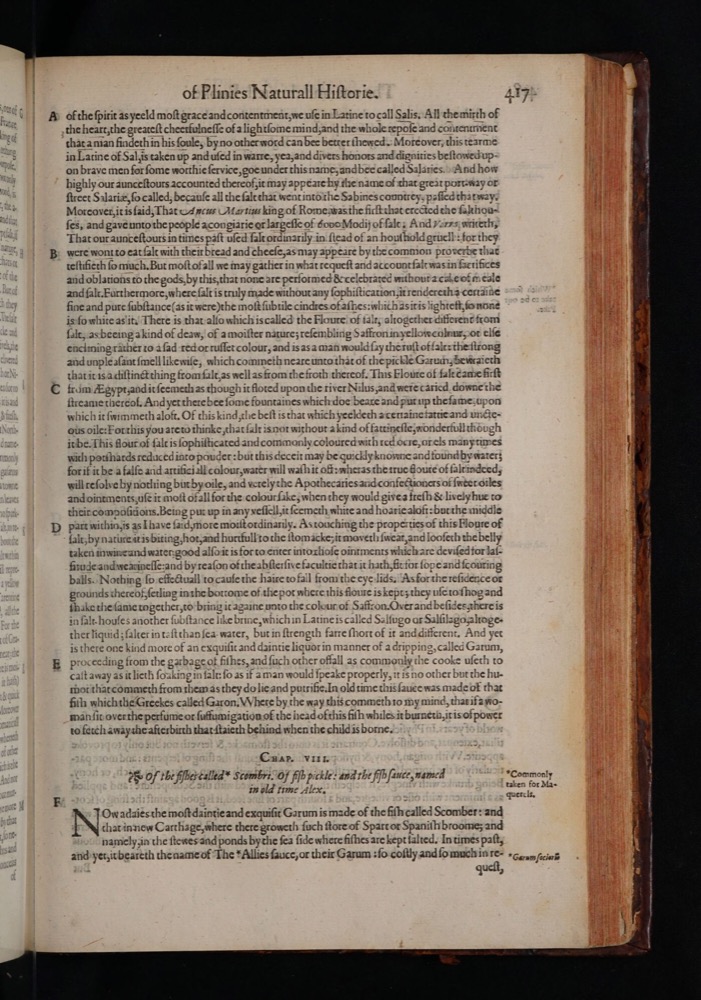
“Moreover, this tearme in Latine of Sal, is taken up and used in warre, yea, and divers honors and dignities bestowed upon brave men for some worthie service, goe under this name, and bee called Salaries.”
Page 417 of Philemon Holland’s English translation of Pliny the Elder’s Natural History, London, 1601. It renders the Latin passage on salt. Spelling is as printed; the page uses the long s, which we write as s. See the page at Wellcome Collection.1
Meanings
What it means today
The word is older than that tidy definition. Johnson’s 1755 dictionary gives “stated hire; annual or periodical payment”.10 Webster in 1828 draws the line that still holds. A fixed sum by the year, as for governors, clergymen or teachers, is a salary. Pay stated by the month, week or day is “pay or wages”.11
In sentences
- The job comes with a salary of $60,000 a year.9
This is hire and salary, not revenge.
Shakespeare, Hamlet, quoted under salary by Samuel Johnson, 1755.10Several persons, out of a salary of five hundred pounds, have always lived at the rate of two thousand.
Jonathan Swift, quoted by Johnson, 1755.10
Words that sit nearby
- salaried
- Paid by a salary. Etymonline lists it as a related form.7
- salariat
- Listed next to salary in Merriam-Webster’s nearby entries.8
- salaryman
- A derived term in Wiktionary.5 Japanese sarariman, “male salaried worker”, is literally “salary-man” and comes from English.7
- wages
- Webster’s word for pay counted by the day or week.11
Synonyms
Synonyms and antonyms for salary
Synonyms
- For regular paywage, pay, payment, stipend, paycheck, compensation, emolument, earnings, remuneration.9 Wage is the first the thesaurus lists.
Antonyms
English has no exact antonym for salary. The Merriam-Webster thesaurus entry for it lists no antonyms and no near antonyms.9 The nearest contrast is in Webster’s 1828 definition, which sets salary against pay or wages counted by the month, week or day.11
Through time
Through time
The word has barely changed in seven centuries. What changed is the story told about its first syllable. Drag the line and read what people wrote at the time.
Route to English
How it traveled from Rome to England
- salLatin, “salt”. From a Proto-Indo-European root for salt.76
- salāriusLatin adjective, “related to salt”.6 Via Salaria, the road by which salt reached the Sabines, is named from it.27
- salāriumLatin noun, “wages, allowance, stipend”. It is the neuter of salārius.56
- salaire, salarieOld French and Anglo-French, “wages, pay, reward”.57
- salarieMiddle English, late 13th century.78
- salaryModern English.5
Stops mark where each language was used. Nobody documented a single journey, and the line is a picture of the word’s family tree. The Proto-Indo-European root comes from Etymonline and Wiktionary’s etymology, and we haven’t checked it against an Indo-European dictionary.
Dates
How old is the word?
Here the dictionaries agree. The two we could read give the same century.
| Source | Gives | What it is dating |
|---|---|---|
| Etymonline7 | late 13th century | The noun salarie, “compensation, payment”. The verb is a later arrival, late 15th century, with Caxton. |
| Merriam-Webster8 | 13th century | First known use, in the sense defined as fixed compensation paid regularly for services. |
| Wiktionary5 | no date | Lists the line Middle English salarie, Anglo-Norman salarie, Old French salaire, Latin salārium. |
The date we could not check is the earliest written example itself. Neither dictionary prints the 13th-century sentence on the page we read, and the Middle English Dictionary refused automated access. We have not seen the first text.
The myth
A myth: Roman soldiers were paid in salt
The word salary exists because Roman soldiers were paid in salt.No ancient source
- The sentence usually cited is Pliny’s. In Latin it reads
honoribus etiam militaeque interponitur salariis inde dictis
, and it says that salt has a place in honours and in military service, and that salaries are named from it.2 It does not say how, and it does not say soldiers were paid in salt.4 - Translators fill the gap differently. In 1601 Philemon Holland has honours given to brave men “called Salaries”, with no money in it.1 The 1855 version says that in the honours of successful warfare salt plays its part, and that our word salarium comes from it. Its footnote then adds “salt money”, which is the translators’ gloss.3
- Salarium argentum, “salt money”, is not in any ancient text. Gainsford traces it to 18th and 19th century Latin dictionaries, which guessed it by analogy with real words like vestiarium, clothing money.4 Wiktionary agrees that the phrase is not attested.5
- The salt evidence that does survive is about tax. Gainsford quotes Livy on a new salt tax set by the censors in 204 BC, and Cato on officials called salinatores aerarii. Neither is about pay.4 We haven’t opened Livy or Cato ourselves.
- Salt did serve as a trade good elsewhere. Salt bars were used in Ethiopia into the early 20th century. That tells you nothing about Rome.4
The story has a paper trail, and it starts earlier than Gainsford’s own guess of the 1860s.4 Webster had it in 1828, hedged with “said to be”.11 Facciolati and Forcellini had a salt allowance for soldiers by 1771.4 Wikipedia now calls the claim baseless.12
What is left is a real puzzle. Gainsford’s own guess is that salarium meant something like “everything-else money”, the way the Greek word for pay, opsōnion, comes from opson, “relish, fish”. He calls it a conjecture, and so do we.4 Etymonline makes a similar comparison with Greek sitērion, “pay”, literally “provision for grain”.7
“Worth your salt” does not rescue the story. Gainsford reports it first appearing in the 1830s, citing Etymonline.4
Measured
The word, measured
Psychologists have asked thousands of people about tens of thousands of words. Here is where salary lands in six of those datasets.
How many people know it
Of 401 people shown it, 99.0% said they knew it, more than for 81% of the 61,855 words tested. Estimates by group: Americans 99.1%, British 97.2%, men 98.9%, women 99%.14
When people learn it
The average age adults recall learning it, earlier than about 63% of 31,105 words. The middle word on the list comes at 11.2. These are adults’ estimates, so read them as a rough guide.15
How concrete it feels
People rate it as something you can experience directly, more so than 70% of 39,954 words. Agreement is low: 29 raters, standard deviation 1.37.16
How it feels emotionally
It leans pleasant, above 86% of 13,915 words, but raters split widely (standard deviation 2.09). It’s more arousing than 78% of those words at 4.86. On dominance it scores 5.05, lower than 59%, meaning people feel less in control.17
Which sense it calls up
Sight comes first, stronger than for 51% of 39,707 words.18
Scale 0 to 5.
Ratings come from panels of roughly 20 to 30 people per word, asked about the word out of context. Percentages are how salary ranks among the words in that dataset.
Where does your vocabulary land?
Twelve words, each known by fewer Americans than the last. See your estimate against the same 221,268 people in the study above.14
Measure my vocabularyRelatives
Its relatives, and one traveling cousin
- sauce
- From Latin salsus, “salted”, which comes from sal.13
- sausage
- From Latin salsīcia, from salsus, “salted”, from sal.13
- salad
- Through Old French and Italian from a Latin verb for salting. Vegetables were dressed with brine or salty oil in Roman times.13
- soldier
- Not a salt word. It comes from Medieval Latin soldarius, “one having pay”, from solidus, a coin. It belongs here as another name for a person defined by pay.13
The same word in other languages
- salarioSpanish
- salaireFrench
- salarioItalian
- salárioPortuguese
- salariCatalan
- salarisDutch
- salariuRomanian
- salarjuMaltese
- サラリーJapanese
Others use a different root: German Gehalt and Lohn, Greek μισθός. Spanish, Romanian, Catalan, Dutch and Italian are listed as descendants of Latin salārium, and Japanese took the English word.65
Test yourself
Three questions from this page
Sources
Where every claim comes from
We read the 1601 page, Johnson, Webster, the Latin of Pliny and the data files ourselves, and calculated the numbers on this page from those files. Etymonline and Merriam-Webster block automated readers, so we read their Internet Archive copies. Material we only know through Gainsford is marked as such. Checked on 5 November 2026. If something is wrong, write to hello@lexicist.com.
- Holland, Philemon, trans. The historie of the world. Commonly called, the naturall historie of C. Plinius Secundus. London: Adam Islip, 1601. Book 31, p. 417. Wellcome Collection, public domain. Open the scan
- Pliny the Elder, Natural History 31.89 (31.41 in older chapter numbering), Latin text. LacusCurtius. penelope.uchicago.edu
- Pliny the Elder, The Natural History, trans. John Bostock and H. T. Riley. London: Taylor and Francis, 1855. Book 31, ch. 41 and note 13. Perseus Digital Library. perseus.tufts.edu
- Gainsford, Peter. “Salt and salary: were Roman soldiers paid in salt?” Kiwi Hellenist, 11 January 2017. Quotes Pliny 31.89, Livy 29.37.3, Facciolati and Forcellini (1771) and Lewis and Short (1879), none of which we opened ourselves. kiwihellenist.blogspot.com
- Wiktionary, “salary”, English section. en.wiktionary.org/wiki/salary
- Wiktionary, “salarium”, Latin section. en.wiktionary.org/wiki/salarium
- Harper, Douglas. “salary”. Online Etymology Dictionary. We read the Internet Archive copy of 2024; the live site blocks automated access. etymonline.com/word/salary
- Merriam-Webster, “salary”. We read the Internet Archive copy; the live site blocks automated access. merriam-webster.com/dictionary/salary
- Merriam-Webster Thesaurus, “salary”, Synonyms, Antonyms and Near Antonyms. Internet Archive copy. merriam-webster.com/thesaurus/salary
- Johnson, Samuel. A Dictionary of the English Language. 1755. johnsonsdictionaryonline.com
- Webster, Noah. An American Dictionary of the English Language. 1828. webstersdictionary1828.com
- Wikipedia, “Salary”, Etymology. en.wikipedia.org/wiki/Salary
- Wiktionary, English entries “sauce”, “sausage”, “salad” and “soldier”, Etymology. en.wiktionary.org
- Brysbaert, M., et al. “Word prevalence norms for 62,000 English lemmas”. Behavior Research Methods 51 (2019): 467–479. doi.org/10.3758/s13428-018-1077-9
- Kuperman, V., et al. “Age-of-acquisition ratings for 30,000 English words”. Behavior Research Methods 44 (2012): 978–990. doi.org/10.3758/s13428-012-0210-4
- Brysbaert, M., et al. “Concreteness ratings for 40 thousand generally known English word lemmas”. Behavior Research Methods 46 (2014): 904–911. doi.org/10.3758/s13428-013-0403-5
- Warriner, A. B., et al. “Norms of valence, arousal, and dominance for 13,915 English lemmas”. Behavior Research Methods 45 (2013): 1191–1207. doi.org/10.3758/s13428-012-0314-x
- Lynott, D., et al. “The Lancaster Sensorimotor Norms”. Behavior Research Methods 52 (2020): 1271–1291. doi.org/10.3758/s13428-019-01316-z
- Brysbaert, M., and B. New. “Moving beyond Kučera and Francis”. Behavior Research Methods 41 (2009): 977–990. doi.org/10.3758/BRM.41.4.977
- Google Books Ngram Viewer, English 2019 corpus, 1700–2022, smoothing 3. Open the chart. Method: Michel, J.-B., et al. Science 331 (2011): 176–182. doi.org/10.1126/science.1199644
Image and audio credits
1601 page: Wellcome Collection, public domain. Recording: Dvortygirl (US), CC BY-SA 3.0, via Wikimedia Commons. Map: Natural Earth, public domain.