mortgage
nounverbmort·gage/ˈmoɹ.ɡɪd͡ʒ/
A loan to buy property in which the property itself stands as security. If the debt is not paid, the lender can take the property.
We paid off the mortgage last year.
From Old French mort gage, “dead pledge”.43 The t is not said aloud: Merriam-Webster shows the sound as “mor-gij”.5 English had morgage by the late 14th century, or the 15th, depending on the dictionary.45 Why a pledge should be called dead was explained in two different ways, more than four centuries apart.12
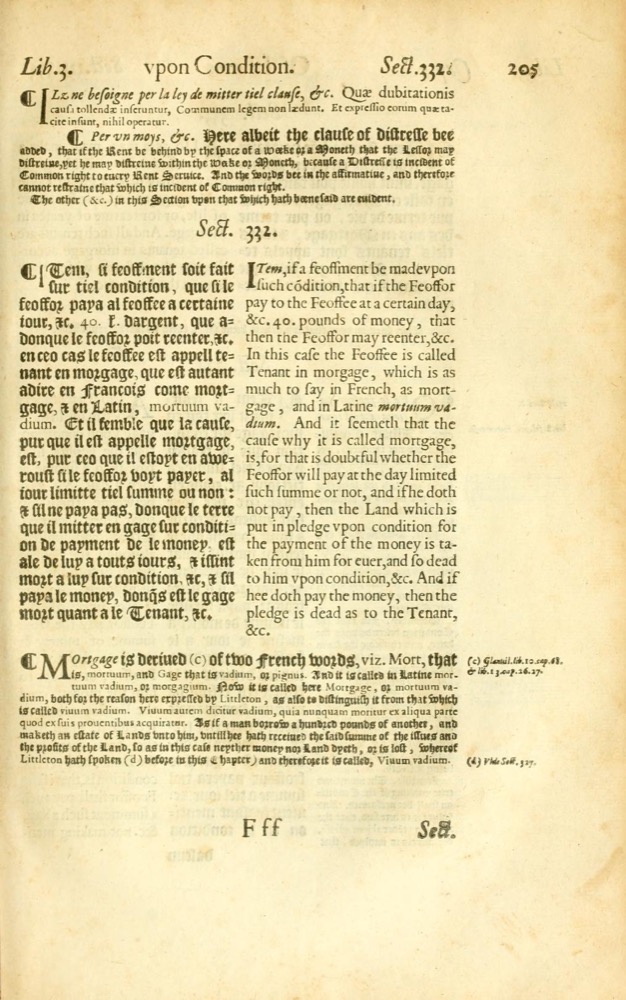
“And it seemeth that the cause why it is called mortgage, is, for that is doubtful whether the Feoffor will pay at the day limited such summe or not.”
Section 332 in Sir Edward Coke’s First Part of the Institutes of the Lawes of England, London, 1628, folio 205. It prints Littleton’s Law French beside an English version, and Coke’s own note under it. Spelling is as printed, with the long s written as s. See the page at the Internet Archive.1
Meanings
What it means today
- A loan secured on property, and the paper that records it. Merriam-Webster’s first sense is a conveyance of, or a lien against, property that becomes void when the loan is paid. Its second covers the document, the loan itself and the lender’s interest in the property.5 Wiktionary describes it as an agreement in which a borrower pledges real property as collateral for a loan.3We paid off the mortgage last year.
- To pledge something against a debt, or to risk the future. As a verb it means to grant property by a mortgage, and, more loosely, to subject something to a claim or obligation. Merriam-Webster marks the second use as usually found in the phrase mortgage the future.5The city has mortgaged the future to pay for the new stadium.
The word has not changed its job much. Johnson’s 1755 dictionary gives “a dead pledge; a thing put into the hands of a creditor”, and a second sense, “the state of being pledged”.7 Webster in 1828 begins with “literally, a dead pledge”, then spends most of the entry on what the law did when the money was or was not paid back, including the “equity of redemption”.8
In sentences
- He will have to take out a mortgage in order to buy the house.5
Th’ estate runs out, and mortgages are made, / Their fortune ruin’d, and their fame betray’d.
John Dryden, quoted under mortgage by Samuel Johnson, 1755.7Already a portion of the entire capital of the nation is mortgaged for the support of drunkards.
Noah Webster’s example under the verb, 1828.8
Words that sit nearby
- mortgagor
- The borrower who gives the mortgage. Wiktionary lists it as a derived term.3 Webster’s 1828 entry uses the older spellings mortgager for the borrower and mortgagee for the lender.8
- reverse mortgage
- A derived term in Wiktionary, and one of the phrases Merriam-Webster lists with mortgage, next to first mortgage, second mortgage and adjustable rate mortgage.35
- Welsh mortgage
- A derived term in Wiktionary.3 It matters for the origin story below.
- mortgage-backed
- Listed in Wiktionary, with mortgage-backed security.3
Synonyms
Synonyms and antonyms for mortgage
Synonyms
- For the verb, as in to commitcommit, pledge, troth, vow, engage, plight, promise, contract, affiance, swear, enroll, sign on, enlist, sign up, betroth, overcommit.6 Commit and pledge come first.
Antonyms
The Merriam-Webster thesaurus gives synonyms for the verb only. It has no entry for the noun, so we list none for the loan. For the verb sense it gives one antonym or near antonym:
- For the verb, as in to commitrenege.6
The two reasons
Why is the pledge “dead”?
A mortgage is a dead pledge because the pledge dies when you pay the debt, or when you fail to.Not the first answer
- This is the answer printed on the page at the top. Littleton, in the English printed beside his Law French, says the feoffee is called a tenant in morgage, “which is as much to say in French, as mortgage, and in Latine mortuum vadium”. He then explains it: it is doubtful whether the borrower will pay on the day. If he does not, the land is taken from him for ever and so “dead to him”. If he does, “the pledge is dead as to the Tenant”.1 Etymonline repeats it with Coke’s words as the quotation.4
- Coke adds that the name also marks a contrast with viuum vadium, the living pledge, which in his Latin gloss (our translation) never dies in any part, because the debt is made up from its yield. His own example is a lender who holds land until he has taken back the sum from its yield. He cites Glanvill for it in the margin.1
- Glanvill’s treatise is more than 400 years older than Coke’s book. Beames’s 1812 translation reads, of a pledge of land: “A pledge is designated by the Term Mortgage when the fruits and Rents, which are received in the interval, in no measure tend to reduce the demand for which the pledge has been given.” A pledge whose rents did reduce the debt was, he says, “just and binding”. The other is “unjust and dishonest”, and is the one called a mortgage.2
- So in the old sense the pledge was dead because it did nothing to pay itself off. Beames notes that this is not the reason Littleton gives, which Coke followed, and thinks Glanvill’s the better fit for the word’s contrast with the living pledge.2 Wiktionary has the same reading: rents and profits kept going to the lender while the pledge lasted, unlike the living pledge, which paid the debt down.3
- Wikipedia’s article on mortgage law goes further. It says the word first meant only the Welsh mortgage, and was later stretched to all pledges and re-explained in the way Coke and Littleton did, which it calls a folk etymology.9 We have only that article’s word for the Welsh part; we did not open a law history ourselves.
A small point that is easy to miss: the French word is mort, “dead”, not “death”. Etymonline traces it to Latin mortuus, the past participle of mori, “to die”.4 Merriam-Webster gives the same Latin.5 Calling it a “death pledge” is a loose translation, not what the French says.
Through time
Through time
The two explanations sit more than four centuries apart, and the money side of the word grew a great deal in between. Drag the line and read what people wrote.
Route to English
How it traveled to England
- mortuusLatin, “dead”, the past participle of mori, “to die”. From a Proto-Indo-European root meaning “to rub away, harm”, and also “to die”.4
- *wadiFrankish, “wager, pledge”. Wiktionary gives it as the source of the second half.3
- mort gageOld French, “dead pledge”. Wiktionary suggests it was modeled on a legal Latin mortuum wadium.34
- mortgage, morgageAnglo-French, then Middle English morgage.53
- mortgageThe t was put back in spelling later, on the Latin model.4
Stops mark where each language was used, not a single journey. The Frankish step comes from Wiktionary’s etymology and we haven’t checked it in a Germanic dictionary. Modern French dropped the word and now says hypothèque.4
Dates
How old is the word?
The two dictionaries we could read disagree on the century, and neither prints the sentence it relies on.
| Source | Gives | What it is dating |
|---|---|---|
| Etymonline4 | late 14th century | The noun morgage, “a conveyance of property on condition as security for a loan or agreement”. The verb is dated to the late 15th century. |
| Merriam-Webster5 | 15th century | First known use of both noun and verb, in the first sense given above. |
| Wiktionary3 | no date | Gives the line Middle English morgage, Anglo-Norman morgage, Old French mort gage, and lists morgage as an obsolete spelling. |
We can’t say why they differ, because neither page names its first example. We have not seen the Middle English Dictionary entry.
Measured
The word, measured
Psychologists have asked thousands of people about tens of thousands of words. Here is where mortgage lands in six of those datasets.
How many people know it
Of 381 people shown it, 99.0% said they knew it, more than for 80% of the 61,855 words tested. Estimates by group: Americans 98.4%, British 98.5%, men 97.4%, women 99.1%.10
When people learn it
The average age adults recall learning it, later than about 67% of 31,105 words. The middle word on the list comes at 11.2. These are adults’ estimates, so read them as a rough guide.11
How concrete it feels
People rate it as something you can experience directly, more so than 57% of 39,954 words. Agreement is low: 28 raters, standard deviation 1.56.12
How it feels emotionally
It leans unpleasant, below 87% of 13,915 words, and raters mostly agree (standard deviation 1.50). It’s more arousing than 63% of those words at 4.43. On dominance it scores 3.74, lower than 92%, meaning people feel less in control.13
Which sense it calls up
Sight comes first, stronger than for 39% of 39,707 words.14
Scale 0 to 5.
Ratings come from panels of roughly 20 to 30 people per word, asked about the word out of context. Percentages are how mortgage ranks among the words in that dataset.
Where does your vocabulary land?
Twelve words, each known by fewer Americans than the last. See your estimate against the same 221,268 people in the study above.10
Measure my vocabularyRelatives
Its relatives and its descendants
- mortal
- From Latin mors, “death”, the same family as mortuus.4
- gage, wage
- Etymonline sends the reader from gage to wage, and Wiktionary says to compare both.34
- murder
- Merriam-Webster’s etymology of mortgage ends with “more at murder”.5
Languages that borrowed it
- mōketeMāori
- morgaisWelsh
- morgaidseScottish Gaelic
- моргейжMongolian
Wiktionary lists these four as borrowings from English.3 Most European languages use a different word for the same loan, from Greek hypothēkē: French hypothèque, German Hypothek, Spanish hipoteca, Italian ipoteca.3 We did not check that Greek source.
Test yourself
Three questions from this page
Sources
Where every claim comes from
We read Coke’s 1628 page, Beames’s translation of Glanvill, Johnson, Webster and the data files ourselves, and calculated the numbers on this page from those files. Etymonline and Merriam-Webster block automated readers, so we read their Internet Archive copies. Wikipedia’s account of the Welsh mortgage is marked as such. Checked on 5 November 2026. If something is wrong, write to hello@lexicist.com.
- Coke, Sir Edward. The first part of the institutes of the lawes of England, or, A commentarie upon Littleton. London, 1628. Lib. 3, cap. 5, sect. 332, fol. 205. The John Adams Library copy at the Boston Public Library, scanned by the Internet Archive. archive.org
- Glanvill, Ranulf de. A Translation of Glanville, trans. John Beames. London, 1812; reprinted Washington, D.C.: John Byrne, 1900. Book X, chapter VI and Beames’s notes, pp. 204–205; Introduction on the date. Internet Archive. archive.org
- Wiktionary, “mortgage”, English section. en.wiktionary.org/wiki/mortgage
- Harper, Douglas. “mortgage”. Online Etymology Dictionary. We read the Internet Archive copy; the live site blocks automated access. etymonline.com/word/mortgage
- Merriam-Webster, “mortgage”. We read the Internet Archive copy of 18 December 2025. merriam-webster.com/dictionary/mortgage
- Merriam-Webster Thesaurus, “mortgage”. Internet Archive copy of 13 January 2026. merriam-webster.com/thesaurus/mortgage
- Johnson, Samuel. A Dictionary of the English Language. 1755. johnsonsdictionaryonline.com
- Webster, Noah. An American Dictionary of the English Language. 1828. webstersdictionary1828.com
- Wikipedia, “Mortgage law”, introduction. en.wikipedia.org/wiki/Mortgage_law
- Brysbaert, M., et al. “Word prevalence norms for 62,000 English lemmas”. Behavior Research Methods 51 (2019): 467–479. doi.org/10.3758/s13428-018-1077-9
- Kuperman, V., et al. “Age-of-acquisition ratings for 30,000 English words”. Behavior Research Methods 44 (2012): 978–990. doi.org/10.3758/s13428-012-0210-4
- Brysbaert, M., et al. “Concreteness ratings for 40 thousand generally known English word lemmas”. Behavior Research Methods 46 (2014): 904–911. doi.org/10.3758/s13428-013-0403-5
- Warriner, A. B., et al. “Norms of valence, arousal, and dominance for 13,915 English lemmas”. Behavior Research Methods 45 (2013): 1191–1207. doi.org/10.3758/s13428-012-0314-x
- Lynott, D., et al. “The Lancaster Sensorimotor Norms”. Behavior Research Methods 52 (2020): 1271–1291. doi.org/10.3758/s13428-019-01316-z
- Brysbaert, M., and B. New. “Moving beyond Kučera and Francis”. Behavior Research Methods 41 (2009): 977–990. doi.org/10.3758/BRM.41.4.977
- Google Books Ngram Viewer, English 2019 corpus, 1700–2022, smoothing 3. Open the chart. Method: Michel, J.-B., et al. Science 331 (2011): 176–182. doi.org/10.1126/science.1199644
Image and audio credits
1628 page: Internet Archive scan of a copy at the Boston Public Library, public domain. Recording: Dvortygirl (US), CC BY-SA 3.0, via Wikimedia Commons. Map: Natural Earth, public domain.