boycott
verbnounboy·cott/ˈbɔɪkɑt/
To refuse, together with others, to buy from, sell to or deal with a person or business, as a protest or to force a change.
They boycotted the store for a year.
From the surname of Captain Charles C. Boycott (1832–1897), a land agent in County Mayo whom the Irish Land League and his neighbors shunned in 1880.34 James Redpath, the journalist who was there, says a priest, Father John O’Malley, coined the verb over dinner. We found no second witness.1
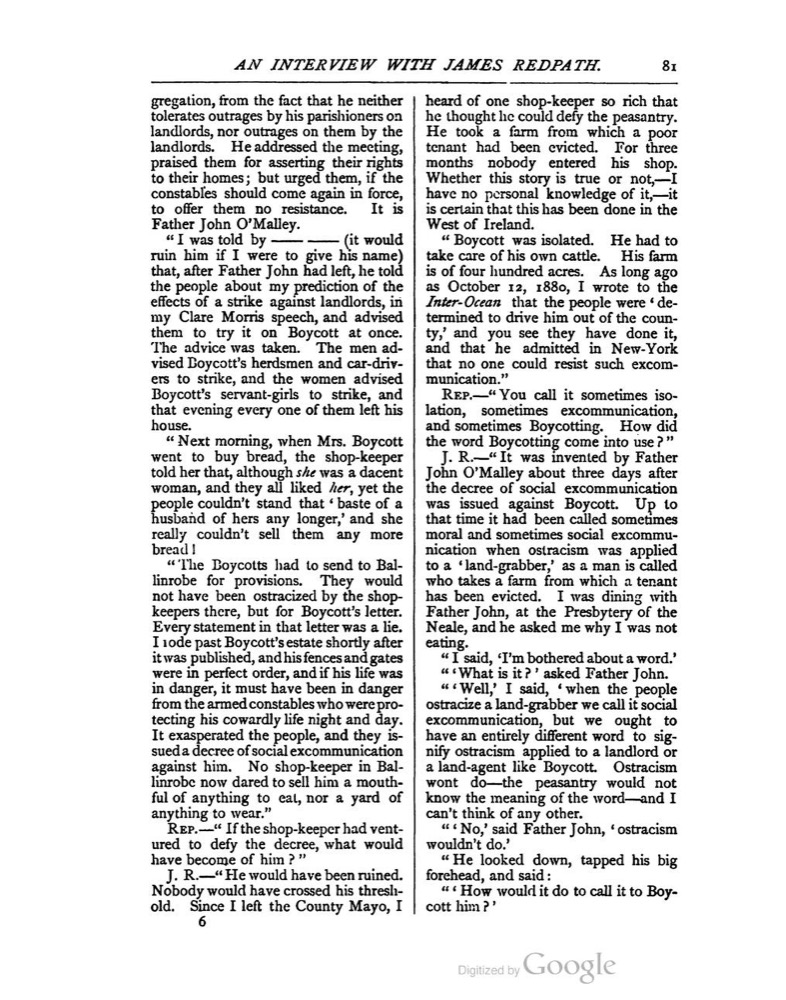
“It was invented by Father John O’Malley about three days after the decree of social excommunication was issued against Boycott.”
Page 81 of James Redpath, Talks about Ireland, New York: P. J. Kenedy, 1881. The interview is reprinted from the Chicago Inter-Ocean of 14 April 1881. The scan is a Google Books copy held by the Internet Archive. See the page at the Internet Archive.1
Meanings
What it means today
- To join others in refusing to deal with someone. Merriam-Webster: to engage in a concerted refusal to have dealings with a person, a store, an organization and the like, usually to express disapproval or to force acceptance of certain conditions.3 Wiktionary has the same idea as abstaining, alone or in a group, from using, buying or dealing with someone as a protest.2Opposition groups frequently boycott elections.
- The act itself. As a noun, Wiktionary defines it as the act of boycotting. Its example is from a 1969 newspaper piece.2The boycott is losing steam.
It is too young to be in Johnson or in Webster. Neither the 1755 dictionary nor the 1828 one has an entry.78 The first volume of the Oxford English Dictionary, in 1888, is the earliest dictionary Wikipedia says included it; we haven’t seen that volume.9
In sentences
- They boycotted the city’s bus system.3
You call it sometimes isolation, sometimes excommunication, and sometimes Boycotting.
A reporter to James Redpath, Inter-Ocean, 14 April 1881.1For some cause the Knights have boycotted the Stetson hats, and have notified all dealers that if they sell them they also will be boycotted.
Railway Conductors’ Monthly, Chicago, April 1886, as transcribed by Wiktionary. We haven’t seen the issue.2
Words that sit nearby
- boycotter
- Merriam-Webster lists it as a related noun. Etymonline has boycotted, boycotter and boycotting as related forms.34
- boycottee
- A derived term in Wiktionary, with boycottage and secondary boycott.2
- anti-boycott
- One of the phrases Merriam-Webster lists with boycott.3
- buycott
- The antonym Wiktionary lists for boycott.2
Synonyms
Synonyms and antonyms for boycott
Synonyms
Antonyms
Wiktionary gives buycott as the antonym.2 The Merriam-Webster thesaurus capture we read has no antonyms, only “dissimilar words”, which are the nearest it offers:
- To refuse to deal withdeal, traffic, trade, bargain, negotiate, merchandise, transact, barter, exchange, swap, horse-trade, resell, auction, rebuy.5
Who was Boycott?
Who was Boycott, and who named it?
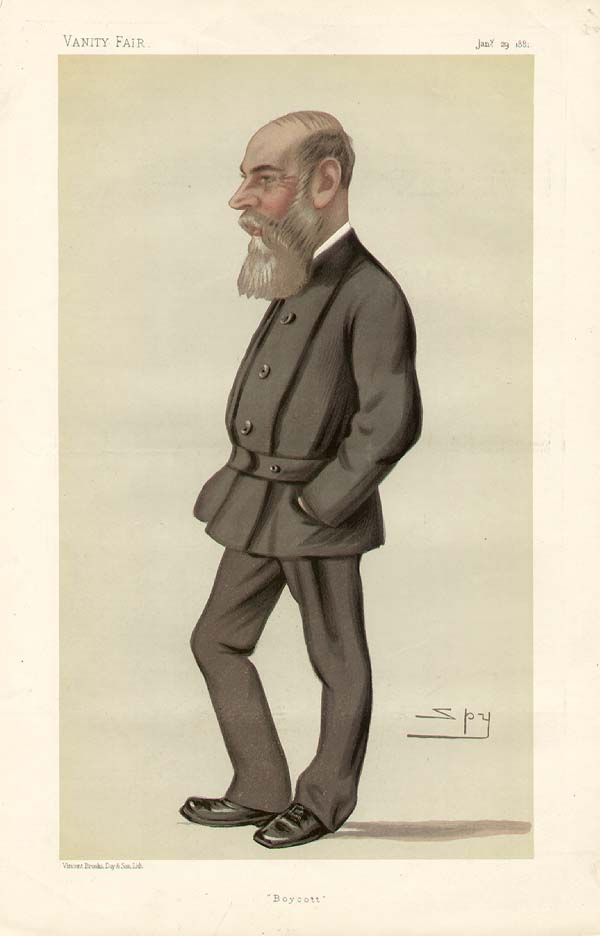
Captain Boycott was the landlord whose tenants shunned him.He was the agent
- The sources call him a land agent. Merriam-Webster: a retired British army captain “acting as an agent for an absentee landlord”.3 Etymonline: land agent of Lough Mask in County Mayo, who refused to lower rents for his tenant farmers.4 Wikipedia names the landlord as Lord Erne.6
- The blur is old. In the sentence on the page at the top Redpath speaks of ostracism applied “to a landlord or a land-agent like Boycott”, as if the two were one case.1
- The dispute was about rent. Wikipedia says Erne agreed to a 10 per cent reduction because of a poor harvest, the tenants except two demanded 25, and Boycott then obtained eviction notices against eleven of them. We have only Wikipedia’s word for these figures.6
- The best witness is one-sided. Redpath was a Land League campaigner, and in the same interview he says every statement in Boycott’s letter to the press “was a lie”. The editor of the book writes of tenants “whom he had pitilessly oppressed”.1 Treat both as opinions from the campaign, not a neutral record.
And who coined the word?
- The only account we found is Redpath’s. At dinner at the presbytery, he says, he told Father John he was “bothered about a word”. Ostracism would not do, because the peasants would not know it. Father John “looked down, tapped his big forehead”, and said: “How would it do to call it to Boycott him?”1
- Redpath also says the pair agreed: “he was the first man who uttered the word and I the first who wrote it.” He compares the plan to lynching, named for a Virginia judge of the backwoods, as he puts it.1
- The method had been described before the word existed. At Ennis on 19 September 1880 Parnell told a crowd to shun a man who takes an evicted man’s farm: “you must shun him in the shop”. The part of the speech Wikipedia quotes does not contain the word.6
- Redpath says that when the Leenane crowd heard him on 28 August 1880 he advised “social excommunication — it is now called Boycotting”. That is his later wording of what he said then.1
- Wikipedia, citing Joyce Marlow’s 1973 biography, gives Redpath’s Inter-Ocean of 12 October 1880 as the first use in print, and an 1880 Birmingham paper calling it a local term.6 We have not seen either paper or the book.
Through time
Through time
Most words take generations. This one took weeks, and the man it was named for was still alive to see it travel. Drag the line and read what was written.

Route to English
How it spread
- BoycottAn English surname, “from a place in England”.4
- Capt. BoycottCharles C. Boycott, land agent near Lough Mask, County Mayo, ostracized in the autumn of 1880.34
- to boycottVerb, coined in Mayo in September 1880 on Redpath’s account.1
- boycottPrinted in Chicago in October 1880, on Marlow’s word, and carried to New York with Boycott’s own visit in April 1881.61
- boycotter, boykottieren, ボイコットNewspapers quickly carried it into other languages, Etymonline says, “as far off as Japanese”.4
Stops mark where the word was in use: near Ballinrobe in Mayo, the Chicago paper Redpath wrote for, and New York, where Boycott landed. The Mayo point is approximate, and nobody documented a single journey.
Dates
How old is the word?
Here the dictionaries agree on the year. The month and the first printed use are what we cannot pin from them.
| Source | Gives | What it is dating |
|---|---|---|
| Etymonline4 | 1880 | The noun and the verb together: “to combine in refusing to have dealings with”. |
| Merriam-Webster3 | 1880 | First known use, in the sense of a concerted refusal to deal. |
| Wikipedia, via Marlow6 | 12 October 1880 | Redpath’s letter in the Inter-Ocean, given as the first use in print. We haven’t seen it. |
| Wiktionary2 | no date for the word | Its earliest quote in the verb entry is the Knights of Labor passage of 1886. |
What the 1881 interview adds is a date for the surrounding events but not for the word: Redpath says he was at Leenane on 28 August 1880, and that the word came about three days after the decree against Boycott.1
Measured
The word, measured
Psychologists have asked thousands of people about tens of thousands of words. Here is where boycott lands in six of those datasets.
How many people know it
Of 366 people shown it, 99.2% said they knew it, more than for 83% of the 61,855 words tested. Estimates by group: Americans 98.8%, British 98.5%, men 98.3%, women 99%.10
When people learn it
The average age adults recall learning it, later than about 70% of 31,105 words. The middle word on the list comes at 11.2. These are adults’ estimates, so read them as a rough guide.11
How concrete it feels
People rate it as more of an idea than a thing, more abstract than 53% of 39,954 words. Agreement is low: 29 raters, standard deviation 1.43.12
How it feels emotionally
It leans unpleasant, below 76% of 13,915 words, and raters mostly agree (standard deviation 1.82). It’s more arousing than 81% of those words at 5.00. On dominance it scores 6.52, higher than 93%, meaning people feel more in control.13
Which sense it calls up
Sight comes first, stronger than for 67% of 39,707 words.14
Scale 0 to 5.
Ratings come from panels of roughly 20 to 30 people per word, asked about the word out of context. Percentages are how boycott ranks among the words in that dataset.
Where does your vocabulary land?
Twelve words, each known by fewer Americans than the last. See your estimate against the same 221,268 people in the study above.10
Measure my vocabularyRelatives
Its relatives, and the languages that took it
- hector
- Etymonline’s comparison for an earlier verb made from a name: to hector, “to bluster, bully”, from Hector of the Iliad, 1650s.4
- Kated
- Another one from Etymonline: Gremio’s line in The Taming of the Shrew, “Petruchio is Kated”.4
- lynching
- Redpath’s own model for the word. He says Lynch was the name of a Virginia backwoods “extra-judicial judge”.1
- ostracism
- The word Redpath says would not do, because the peasantry would not know its meaning.1
The same word in other languages
- boycotterFrench
- boykottierenGerman
- boicotearSpanish
- boicottareItalian
- boicotarPortuguese
- boycottenDutch
- bojkotowaćPolish
- бойкотироватьRussian
- boikotoidaFinnish
- boykotTurkish
- ボイコットJapanese
- 杯葛Chinese
These are from Wiktionary’s translation table and its descendants list for English boycott.2 Chinese bēigé is marked there as a loanword. Etymonline says newspapers adopted the word quickly in languages “as far off as Japanese”.4
Test yourself
Three questions from this page
Sources
Where every claim comes from
We read Redpath’s 1881 book, Johnson, Webster, Wiktionary and the data files ourselves, and calculated the numbers on this page from those files. Etymonline and Merriam-Webster block automated readers, so we read their Internet Archive copies. Everything we know only through Wikipedia is marked as such. Checked on 5 November 2026. If something is wrong, write to hello@lexicist.com.
- Redpath, James. Talks about Ireland. New York: P. J. Kenedy, 1881. “An Interview with James Redpath”, pp. 81–82 (reprinted from the Chicago Inter-Ocean, 14 April 1881); chapter V on the Leenane speech; editor’s note to the interview. Google Books copy at the Internet Archive. archive.org
- Wiktionary, “boycott”, English section. en.wiktionary.org/wiki/boycott
- Merriam-Webster, “boycott”. We read the Internet Archive copy of 31 December 2025; the live site blocks automated access. merriam-webster.com/dictionary/boycott
- Harper, Douglas. “boycott”. Online Etymology Dictionary. We read the Internet Archive copy; the live site blocks automated access. etymonline.com/word/boycott
- Merriam-Webster Thesaurus, “boycott”. Internet Archive copy. merriam-webster.com/thesaurus/boycott
- Wikipedia, “Charles Boycott”. We read it for the Land League, the Ennis speech and Marlow’s dating, and did not open its sources. en.wikipedia.org/wiki/Charles_Boycott
- Johnson, Samuel. A Dictionary of the English Language. 1755. No entry for boycott. johnsonsdictionaryonline.com
- Webster, Noah. An American Dictionary of the English Language. 1828. No entry for boycott. webstersdictionary1828.com
- Wikipedia, “Charles Boycott”, section “The word boycott”, on the 1888 dictionary entry. Same article as note 6. en.wikipedia.org/wiki/Charles_Boycott
- Brysbaert, M., et al. “Word prevalence norms for 62,000 English lemmas”. Behavior Research Methods 51 (2019): 467–479. doi.org/10.3758/s13428-018-1077-9
- Kuperman, V., et al. “Age-of-acquisition ratings for 30,000 English words”. Behavior Research Methods 44 (2012): 978–990. doi.org/10.3758/s13428-012-0210-4
- Brysbaert, M., et al. “Concreteness ratings for 40 thousand generally known English word lemmas”. Behavior Research Methods 46 (2014): 904–911. doi.org/10.3758/s13428-013-0403-5
- Warriner, A. B., et al. “Norms of valence, arousal, and dominance for 13,915 English lemmas”. Behavior Research Methods 45 (2013): 1191–1207. doi.org/10.3758/s13428-012-0314-x
- Lynott, D., et al. “The Lancaster Sensorimotor Norms”. Behavior Research Methods 52 (2020): 1271–1291. doi.org/10.3758/s13428-019-01316-z
- Brysbaert, M., and B. New. “Moving beyond Kučera and Francis”. Behavior Research Methods 41 (2009): 977–990. doi.org/10.3758/BRM.41.4.977
- Google Books Ngram Viewer, English 2019 corpus, 1700–2022, smoothing 3. Open the chart. Method: Michel, J.-B., et al. Science 331 (2011): 176–182. doi.org/10.1126/science.1199644
Image and audio credits
1881 page: Internet Archive copy of a Google Books scan, public domain. Caricature: Leslie Ward, Vanity Fair, 1881, public domain, via Wikimedia Commons. Map: Natural Earth, public domain.