mentor
nounmen·tor/ˈmɛn.tɔɹ/
A trusted adviser or teacher, usually an older person who guides someone younger or less experienced.
She became my mentor at the firm.
From French mentor, which was taken from Mentor, a character in a novel of 1699 about the son of Odysseus.4 That novel built on Homer’s Odyssey, where Mentor is a minor figure and the adviser is the goddess Athena wearing his shape.21 Etymonline dates the general noun to 1750.3
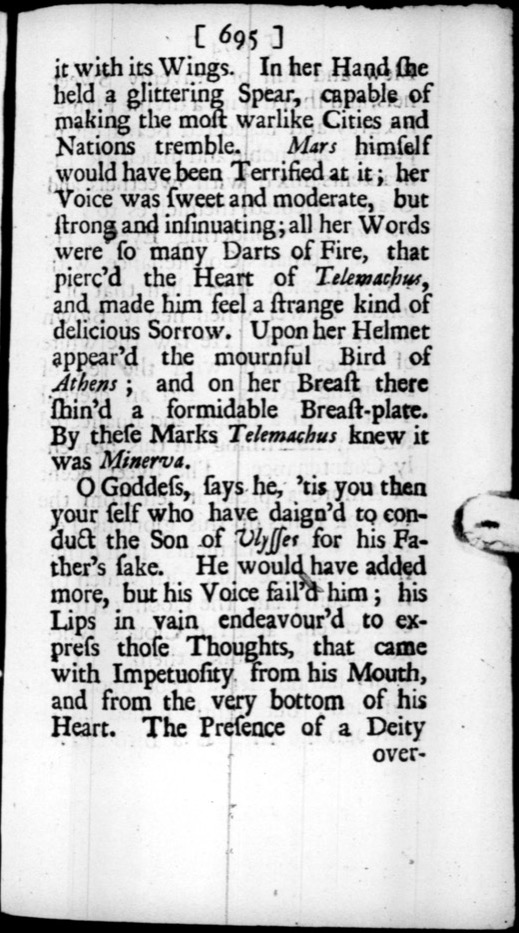
“By these Marks Telemachus knew it was Minerva.”
Page 695 of The Adventures of Telemachus the Son of Ulysses, translated from the French, London, 1699. Mentor, who has guided the young prince through the whole book, is shown to be the goddess Minerva (the Roman Athena). Spelling is as printed; the page uses the long s, which we write as s. See the book at the Internet Archive.1
Meanings
What it means today
The first entry in Merriam-Webster is different: with a capital M, it is the friend of Odysseus who was left to look after his house.4 The common noun is that name put to work.
In sentences
- After college, her professor became her close friend and mentor.4
I thought he was supposed to be my mentor. But, in actuality, what did I know about the often beguiling world of adults?
Reif Larsen, The Selected Works of T. S. Spivet, 2009, as quoted by Wiktionary.6
Words that sit nearby
- mentee
- The person being mentored. Wiktionary lists it, with mentoree, among derived terms.6
- mentorship
- Etymonline lists it as a related form.3 So are mentored and mentoring.3
- monitor
- Etymonline puts monitor, “one who reminds, admonishes”, on the same root.3
- mind
- Wiktionary says the name Mentor shares its root with English mind.6
Synonyms
Synonyms and antonyms for mentor
Synonyms
- For an adviseradvisor, adviser, counselor, counsellor, guide, cicerone.5 The thesaurus lists advisor first.
- For a teacher or trainerteacher, instructor, tutor, coach, trainer, drillmaster, driller.5
- For someone in charge of youmanager, handler.5
- As a verb, “to mentor”guide, coach, show, teach, tutor, lead, counsel, steer, shepherd, nurture, and many more.5
Antonyms
English has no exact antonym for mentor. The Merriam-Webster thesaurus entry lists no antonyms and no near antonyms for it, as noun or verb.5 The mirror-image word is mentee, which is a counterpart and not an opposite.6
Through time
Through time
Mentor was a name for a long time before it was a job. It became a job title because of a novel, and then the novel faded and the title stayed. Drag the line and read what was printed at each point.
Why a goddess in disguise became the model teacher
Homer gives the character very little. When Odysseus sailed to Troy he left his house in Mentor’s care, and in book 2 Mentor rises in the assembly to scold the people of Ithaca for not stopping the suitors.2 The wise advice that follows comes from Athena, who takes Mentor’s form for the journey with Telemachus.2 Fénelon’s novel stretched that into a whole book. His Mentor scolds the young prince when he preens over a new tunic, and at the end the goddess says she led him through Shipwracks, unknown Countries, Bloody Wars
.1 Merriam-Webster notes that in Fénelon’s work Mentor’s speeches make up much of the book.4
Route to English
How it traveled from Ithaca to England
- ΜέντωρGreek, the name of a friend of Odysseus in the Odyssey.2 Etymonline thinks it may be an agent noun meaning “adviser”, from a root meaning “to think”.3
- MentorLatin, the same name.4
- mentorFrench, a common noun, taken from Mentor in Fénelon’s Les aventures de Télémaque, 1699.4
- mentorEnglish, borrowed from French.4 Etymonline dates the general sense to 1750.3
Stops mark where each language was used. Nobody documented a single journey. The meaning of the name is Etymonline’s reading, with “perhaps”, and we have not checked it against an Indo-European dictionary.
Dates
How old is the word?
The two dictionaries we could read are 134 years apart. They are dating different things.
| Source | Gives | What it is dating |
|---|---|---|
| Merriam-Webster4 | 1616 | The noun, “in the meaning defined at sense 1”. That is the capitalized name, the friend of Odysseus. |
| Etymonline3 | 1750 | The general noun, “wise adviser, intimate friend who also is a sage counselor”. |
| Etymonline3 | 1888 | The verb, “serve as a mentor to”. |
| Merriam-Webster4 | 1918 | The verb. |
| Wiktionary6 | no date | Gives the line French mentor, from Greek Μέντωρ. |
Merriam-Webster’s page dates only the name. Etymonline dates the job title. For the verb the two disagree by 30 years and neither prints the sentence on the page we read, so we cannot say who is right.
The myth
A myth: Mentor was the teacher Odysseus chose for his son
In the Odyssey, Odysseus put his friend Mentor in charge of teaching Telemachus.Not in Homer
- The sentence in the poem says Odysseus gave Mentor his house. In Murray’s translation, Mentor
was a comrade of noble Odysseus. To him, on departing with his ships, Odysseus had given all his house in charge, that it should obey the old man and that he should keep all things safe.
The Greek is ἐπέτρεπεν οἶκον ἅπαντα, “entrusted the whole house”.2 It says nothing about a pupil. - Merriam-Webster’s first entry still says that he was
entrusted with the education of Odysseus’ son Telemachus
.4 We found no such line at the place in the Odyssey where Mentor is introduced.2 We read book 2, and we have not searched the whole poem. - The adviser who does speak to Telemachus is Athena. Μέντορι εἰδομένη ἠμὲν δέμας ἠδὲ καὶ αὐδήν, the Greek says: she looks like Mentor, in build and in voice (our translation).2
- The teacher-and-prince story is Fénelon’s. In his book Mentor is the young man’s constant guide, and at the end he turns out to be the goddess.1 Etymonline says the general use probably came by way of later romances, where Mentor played a larger part than in Homer.3
The word is not a mistake. Fénelon built the teacher out of Athena’s visit, and English kept him. What went missing is the original Mentor, an old man minding a house.
Measured
The word, measured
Psychologists have asked thousands of people about tens of thousands of words. Here is where mentor lands in six of those datasets.
How many people know it
Of 428 people shown it, 100.0% said they knew it, more than for 97% of the 61,855 words tested. Estimates by group: Americans 99.5%, British 99.5%, men 99.5%, women 99.1%.7
When people learn it
The average age adults recall learning it, later than about 52% of 31,105 words. The middle word on the list comes at 11.2. These are adults’ estimates, so read them as a rough guide.8
How concrete it feels
People rate it as something you can experience directly, more so than 71% of 39,954 words. Agreement is moderate: 30 raters, standard deviation 1.18.9
How it feels emotionally
It leans pleasant, above 95% of 13,915 words, and raters mostly agree (standard deviation 1.81). It’s calmer than 78% of those words, at 3.50. On dominance it scores 6.60, higher than 94%, meaning people feel more in control.10
Which sense it calls up
Sight comes first, stronger than for 60% of 39,707 words.11
Scale 0 to 5.
Ratings come from panels of roughly 20 to 30 people per word, asked about the word out of context. Percentages are how mentor ranks among the words in that dataset.
Where does your vocabulary land?
Twelve words, each known by fewer Americans than the last. See your estimate against the same 221,268 people in the study above.7
Measure my vocabularyRelatives
Its relatives, and the same word elsewhere
- monitor
- Latin monitor, “one who reminds, admonishes”, from monere, “to remind, advise, warn”. Etymonline puts it with mentor under the same root, “to think”.3
- mantar
- Sanskrit man-tar-, “one who thinks”, cited by Etymonline as another descendant of the root.3
- mind
- Wiktionary says the name Mentor shares its root with mind.6
The same word in other languages
- mentorSpanish
- mentorFrench
- MentorGerman
- mentoreItalian
- mentorPortuguese
- mentorPolish
- mentorSwedish
- μέντοραςGreek
- メンターJapanese
- 멘토Korean
Russian, Finnish and Turkish use other words in Wiktionary’s list: наставник, ohjaaja and hoca.6
Test yourself
Three questions from this page
Sources
Where every claim comes from
We read the 1699 page, the Greek and English of the Odyssey passage, and the data files ourselves, and calculated the numbers on this page from those files. Etymonline and Merriam-Webster block automated readers, so we read their Internet Archive copies. We could not read Johnson’s 1755 dictionary (the site’s entry service was down, and an OCR copy was unusable here for this word), and Webster’s 1828 dictionary has no entry for mentor on the site we searched. Checked on 5 November 2026. If something is wrong, write to hello@lexicist.com.
- The Adventures of Telemachus the Son of Ulysses. Translated from the French. London: Printed for Awnsham and John Churchil, 1699. Pages 695–696, with the translator’s preface. Internet Archive scan of a microfilm copy; the book is in the public domain. archive.org
- Homer, Odyssey 2.225–241 and 2.267–270, Greek text and A. T. Murray’s translation (Loeb, 1919). Perseus Digital Library. Greek · English
- Harper, Douglas. “mentor”. Online Etymology Dictionary. We read the Internet Archive copy of 2024; the live site blocks automated access. etymonline.com/word/mentor
- Merriam-Webster, “mentor”. We read the Internet Archive copy; the live site blocks automated access. merriam-webster.com/dictionary/mentor
- Merriam-Webster Thesaurus, “mentor”, noun and verb. Internet Archive copy. merriam-webster.com/thesaurus/mentor
- Wiktionary, “mentor”, English section. en.wiktionary.org/wiki/mentor
- Brysbaert, M., et al. “Word prevalence norms for 62,000 English lemmas”. Behavior Research Methods 51 (2019): 467–479. doi.org/10.3758/s13428-018-1077-9
- Kuperman, V., et al. “Age-of-acquisition ratings for 30,000 English words”. Behavior Research Methods 44 (2012): 978–990. doi.org/10.3758/s13428-012-0210-4
- Brysbaert, M., et al. “Concreteness ratings for 40 thousand generally known English word lemmas”. Behavior Research Methods 46 (2014): 904–911. doi.org/10.3758/s13428-013-0403-5
- Warriner, A. B., et al. “Norms of valence, arousal, and dominance for 13,915 English lemmas”. Behavior Research Methods 45 (2013): 1191–1207. doi.org/10.3758/s13428-012-0314-x
- Lynott, D., et al. “The Lancaster Sensorimotor Norms”. Behavior Research Methods 52 (2020): 1271–1291. doi.org/10.3758/s13428-019-01316-z
- Brysbaert, M., and B. New. “Moving beyond Kučera and Francis”. Behavior Research Methods 41 (2009): 977–990. doi.org/10.3758/BRM.41.4.977
- Google Books Ngram Viewer, English 2019 corpus, 1700–2022, smoothing 3. Open the chart. Method: Michel, J.-B., et al. Science 331 (2011): 176–182. doi.org/10.1126/science.1199644
Image and audio credits
1699 page: Internet Archive, microfilm scan, public domain. Map: Natural Earth, public domain.