idiot
nounid·i·ot/ˈɪdiət/
A very foolish person. In older law and medicine, someone judged to have had no power of reason from birth.
I felt like an idiot.
From Greek idiōtēs, “private person, layman”, built on idios, “one’s own”.23 It came through Latin idiota and Old French idiote and was in English by the 14th century.23 In English it first meant a person without reasoning power or without learning, not the everyday insult.23 The tale that Athens used it for citizens who skipped politics has no ancient source.910
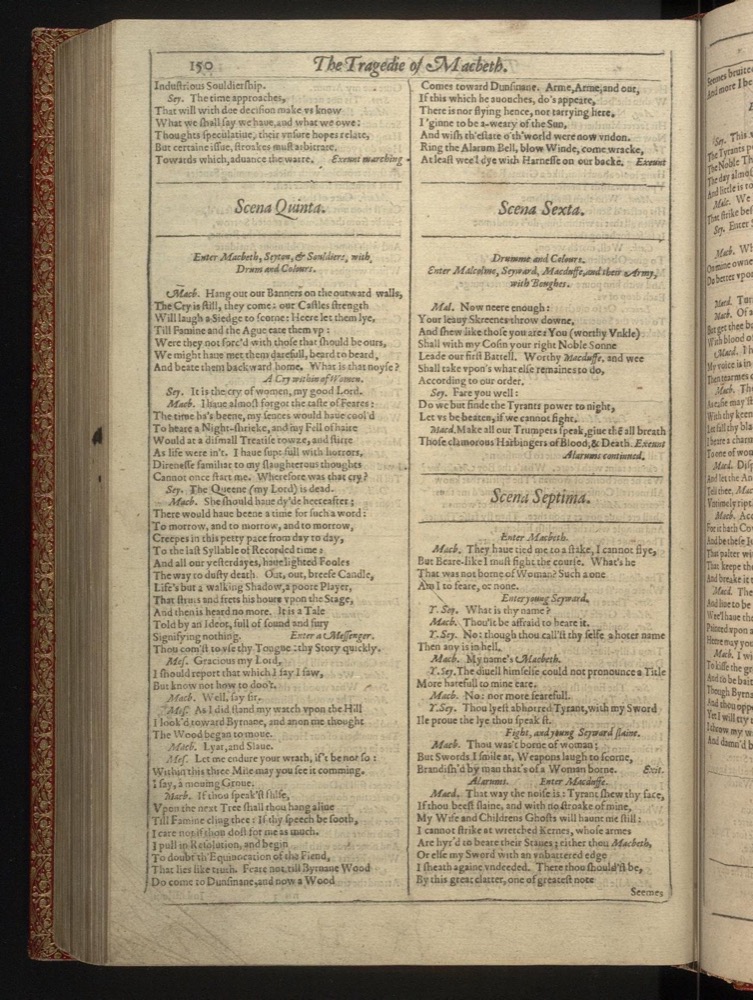
“It is a Tale / Told by an Ideot, full of sound and fury / Signifying nothing.”
Page 150 of the First Folio, London, 1623: The Tragedie of Macbeth, Act 5, scene 5, left column. The word is spelled Ideot. The page uses the long s, which we write as s. Scan: Schoenberg Center for Electronic Text & Image, via Wikimedia Commons. See the page at Commons.1

Meanings
What it means today
- In older law and medicine, a person judged to have had no reasoning power from birth. Merriam-Webster marks this sense dated and now offensive. Its usage note says that idiot, imbecile and moron were once technical terms in medical, educational and legal settings, and that this use was broadly rejected by the end of the 20th century.3Idiots were thought to be peculiarly under the care of the Deity. (Clifton Johnson, 1896, as quoted by Wiktionary)
The older sense is the one the early dictionaries give. Johnson’s 1755 dictionary has “a fool; a natural; a changeling; one without the powers of reason”.6 Webster in 1828 begins with “a natural fool or fool from his birth” and then draws a legal line. A person with enough understanding to measure a yard of cloth, count twenty, or tell the days of the week “is not an idiot in the eye of the law”. His second sense is the one we use: “a foolish person; one unwise.”7
In sentences
Only an idiot would invest in a company just because a casual acquaintance recommended it.
Example in the Merriam-Webster thesaurus entry.4Life is a tale, told by an idiot, full of sound and fury, signifying nothing.
Shakespeare, Macbeth, quoted under idiot by Samuel Johnson, 1755, with the spelling modernized.6Many idiots will believe that they see what they only hear.
John Dennis, quoted by Johnson, 1755.6
Words that sit nearby
- idiocy
- Listed as a related term in Wiktionary.5 Like idiot, it was a medical and legal word before it was an insult.3
- idiot savant
- Etymonline dates it to 1870.2
- idiot box
- A television set, from 1959 in Etymonline’s dating.2
- idiot light
- A dashboard warning signal, from 1961.2
- village idiot
- A derived term in Wiktionary.5
- useful idiot
- Listed under idiot in Merriam-Webster’s phrases.3
Synonyms
Synonyms and antonyms for idiot
Synonyms
- For a foolish personmoron, dummy, fool, dolt, dunce, dimwit, blockhead, simpleton, nitwit, ninny, oaf.4 Moron is the first the thesaurus lists. Wiktionary offers imbecile and moron for the same sense.5
- In the older sensefool, natural, changeling, in Johnson’s own words.6 The thesaurus also lists natural.4 Webster’s word is natural fool.7
Antonyms
English has no exact antonym for idiot. The Merriam-Webster thesaurus lists only near antonyms, words for a person who thinks well.4
- Near antonymsgenius, brain, intellect, thinker, sage, intellectual, polymath.4
Through time
Through time
For seven hundred years the word has been moving between “someone without learning”, “someone without reason” and “someone who acted foolishly”. Drag the line and read what people wrote.
The page that defines both words
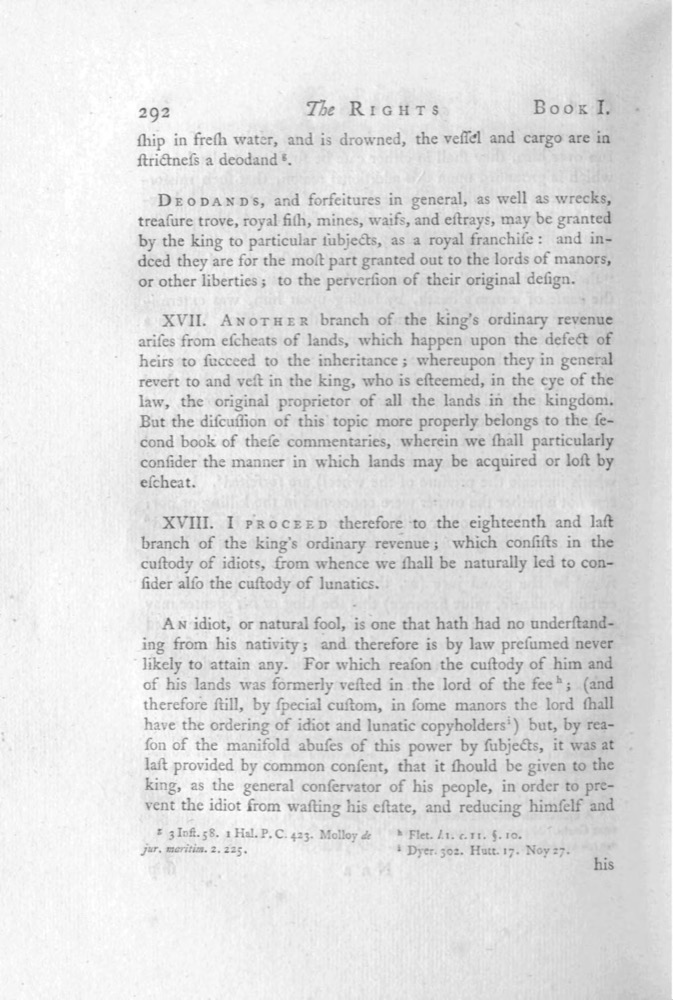
Blackstone’s chapter on the king’s revenue ends with the king’s duty to look after people who could not manage their affairs. He treats the idiot first, then the lunatic, and the two are told apart by when the loss of reason began: from birth, or later.8
Route to English
How it traveled from Athens to England
- ἴδιος, idiosGreek, “one’s own, pertaining to oneself, private”.5
- ἰδιώτης, idiōtēsGreek, “private person” as opposed to someone in public affairs, and “layman” as opposed to a skilled worker. Etymonline says it was “used patronizingly for ignorant person”.2
- idiotaLatin, “ordinary person, layman, outsider”. In Late Latin, “uneducated or ignorant person”.2
- idioteOld French, “uneducated or ignorant person”, 12th century.2
- ydiote, idioteMiddle English, “layman” and “fool”, from the early 14th century.212
- idiotModern English.5
Stops mark where each language was used. Nobody documented a single journey, and the line is a picture of the word’s family tree. We could not open the Middle English Dictionary, which sits behind a bot check, so the Middle English step rests on Etymonline, Merriam-Webster and Wiktionary.
Dates
How old is the word?
The dictionaries agree on the century. Where they quietly disagree is which meaning came first.
| Source | Gives | What it is dating |
|---|---|---|
| Etymonline2 | early 14c. | “Person so mentally deficient as to be incapable of ordinary reasoning.” The sense “simple man, uneducated person, layman” follows in the late 14th century. |
| Merriam-Webster3 | 14th century | First known use, in the sense it numbers 2, a person with an intellectual disability, now marked offensive. |
| Wiktionary5 | no date | Its Middle English entry lists both “layman” and “idiot, fool”.12 |
Merriam-Webster’s own word-history note says that English idiot “originally meant ‘ignorant person’”, yet the date it gives belongs to the disability sense.3 Etymonline puts the disability sense first and the layman some decades later.2 We cannot tell from these pages which is right. The earliest written sentence would settle it, and the Middle English Dictionary was not open to us.
The myth
A myth: Athenians called people who skipped politics idiots
In ancient Athens an idiōtēs was a citizen who took no part in public life, and that is why we call fools idiots.No ancient source
- The Greek word meant “private person” as opposed to a public official, and “layman” as opposed to an expert or craftsman.2310 Etymonline says it could also be used patronizingly for an ignorant person.2
- The passage people point to is Pericles’ funeral speech in Thucydides 2.40. In the 1910 translation it says that Athens regards “him who takes no part in these duties not as unambitious but as useless”.9 We opened the Greek of that chapter. It calls such a man apragmōn, “unambitious”, and achreios, “useless”. The word idiōtēs is not in it.9
- Wikipedia reports that scholars find no ancient writer using the word for non-participants or as an insult, and that the insult came centuries later. It names a 1988 article by A. W. Sparkes, a 2014 article by Matthew Landauer, and the Cambridge Greek Lexicon. We have not opened them.10
- The same article traces the political reading in English to 1856, long after the insult existed in English.10 The English insult comes down the other path: Latin and French idiota meant “ignorant”, and English added “mentally deficient” in the 14th century.2310
What is true is smaller. Pericles did say that a man who stays out of public affairs is useless. He did not call that man an idiōtēs, and the English insult grew from a different sense of the word.
Measured
The word, measured
Psychologists have asked thousands of people about tens of thousands of words. Here is where idiot lands in six of those datasets.
How many people know it
Of 403 people shown it, 98.8% said they knew it, more than for 79% of the 61,855 words tested. Estimates by group: Americans 97.8%, British 99.5%, men 98.3%, women 98.6%.13
When people learn it
The average age adults recall learning it, earlier than about 91% of 31,105 words. The middle word on the list comes at 11.2. These are adults’ estimates, so read them as a rough guide.14
How concrete it feels
People rate it as something you can experience directly, more so than 62% of 39,954 words. Agreement is low: 29 raters, standard deviation 1.39.15
How it feels emotionally
It leans unpleasant, below 92% of 13,915 words, and raters mostly agree (standard deviation 1.75). It’s more arousing than 77% of those words at 4.85. On dominance it scores 4.20, lower than 85%, meaning people feel less in control.16
Which sense it calls up
Sight comes first, stronger than for 74% of 39,707 words, and hearing is close behind at 92%.17
Scale 0 to 5.
Ratings come from panels of roughly 20 to 30 people per word, asked about the word out of context. Percentages are how idiot ranks among the words in that dataset.
Where does your vocabulary land?
Twelve words, each known by fewer Americans than the last. See your estimate against the same 221,268 people in the study above.13
Measure my vocabularyRelatives
Its relatives, and the same word elsewhere
- idiom
- Same Greek root. Etymonline derives it from idioma, “peculiarity”, from idioumai, “to appropriate to oneself”, from idios, “personal, private”.11
- idiocy
- Listed with idiom and idiosyncratic as related terms in Wiktionary.5
- idiosyncratic
- A related term in Wiktionary.5
The same word in other languages
- idiotaSpanish
- idiotFrench
- idiotaItalian
- idiotaPortuguese
- idiotaCatalan
- IdiotGerman
- idiootDutch
- idiotRomanian
- идиотRussian
- idiotaPolish
- idiótaHungarian
- idioottiFinnish
Wiktionary’s translation list gives Greek ηλίθιος and βλάκας for the modern insult, and Turkish aptal and Welsh twpsyn.5
Test yourself
Three questions from this page
Sources
Where every claim comes from
We read the 1623 page, Johnson, Webster, Blackstone’s page, the Greek of Thucydides and the data files ourselves, and calculated the numbers on this page from those files. Etymonline and Merriam-Webster block automated readers, so we read their Internet Archive copies. Material we know only through Wikipedia’s article is marked as such. Checked on 5 November 2026. If something is wrong, write to hello@lexicist.com.
- The Tragedie of Macbeth, in Shakespeare, Comedies, Histories & Tragedies (First Folio). London, 1623, p. 150. Scan by the Schoenberg Center for Electronic Text & Image, public domain, via Wikimedia Commons. commons.wikimedia.org. The spelling is also in the Wikisource transcription of the 1910 facsimile, Act 5, scene 5.
- Harper, Douglas. “idiot”. Online Etymology Dictionary. We read the Internet Archive copy of 28 December 2024; the live site blocks automated access. etymonline.com/word/idiot
- Merriam-Webster, “idiot”, with its usage note and word history. We read the Internet Archive copy of 21 December 2024; the live site blocks automated access. merriam-webster.com/dictionary/idiot
- Merriam-Webster Thesaurus, “idiot”, Synonyms, Antonyms and Near Antonyms. Internet Archive copy of 13 December 2024. merriam-webster.com/thesaurus/idiot
- Wiktionary, “idiot”, English section, with its translation list. en.wiktionary.org/wiki/idiot
- Johnson, Samuel. A Dictionary of the English Language. 1755. johnsonsdictionaryonline.com
- Webster, Noah. An American Dictionary of the English Language. 1828. webstersdictionary1828.com
- Blackstone, William. Commentaries on the Laws of England, vol. 1. Oxford: Clarendon Press, 1765. Book 1, ch. 8, pp. 292–294. Scan on the Internet Archive; text of the chapter at the Avalon Project, Yale. archive.org · avalon.law.yale.edu
- Thucydides, The Peloponnesian War, 2.40. Greek text and the translation by Richard Crawley (London: J. M. Dent, 1910). Perseus Digital Library. perseus.tufts.edu
- Wikipedia, “Idiot”, Etymology. It cites Sparkes (1988), Landauer (2014), the Cambridge Greek Lexicon and the commentators of 1846 to 2017, none of which we opened. en.wikipedia.org/wiki/Idiot
- Harper, Douglas. “idiom”. Online Etymology Dictionary, Internet Archive copy, shown in the entries linked from “idiot”. etymonline.com/word/idiom
- Wiktionary, “ydiote”, Middle English section. en.wiktionary.org/wiki/ydiote
- Brysbaert, M., et al. “Word prevalence norms for 62,000 English lemmas”. Behavior Research Methods 51 (2019): 467–479. doi.org/10.3758/s13428-018-1077-9
- Kuperman, V., et al. “Age-of-acquisition ratings for 30,000 English words”. Behavior Research Methods 44 (2012): 978–990. doi.org/10.3758/s13428-012-0210-4
- Brysbaert, M., et al. “Concreteness ratings for 40 thousand generally known English word lemmas”. Behavior Research Methods 46 (2014): 904–911. doi.org/10.3758/s13428-013-0403-5
- Warriner, A. B., et al. “Norms of valence, arousal, and dominance for 13,915 English lemmas”. Behavior Research Methods 45 (2013): 1191–1207. doi.org/10.3758/s13428-012-0314-x
- Lynott, D., et al. “The Lancaster Sensorimotor Norms”. Behavior Research Methods 52 (2020): 1271–1291. doi.org/10.3758/s13428-019-01316-z
- Brysbaert, M., and B. New. “Moving beyond Kučera and Francis”. Behavior Research Methods 41 (2009): 977–990. doi.org/10.3758/BRM.41.4.977
- Google Books Ngram Viewer, English 2019 corpus, 1700–2022, smoothing 3. Open the chart. Method: Michel, J.-B., et al. Science 331 (2011): 176–182. doi.org/10.1126/science.1199644
Image and audio credits
1623 page: Schoenberg Center for Electronic Text & Image, public domain, via Wikimedia Commons. 1765 page: Internet Archive, public domain. Recording: Dvortygirl (US), CC BY-SA 3.0, via Wikimedia Commons. Map: Natural Earth, public domain.