nice
adjective/naɪs/
Pleasant or agreeable. Said of a person, kind and friendly.
She’s very nice.
From Old French nice, “simple, foolish, ignorant”, which comes from Latin nescius, “ignorant”, literally “not knowing”.23 English had it by the late 13th century, and it meant “foolish”.2 Etymonline dates “agreeable, delightful” to 1769 and “kind, thoughtful” to 1830.2
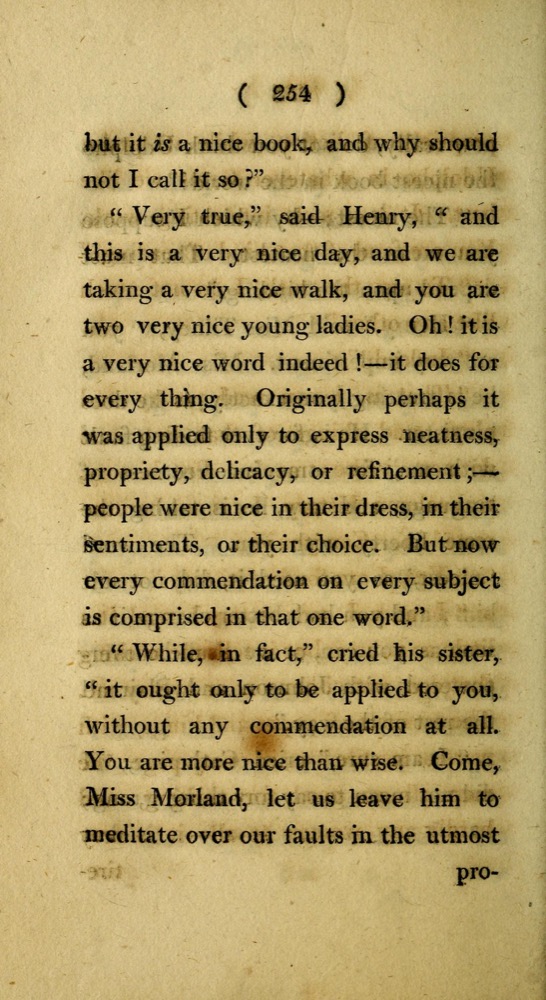
“Oh! it is a very nice word indeed!—it does for every thing. Originally perhaps it was applied only to express neatness, propriety, delicacy, or refinement.”
Page 254 of the first volume of Jane Austen’s Northanger Abbey, printed with Persuasion by John Murray, London, 1818. Henry Tilney is teasing Catherine Morland for calling a book nice. Duke University Libraries’ copy, scanned by the Internet Archive. See the book at the Internet Archive.1
Meanings
What it means today
- Of a person: kind, friendly. Wiktionary lists this separately, also from the 18th century.3She’s very nice.
- Exact, fine, delicate. Still alive in a few set phrases. Merriam-Webster gives “possessing, marked by, or demanding great or excessive precision”, as in a nice distinction between two words.5A nice distinction.
In sentences
- That’s nice of you to say.5
Thus critics, of less judgment than caprice, / Curious, not knowing, not exact, but nice.
Alexander Pope, quoted under nice by Samuel Johnson, 1755. Here nice is a fault: fussy.7It is a very nice word indeed!
Henry Tilney in Jane Austen’s Northanger Abbey, 1818. See the page at the top of this article.1
Words that sit nearby
- nicety
- A fine point, an exact detail. Etymonline says it first meant “folly, stupidity” in the late 14th century and then followed the same path as nice.10
- nicely
- Merriam-Webster lists it as a derived form of nice.5
- nescient
- “Ignorant”. From the Latin verb nescire, “not to know”, the same verb that gave nice its start.10
- Nice
- The French city is not related. Etymonline traces it to Greek nikaios, “victorious”.2
Synonyms
Synonyms and antonyms for nice
Synonyms
- Pleasantpleasant, delightful, enjoyable, pleasing, good, satisfying, welcome, pleasurable, comfortable.6
- Of a person, graciousfriendly, amiable, kind, polite, agreeable, gentle, thoughtful, courteous, considerate, likable.6
- Polite, properpolite, proper, respectable, acceptable, decent, correct, genteel, seemly.6
- Careful, hard to pleaseparticular, fastidious, finicky, picky, dainty, choosy, fussy, exacting.6
- Subtle, exactsubtle, fine, delicate, exact, minute, nuanced, refined, meticulous.6
- Honorablehonorable, good, honest, ethical, decent, moral, worthy, upright, virtuous.6
Antonyms
Which word is the opposite depends on which nice you mean. The Merriam-Webster thesaurus lists, sense by sense, antonyms and near antonyms:6
- Pleasantunpleasant, disagreeable, unwelcome, miserable, horrid, boring, offensive.6
- Of a person, graciousunpleasant, disagreeable, ungracious, rude, unkind, impolite, surly.6
- Polite, properimproper, inappropriate, unacceptable, indecent, unseemly, informal, casual.6
- Careful, hard to pleaseflexible, relaxed, undemanding, breezy, lenient, permissive, laid-back.6
- Subtle, exactrough, coarse, obvious, plain, inexact, sloppy, careless.6
Through time
Through time
Few everyday words sit as far from where they started. Drag the line and read what people wrote at each step, from “foolish” to “fussy”, and on to “kind”.
Route to English
How it traveled from Rome to England
- ne + scireLatin, “not” and “to know”.23
- nesciusLatin, “ignorant, not knowing”.3
- niceOld French, 12th century: “careless, clumsy; weak; poor, needy; simple, stupid, silly, foolish”.2
- nyceMiddle English, “foolish, simple, ignorant”. The Middle English forms are nyce, nice, nys.34
- niceModern English.
Stops mark where each language was used. Nobody documented a single journey, and the line is a picture of the word’s family tree. The Proto-Indo-European roots come from Etymonline’s entries for nice and science, and we haven’t checked them against an Indo-European dictionary.
Dates
How old is the word?
The dates differ because the books are dating different meanings. None of them is dating “pleasant”.
| Source | Gives | What it is dating |
|---|---|---|
| Etymonline2 | late 13th century | Nice meaning “foolish, ignorant, frivolous, senseless”. Later steps: “agreeable, delightful” 1769, “kind, thoughtful” 1830. |
| Merriam-Webster5 | 14th century | First known use of the adjective, in the obsolete sense 7a, “wanton, dissolute”. The adverb is dated about 1544. |
| Wiktionary34 | 14th century for the older senses; 18th century for “pleasant” and “friendly” | Lists Middle English nyce with senses from “foolish” to “fussy” and “wanton”, and separates the modern informal senses. |
| Johnson 17557 | no “pleasant” | Eight senses, all about exactness, delicacy or fussiness. |
The date we could not check is the earliest written example itself. None of the dictionaries we could read prints the 13th-century sentence, and the Middle English Dictionary refused automated access. We have not seen the first text.
The claim
A claim checked: nice used to mean stupid
Nice once meant “foolish”.True, but only at the start
- The Latin source is nescius, “ignorant”.23 The Old French nice meant “simple, stupid, silly, foolish”.2 Etymonline’s first English definition, from the late 13th century, is “foolish, ignorant, frivolous, senseless”.2
- It did not stay there. Etymonline lists the steps: “timid, faint-hearted” before 1300, “fussy, fastidious” in the late 14th century, “dainty, delicate” about 1400, “precise, careful” in the 1500s, “agreeable, delightful” in 1769 and “kind, thoughtful” in 1830.2 Etymonline quotes the etymologist Ernest Weekley: “The sense development has been extraordinary, even for an adj.”2
- So the claim holds for the word’s first few centuries and fails for everything after. Chaucer, before 1400, sets nyce beside straunge, “strange”, which is not the plain “foolish” of the dictionaries.49 The word nicety, from the same source, was “folly, stupidity” in the late 14th century before it came to mean a fine point.10
- Neither great 18th and 19th century dictionary has it the way we use it. Johnson in 1755 has fussiness and exactness.7 Webster in 1828 lists “very pleasant to the taste” first and fastidious and delicate senses after it. He does not list “kind”.8
- Both also guessed the origin wrong. Johnson gives a Saxon word for “soft”, and Webster a German verb for eating sweets.78 Etymonline and Wiktionary both give Latin nescius.23
One more thing the sources agree on: the city of Nice has nothing to do with it. Etymonline traces the place name to Greek nikaios, “victorious”.2
Measured
The word, measured
Psychologists have asked thousands of people about tens of thousands of words. Here is where nice lands in six of those datasets.
How many people know it
Of 392 people shown it, 100.0% said they knew it, more than for 97% of the 61,855 words tested. Estimates by group: Americans 99.5%, British 99.5%, men 98.9%, women 99.5%.11
When people learn it
The average age adults recall learning it, earlier than about 99% of 31,105 words. The middle word on the list comes at 11.2. These are adults’ estimates, so read them as a rough guide.12
How concrete it feels
People rate it as more of an idea than a thing, more abstract than 73% of 39,954 words. Agreement is low: 28 raters, standard deviation 1.31.13
How it feels emotionally
It leans pleasant, above 94% of 13,915 words, but raters split widely (standard deviation 2.04). It’s calmer than 76% of those words, at 3.53. On dominance it scores 6.47, higher than 92%, meaning people feel more in control.14
Which sense it calls up
Sight comes first, stronger than for 34% of 39,707 words, and taste is close behind at 91%.15
Scale 0 to 5.
Ratings come from panels of roughly 20 to 30 people per word, asked about the word out of context. Percentages are how nice ranks among the words in that dataset.
Where does your vocabulary land?
Twelve words, each known by fewer Americans than the last. See your estimate against the same 221,268 people in the study above.11
Measure my vocabularyRelatives
Its relatives
- science
- Same Latin verb, scire, “to know”. Etymonline gives science from Latin scientia, “knowledge”, and says nice is built on ne- plus the stem of scire.102
- nescient
- From Latin nescire, “not to know”. Early 15th century in English.10
- nicety
- Late 14th century, “folly, stupidity”; from Old French niceté.10
The word in other languages
We did not check descendants in other languages for this word, so we list none. The Old French nice is the one that matters for English.2
Test yourself
Three questions from this page
Sources
Where every claim comes from
We read the 1818 page, Johnson, Webster, Chaucer’s lines in the Gutenberg text and the data files ourselves, and calculated the numbers on this page from those files. Etymonline and Merriam-Webster block automated readers, so we read their Internet Archive copies. The Middle English Dictionary refused automated access and we did not open it. Material we know only through another writer is marked as such. Checked on 5 November 2026. If something is wrong, write to hello@lexicist.com.
- Austen, Jane. Northanger Abbey: and Persuasion. London: John Murray, 1818. Vol. 1, p. 254. Duke University Libraries copy, Internet Archive, no known restrictions as a work of 1818. archive.org/details/northangerabbeyp141aust
- Harper, Douglas. “nice”. Online Etymology Dictionary. We read the Internet Archive copy of December 2024; the live site blocks automated access. etymonline.com/word/nice
- Wiktionary, “nice”, English section. en.wiktionary.org/wiki/nice
- Wiktionary, “nyce”, Middle English section. en.wiktionary.org/wiki/nyce
- Merriam-Webster, “nice”. We read the Internet Archive copy of 2024; the live site blocks automated access. merriam-webster.com/dictionary/nice
- Merriam-Webster Thesaurus, “nice”, Synonyms, Antonyms and Near Antonyms. Internet Archive copy of December 2024. merriam-webster.com/thesaurus/nice
- Johnson, Samuel. A Dictionary of the English Language. 1755. johnsonsdictionaryonline.com
- Webster, Noah. An American Dictionary of the English Language. 1828. webstersdictionary1828.com
- Chaucer, Geoffrey. Troilus and Criseyde, book 2, proem, lines 22 to 25. Project Gutenberg eBook 257. gutenberg.org/ebooks/257
- Harper, Douglas. “nicety”, “nescient”, “science”. Online Etymology Dictionary, Internet Archive copies. etymonline.com/word/nicety
- Brysbaert, M., et al. “Word prevalence norms for 62,000 English lemmas”. Behavior Research Methods 51 (2019): 467–479. doi.org/10.3758/s13428-018-1077-9
- Kuperman, V., et al. “Age-of-acquisition ratings for 30,000 English words”. Behavior Research Methods 44 (2012): 978–990. doi.org/10.3758/s13428-012-0210-4
- Brysbaert, M., et al. “Concreteness ratings for 40 thousand generally known English word lemmas”. Behavior Research Methods 46 (2014): 904–911. doi.org/10.3758/s13428-013-0403-5
- Warriner, A. B., et al. “Norms of valence, arousal, and dominance for 13,915 English lemmas”. Behavior Research Methods 45 (2013): 1191–1207. doi.org/10.3758/s13428-012-0314-x
- Lynott, D., et al. “The Lancaster Sensorimotor Norms”. Behavior Research Methods 52 (2020): 1271–1291. doi.org/10.3758/s13428-019-01316-z
- Brysbaert, M., and B. New. “Moving beyond Kučera and Francis”. Behavior Research Methods 41 (2009): 977–990. doi.org/10.3758/BRM.41.4.977
- Google Books Ngram Viewer, English 2019 corpus, 1700–2022, smoothing 3. Open the chart. Method: Michel, J.-B., et al. Science 331 (2011): 176–182. doi.org/10.1126/science.1199644
Image and audio credits
1818 page: Duke University Libraries, via the Internet Archive. Public domain. Recording: Dvortygirl (US), CC BY-SA 3.0, via Wikimedia Commons. Map: Natural Earth, public domain.