avocado
nounav·o·ca·do/ˌæv.əˈkɑ.doʊ/
A pulpy green fruit with one large stone, or the tropical American tree that bears it. Also a light yellowish green.
From Spanish aguacate, from Nahuatl āhuacatl.67 An English merchant wrote it aluacatas in a report dated 1572.2 By 1696 the physician Hans Sloane printed Avocado in a catalogue of Jamaican plants.1
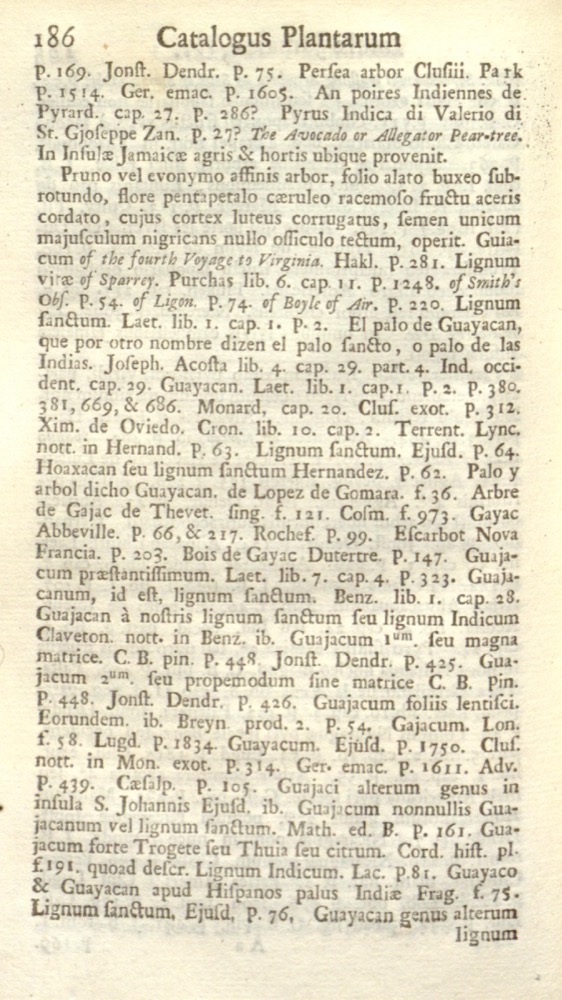
“The Avocado or Allegator Pear-tree.”
Page 186 of Hans Sloane, Catalogus plantarum quae in insula Jamaica, London, 1696. English words stand out in a Latin page. Scan: Missouri Botanical Garden Library, via the Internet Archive. See the page there.
Meanings
Three meanings in use today
- The fruit. Pulpy, nutty-flavored, green to purple skin, from trees of the genus Persea, mainly P. americana. Plural avocados, and Merriam-Webster also allows avocadoes.7Add avocado to the salad.
- The tree that bears it. A member of the laurel family.7The avocado by the fence is taller than the house.
In sentences
- She mashed an avocado onto toast.
- The recipe calls for one ripe avocado.
The fruit is of itself very insipid, for which reason they generally eat it with the juice of lemons and sugar, to give it a poignancy.
Samuel Johnson, 1755, in an entry he credits to Miller.4
Words people mix up with it
- guacamole
- A dish made from avocados. The name comes from the same Nahuatl root, plus a word for sauce.9
- alligator pear
- The old name for the fruit, and still listed as a synonym.86
- avocado pear
- The British name when the fruit became common in the 1960s, according to Wikipedia.9
- advocate
- Not a relative of the fruit. It shares a Latin source with Spanish avocado, “lawyer”, a lookalike that Etymonline says reshaped the fruit’s name.6
The clipped form avo began in Australian English and is now common in South Africa and the UK too.9
Synonyms
Synonyms and antonyms for avocado
Synonyms
- For the fruitalligator pear, avocado pear, butter pear, butter fruit.8 Abacate is the Portuguese form that English also borrowed once.8
- For the treeavocado tree, and in botany Persea americana.8
Antonyms
A fruit name has no antonym in English, and none of the sources we opened lists one. We couldn't open a thesaurus entry for avocado at Merriam-Webster.
Through time
How the word was written, year by year
The dates in dictionaries start in 1696 or 1763. The word was in English print more than a century before that. Drag the line and read the lines as they were written.
A pear with a reptile’s name
Sloane’s line gives two names for one tree, Avocado and Allegator Pear. Etymonline calls alligator pear a corruption of the Mexican Spanish alvacata and alligato.6 Wikipedia describes the same chain from the other end: avogato, then avocado pear, then alligator pear.9 The fruit has nothing to do with alligators.
Route to English
From Nahuatl to a Jamaican plant list
- *pawaProto-Nahuan, reconstructed. Etymonline gives it as the root of the Nahuatl word for avocado.6
- āhuacatlNahuatl, the language of the Aztecs. Molina’s dictionary gives auacatl in 1571, with a second meaning, “testicle”.3
- aguacateSpanish, borrowed from Nahuatl. It is the usual word in Central America, the Caribbean and Spain.69
- avocadoSpanish, in a variant Etymonline says was reshaped after Spanish avocado, “lawyer”.6 Wiktionary notes that this claim still wants a source.8
- aluacatasEnglish, in Henry Hawkes’s report of 1572.2
- Avocado, Allegator PearEnglish, in Hans Sloane’s catalogue of 1696.1
The map marks the three places whose speech the word passed through. Sloane catalogued plants he had seen in Jamaica, and we haven’t traced the word’s own journey any closer than the chain above.
Why dates differ
Why dictionaries date it so differently
Look the word up and you get 1696, 1697 or 1763. The page itself is older than all three.
| Source | Gives | What it is dating |
|---|---|---|
| Hawkes, in Hakluyt2 | 1572 | The spelling aluacatas, in a list of New Spain’s fruits. We read it in a modern reprint |
| Merriam-Webster7 | 1696 | The fruit sense, matching Sloane’s catalogue |
| Wiktionary8 | 1696 | The first mention it points to, again Sloane |
| Wikipedia9 | 1697 | Avogato pear. We haven’t opened the source it uses |
| Johnson4 | 1755 | A full dictionary entry, with the plant described |
| Etymonline6 | 1763, 1945 | The fruit and alligator pear, then the color |
Merriam-Webster and Wiktionary agree with the page, and Etymonline is 67 years later. We can’t say why. The 1572 line is not a dictionary date at all: it is an English merchant spelling a Nahuatl word the way he heard it. No dictionary we opened counts it as the word’s first use.
A myth
“Avocado means testicle”
The word avocado began as the Aztec word for testicle.Backwards
- The claim has a real basis. Molina’s 1571 dictionary gives auacatl as
fruta conocida, o el compañon
, a known fruit, or the testicle.3 Merriam-Webster’s etymology readsavocado, testicle
.7 - The fruit comes first. Etymonline calls the testicle sense a secondary meaning, probably from the resemblance.6 Wikipedia adds that the oldest form can be reconstructed as “avocado”, and that Nahuatl seems to have used the word as a euphemism.9
- So the dictionaries agree that both meanings existed, and disagree with the popular order. We didn’t read a Nahuatl linguistics paper on the direction, only these dictionaries and their summaries.
Measured
The word, measured
Psychologists have asked thousands of people about tens of thousands of words. Here is where avocado lands in six of those datasets.
How many people know it
Of 375 people shown it, 99.2% said they knew it, more than for 84% of the 61,855 words tested. Estimates by group: Americans 98.4%, British 99.5%, men 98.3%, women 99.1%.11
When people learn it
The average age adults recall learning it, earlier than about 72% of 31,105 words. The middle word on the list comes at 11.2. These are adults’ estimates, so read them as a rough guide.12
How concrete it feels
People rate it as something you can experience directly, more so than 97% of 39,954 words. Agreement is high: 27 raters, standard deviation 0.58.13
How it feels emotionally
It leans pleasant, above 84% of 13,915 words, but raters split widely (standard deviation 2.14). It’s calmer than 54% of those words, at 4.05. On dominance it scores 5.22, lower than 52%, meaning people feel less in control.14
Which sense it calls up
Taste comes first, stronger than for 99% of 39,707 words, and smell is close behind at 97%.15
Scale 0 to 5.
Ratings come from panels of roughly 20 to 30 people per word, asked about the word out of context. Percentages are how avocado ranks among the words in that dataset.
Where does your vocabulary land?
Twelve words, each known by fewer Americans than the last. See your estimate against the same 221,268 people in the study above.11
Measure my vocabularyRelatives
Its relatives, and a few impostors
- guacamole
- From Nahuatl ahuacamolli, “avocado soup or sauce”.9
- aguacate
- The Spanish word the English one comes from, and the usual name in Central America, the Caribbean and Spain.9
- palta
- The word in Argentina, Chile, Peru and Uruguay, from Quechua.9
- abacate
- The Portuguese word. Wiktionary calls it a doublet of avocado, a second descendant of the same source.8
- zaboca
- Trinidad and Tobago’s word, from French Creole l’avocat.9
- avocat
- French, where the one word means both the fruit and the lawyer.86
- Impostors
- Pear is wrong too: avocados belong to the laurel family.7
The fruit in other languages
- aguacateSpanish
- abacatePortuguese
- avocatFrench
- AvocadoGerman
- awokadoPolish
- авока́доRussian
- avokadoTurkish
- avokadoFinnish
- アボカドJapanese
- 아보카도Korean
- อาโวคาโดThai
- אָבוֹקָדוֹHebrew
Not every language kept the Nahuatl sound. Vietnamese says bơ, “butter”. Hindi has मक्खनफल, “butter fruit”, and Thai ลูกเนย says much the same. Turkish has Amerika armudu, “America pear”, and Japanese has 鰐梨 waninashi, written with the characters for alligator and pear.8
Test yourself
Four questions from this page
Sources
Where every claim comes from
We read Sloane’s page, Johnson, Webster, Hakluyt’s text and the data files ourselves, and calculated the numbers on this page from those files. Everything else is credited to the source that says it. Etymonline and Merriam-Webster blocked our requests, so we read their Internet Archive copies. Checked on 5 November 2026. If something is wrong, write to hello@lexicist.com.
- Sloane, Hans. Catalogus plantarum quae in insula Jamaica sponte proveniunt. London, 1696. Pages 185 and 186. Scan from the Missouri Botanical Garden Library, via the Internet Archive; the book is in the public domain. Open page 186
- Hawkes, Henry. “A relation of the commodities of Noua Hispania, and the maners of the inhabitants”, dated 1572, in Richard Hakluyt, The Principal Navigations, vol. 14 of 16 in a modern reprint. Project Gutenberg #40803. gutenberg.org/files/40803
- “ahuacatl”. Nahuatl Dictionary, Wired Humanities Projects, University of Oregon, quoting Alonso de Molina, Vocabulario en lengua castellana y mexicana, 1571, f. 9r, and the Florentine Codex, book 11, fol. 122r. nahuatl.wired-humanities.org/content/ahuacatl
- Johnson, Samuel. A Dictionary of the English Language. 1755. johnsonsdictionaryonline.com
- Webster, Noah. An American Dictionary of the English Language. 1828. webstersdictionary1828.com
- Harper, Douglas. “avocado”. Online Etymology Dictionary. We read it through its Internet Archive copy, because the live site blocked our requests. etymonline.com/word/avocado
- Merriam-Webster, “avocado”. Read through its Internet Archive copy, because the live site blocked our requests. merriam-webster.com/dictionary/avocado
- Wiktionary, “avocado”, English section, with its translation table. en.wiktionary.org/wiki/avocado
- Wikipedia, “Avocado”, Etymology and Regional names. en.wikipedia.org/wiki/Avocado
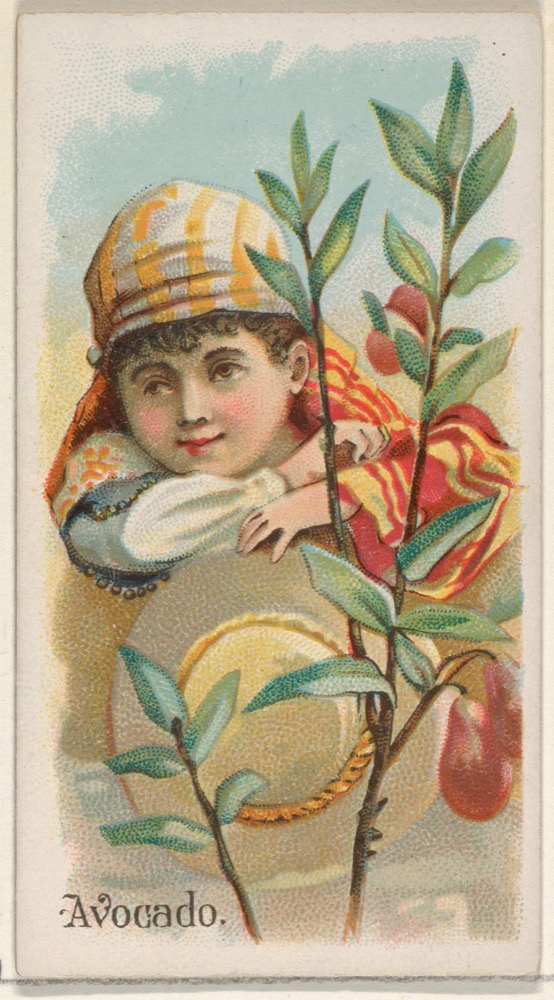
- Allen & Ginter. Avocado, from the Fruits series (N12) for Allen & Ginter Cigarettes Brands, 1891. The Metropolitan Museum of Art, 407787, CC0. metmuseum.org
- Brysbaert, M., et al. “Word prevalence norms for 62,000 English lemmas”. Behavior Research Methods 51 (2019): 467–479. doi.org/10.3758/s13428-018-1077-9
- Kuperman, V., et al. “Age-of-acquisition ratings for 30,000 English words”. Behavior Research Methods 44 (2012): 978–990. doi.org/10.3758/s13428-012-0210-4
- Brysbaert, M., et al. “Concreteness ratings for 40 thousand generally known English word lemmas”. Behavior Research Methods 46 (2014): 904–911. doi.org/10.3758/s13428-013-0403-5
- Warriner, A. B., et al. “Norms of valence, arousal, and dominance for 13,915 English lemmas”. Behavior Research Methods 45 (2013): 1191–1207. doi.org/10.3758/s13428-012-0314-x
- Lynott, D., et al. “The Lancaster Sensorimotor Norms”. Behavior Research Methods 52 (2020): 1271–1291. doi.org/10.3758/s13428-019-01316-z
- Brysbaert, M., and B. New. “Moving beyond Kučera and Francis”. Behavior Research Methods 41 (2009): 977–990. doi.org/10.3758/BRM.41.4.977
- Google Books Ngram Viewer, English 2019 corpus, 1700–2022, smoothing 3. Open the chart. Method: Michel, J.-B., et al. Science 331 (2011): 176–182.
Image and audio credits
1696 page: Missouri Botanical Garden Library via the Internet Archive, public domain. Cigarette card: The Metropolitan Museum of Art, CC0. Recording: Dvortygirl (US), CC BY-SA 3.0, via Wikimedia Commons. Map: Natural Earth, public domain.